Solar Panels Victoria Rebate 2026 — Solar Homes Program Guide
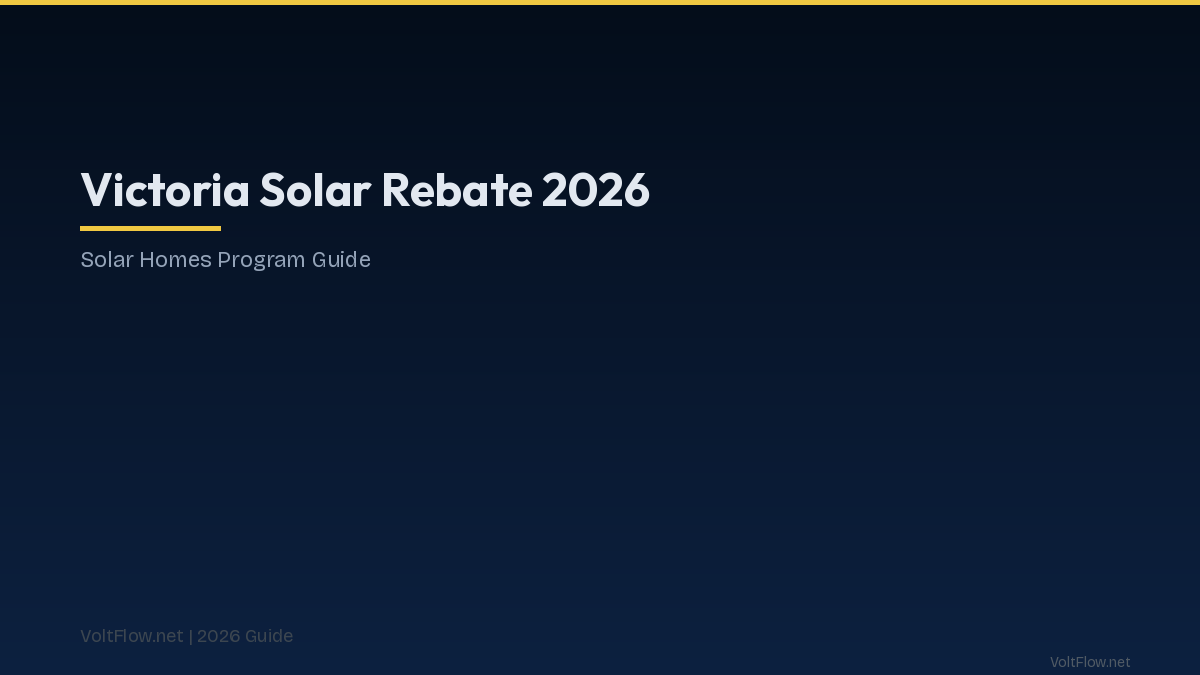
The Victorian Government's Solar Homes Program offers rebates up to A$1,400 for solar panels and A$2,950 for batteries, plus interest-free loans. Combined with federal STCs, a 6.6kW system in Victoria can cost as little as A$2,500-4,000 out of pocket.
Solar Panel Rebate: Up to A$1,400
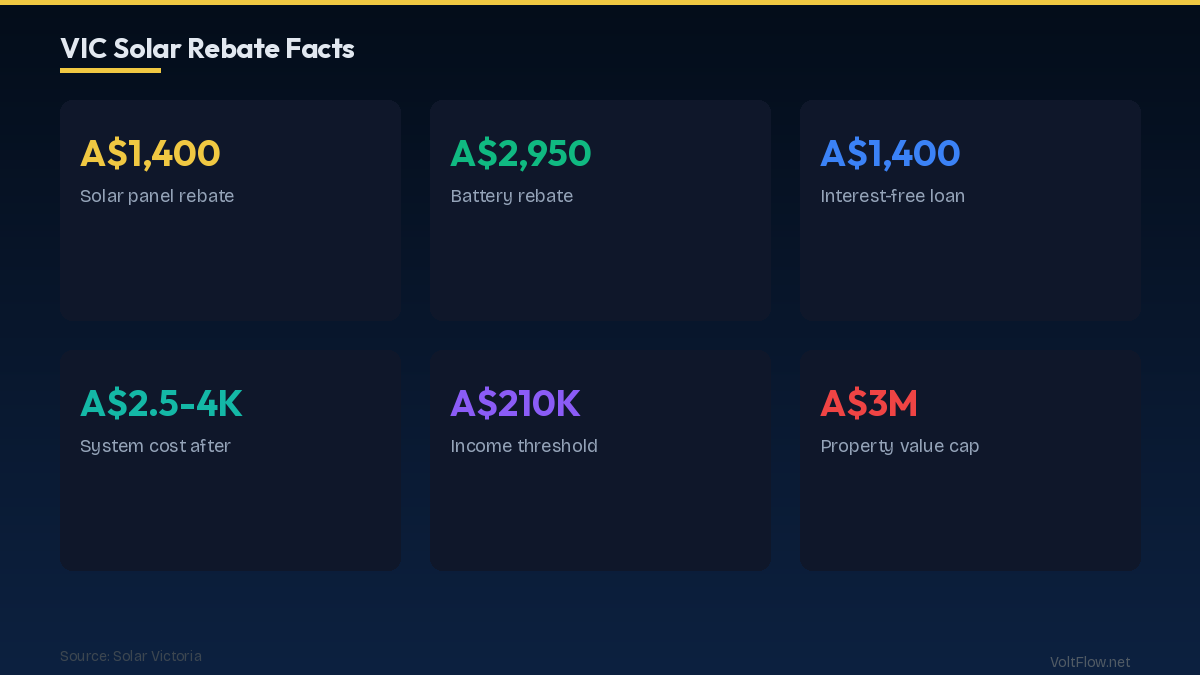
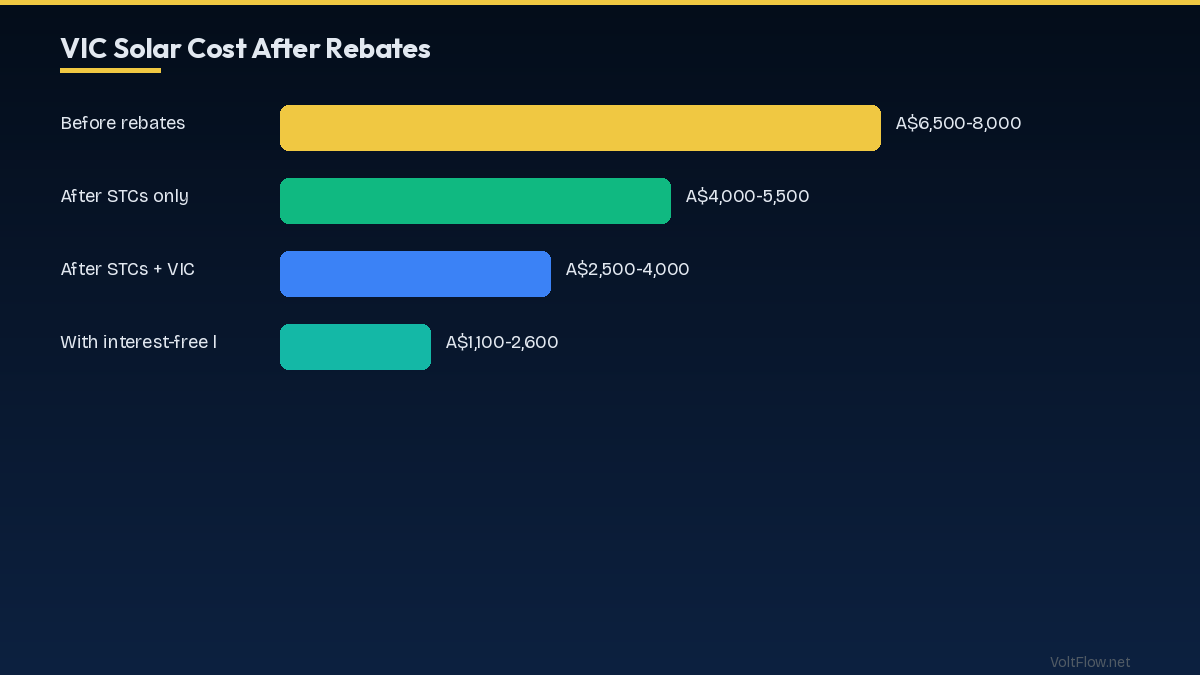
The Solar Homes solar panel rebate provides up to A$1,400 off the cost of a solar panel system for eligible Victorian households. This is applied at point of sale — your installer handles the paperwork and deducts the rebate from your quote. Eligibility requirements: Combined household income under A$210,000. Property value under A$3 million. Must be an owner-occupier (not investment properties). Must not have previously received a Solar Homes solar rebate. Must use an approved Solar Victoria retailer. System must be at least 1kW and use CEC-approved components. Interest-free loan: In addition to the rebate, eligible households can access an interest-free loan equal to the rebate amount (up to A$1,400), repaid over 4 years. This effectively doubles the upfront assistance to A$2,800. How it stacks with STC: Federal STCs provide A$2,500-3,800 additional discount (applied at point of sale). Total combined discount: A$4,000-5,200 on a 6.6kW system. Out-of-pocket cost: A$2,500-4,000 depending on system quality. Application: Apply through solarvictoria.vic.gov.au. Rebates are released in periodic batches — they fill quickly when announced. Set up an account and check regularly for new rounds.
Battery Rebate: A$2,950
The Solar Homes battery rebate offers A$2,950 toward home battery storage. This can be combined with a new or existing solar system. Eligibility: Same income and property requirements as the solar rebate. Must have solar panels installed (or install simultaneously). Must not have previously received a Solar Homes battery rebate. Battery must be at least 6kWh usable capacity. Must use approved battery products and installers. Interest-free loan: Up to A$2,950 additional as an interest-free loan over 4 years. Total battery assistance: A$5,900. For a Tesla Powerwall 2 at A$12,000, this brings the cost down to A$6,100. Is a battery worth it with the rebate? Without rebate, battery payback is 8-12 years. With A$5,900 assistance, the effective cost is A$6,000-8,000 and payback improves to 4-7 years — within the 10-year warranty period. For households on TOU tariffs or participating in VPPs, the rebated battery is a solid financial investment. Hot water heat pump: Solar Homes also offers discounts on heat pump hot water systems — potentially covering the full cost for eligible households replacing electric or gas hot water. Check solarvictoria.vic.gov.au for current availability.
Solar Performance in Victoria: What to Expect
Victoria's solar performance is lower than northern states but still produces excellent returns. Melbourne average: 3.8 kWh/kWp/day annual average. A 6.6kW system produces approximately 9,150 kWh/year. Summer (Dec-Feb): 5.5-6.2 kWh/kWp/day. Long sunny days mean excellent production. A 6.6kW system generates 35-40 kWh/day — enough to power most homes with surplus for export or battery charging. Winter (Jun-Aug): 1.5-2.2 kWh/kWp/day. Significantly reduced output due to shorter days, lower sun angle, and more cloud cover. A 6.6kW system generates only 10-15 kWh/day. You'll import more grid electricity in winter. Seasonal strategy: Summer — maximize self-consumption and battery charging. Export surplus at 4.2-10c/kWh. Winter — supplement with off-peak grid electricity. Use TOU tariff to minimize costs. Year-round — a battery smooths the seasonal variation by storing summer surplus for evening use. Regional variation: Mildura and northwest VIC get 4.3-4.5 kWh/kWp/day — 15% more than Melbourne. Gippsland and the coast get 3.5-3.8 kWh/kWp/day. If you're in regional VIC, your solar may outperform Melbourne significantly.
Best Solar Systems for Victoria
Given Victoria's lower irradiance, panel efficiency matters more here than in Queensland. Recommended panels: LONGi Hi-MO 5/6 (21.3% efficiency, excellent value), Q Cells Q.Peak Duo (21.4%, strong warranty), REC Alpha (22.3%, premium), SunPower Maxeon (22.8%, highest efficiency, 25-year warranty). For Victorian households, the 5-10% extra output from premium panels translates to A$50-100/year extra generation — adding up over the 25-year panel life. Recommended inverters: Fronius Gen24 Plus (hybrid-ready, excellent monitoring, Austrian quality). Huawei SUN2000 (best value hybrid, 10-year warranty). Enphase IQ8 microinverters (best for shading, 25-year warranty, higher cost). SMA Sunny Boy (German engineering, reliable). Optimal system size for VIC: A 6.6kW panel system with 5kW inverter is the sweet spot for most Victorian homes. It produces enough to significantly offset bills while keeping cost reasonable. Larger homes or EV owners should consider 10kW (requires 3-phase). Orientation: North-facing is optimal. East-west splits work well for self-consumption (more morning and afternoon production). Many Victorian homes have east-west rooflines — a split installation only produces 10-12% less annually than optimal north.
How to Apply and Maximize Your Rebate
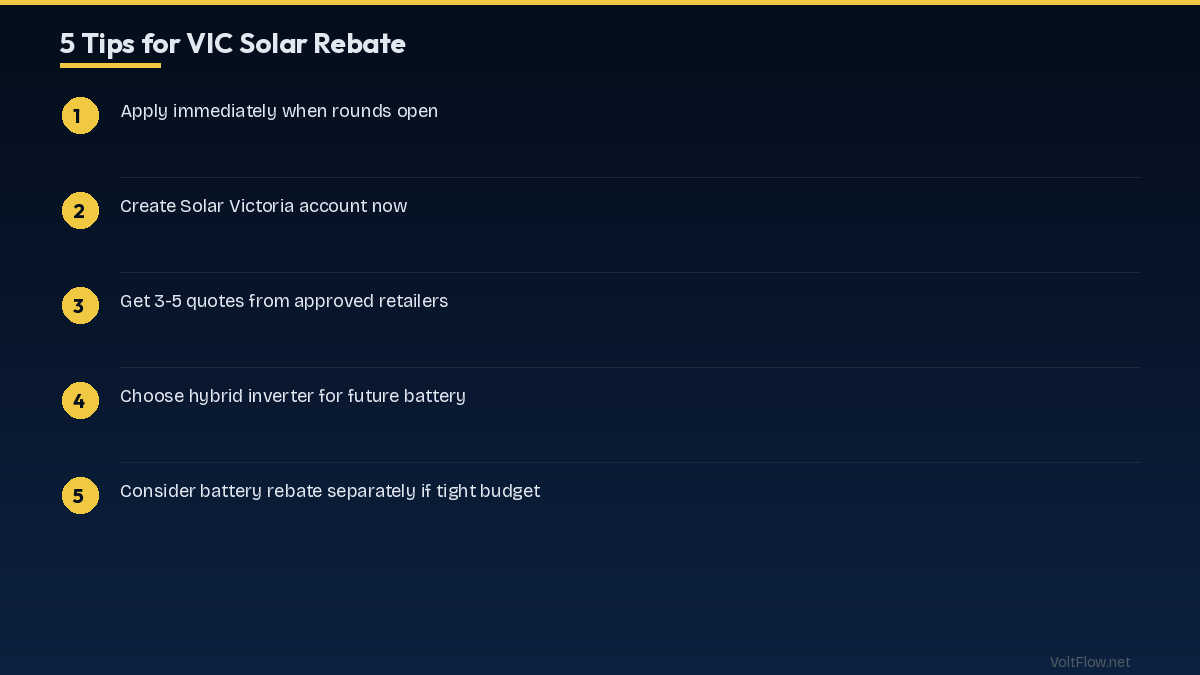
Step 1: Check eligibility. Visit solarvictoria.vic.gov.au and use the eligibility checker. You need your property address, household income, and property value. Step 2: Get quotes. Use 3-5 approved Solar Victoria retailers. SolarQuotes.com.au is the best comparison platform. Ensure quotes include the Solar Victoria rebate and STC discount applied at point of sale. Step 3: Apply online. Create an account on the Solar Victoria portal. When a rebate round opens, apply immediately — rounds fill within hours to days. You'll receive a unique eligibility number valid for 6 months. Step 4: Install. Your approved retailer installs the system and handles all paperwork (Solar Victoria rebate, STC, DNSP connection, smart meter coordination). Typical timeline: 2-6 weeks from signing to energisation. Step 5: Interest-free loan (optional). If you elected the interest-free loan, repayments are quarterly over 4 years. Set up direct debit for convenience. Tips for maximizing value: Don't rush into the cheapest quote — system quality matters for 25 years of performance. Check your retailer's reviews on SolarQuotes and Google. Choose a hybrid inverter if you plan to add a battery later — it saves A$1,000-2,000 on future installation. Apply for the battery rebate in a separate round if budget is tight — you can add a battery to an existing solar system later.
Frequently Asked Questions
How much is the Victorian solar rebate in 2026?
Up to A$1,400 for solar panels plus an optional A$1,400 interest-free loan. Battery rebate is A$2,950 plus A$2,950 interest-free loan. Combined with federal STCs, total savings are A$4,000-5,200.
What are the eligibility requirements for Solar Homes?
Combined household income under A$210,000, property value under A$3 million, owner-occupier, and not previously received the same Solar Homes rebate. Must use an approved retailer.
How much does a 6.6kW solar system cost in Victoria after rebates?
After Solar Victoria rebate (A$1,400) and STCs (A$2,500-3,800), a 6.6kW system costs A$2,500-4,000 out of pocket. With the interest-free loan, upfront cost is as low as A$1,100-2,600.
How much does solar produce in Melbourne?
A 6.6kW system in Melbourne produces about 9,150 kWh/year (25 kWh/day average). Summer: 35-40 kWh/day. Winter: 10-15 kWh/day. Annual savings: A$1,200-1,800.
When do Solar Victoria rebate rounds open?
Rebate rounds open periodically throughout the year and fill quickly. Create an account on solarvictoria.vic.gov.au and enable notifications to be alerted when new rounds open.