Home Battery Storage Australia 2026 — Cost, Best Systems & Rebates
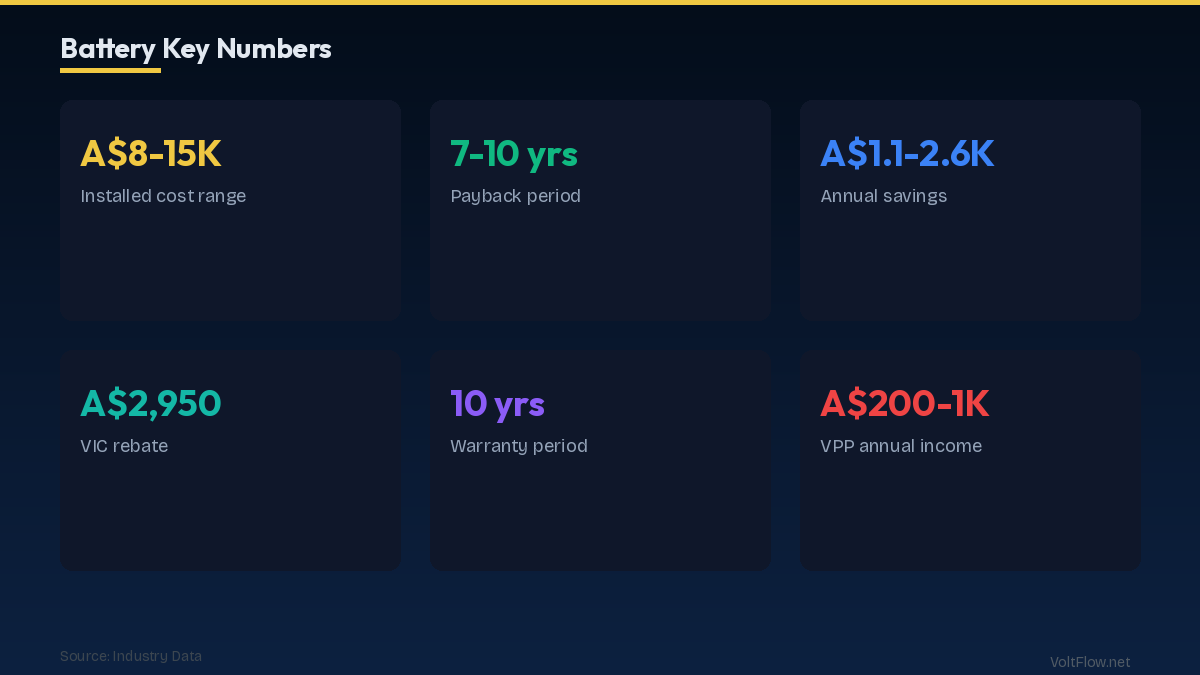
Home batteries in Australia cost A$8,000-15,000 installed in 2026. With rising TOU peak rates and falling battery prices, payback has improved to 7-10 years. VPP programs add A$200-1,000/year. The VIC Solar Homes rebate covers A$2,950 off battery costs.
Battery Prices in 2026: What You'll Pay Installed
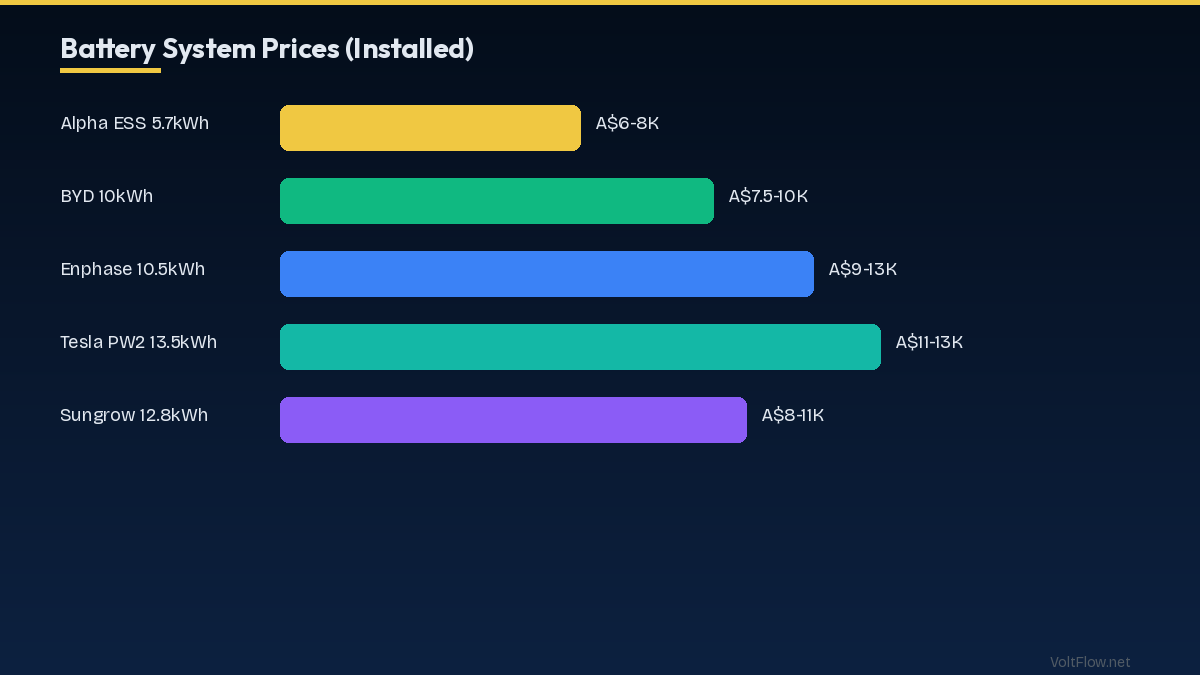
Tesla Powerwall 2 (13.5 kWh): A$11,000-13,000 installed. The market leader with excellent app, VPP integration, and whole-home backup capability. Continuous output: 5kW, peak: 7kW. 10-year warranty (guaranteed 70% capacity). BYD Battery-Box HVS (5.1-12.8 kWh): A$5,000-10,500 installed. Modular design — start with 5.1 kWh and add modules later. Pairs with most hybrid inverters (Fronius, GoodWe, Sungrow). Excellent value per kWh. Alpha ESS SMILE5 (5.7 kWh): A$6,000-8,000 installed. Good entry-level option with integrated inverter. Enphase IQ Battery (3.5-10.5 kWh): A$6,500-13,000. Modular, microinverter-based system with excellent monitoring. Pairs naturally with Enphase solar systems. Sungrow SBR (9.6-25.6 kWh): A$7,500-14,000. Strong value for larger capacity needs. 10-year warranty. The general price trend: batteries are declining 8-12% annually. A system that costs A$12,000 today would have cost A$18,000 three years ago.
Financial Analysis: Do Batteries Pay for Themselves?
Battery savings come from three sources. 1. Solar self-consumption: Store excess solar (worth 3-8c when exported) and use it during evening peak (worth 28-45c). For 8 kWh/day shifted: A$2.00-3.00/day = A$730-1,095/year. 2. TOU arbitrage: On TOU tariffs, charge off-peak (15-22c) and discharge during peak (35-50c). Additional A$0.50-1.50/day = A$180-550/year. 3. VPP payments: Programs from Tesla Energy (A$350-500/year), AGL (A$200-400/year), Amber Electric (variable, up to A$1,000 in high-price events). Total annual savings: A$1,100-2,600/year. On a A$12,000 battery, payback is 5-11 years depending on tariff, usage pattern, and VPP participation. In SA with high tariffs: 5-7 years. In QLD with lower tariffs: 9-12 years. Important: Battery payback calculations should include the warranty period — most batteries warrant 10 years or 10,000 cycles. If payback exceeds the warranty period, the investment carries risk of battery degradation before break-even.
State Rebates and Incentives
Victoria Solar Homes: Previously offered A$2,950 rebate for batteries (reducing a A$12,000 system to A$9,050). Check current program status — funding rounds open periodically and fill quickly. Interest-free loans also available. South Australia Home Battery Scheme: A$2,000-4,000 subsidy depending on battery size and household energy concession status. SA has the strongest economic case for batteries. NSW Peak Demand Reduction Scheme (PDRS): Doesn't directly rebate batteries but provides ongoing payments for systems that reduce peak demand — effectively a VPP-style payment. ACT: Interest-free loans for solar + battery under the Sustainable Household Scheme (up to A$15,000 loan). Federal: No direct battery rebate, but batteries installed with a new solar system benefit from the STC scheme indirectly through increased self-consumption value. Important: Government rebates change frequently. Check your state energy department website or solarquotes.com.au/battery-storage for the latest available incentives before purchasing.
Virtual Power Plants: Earn While You Store
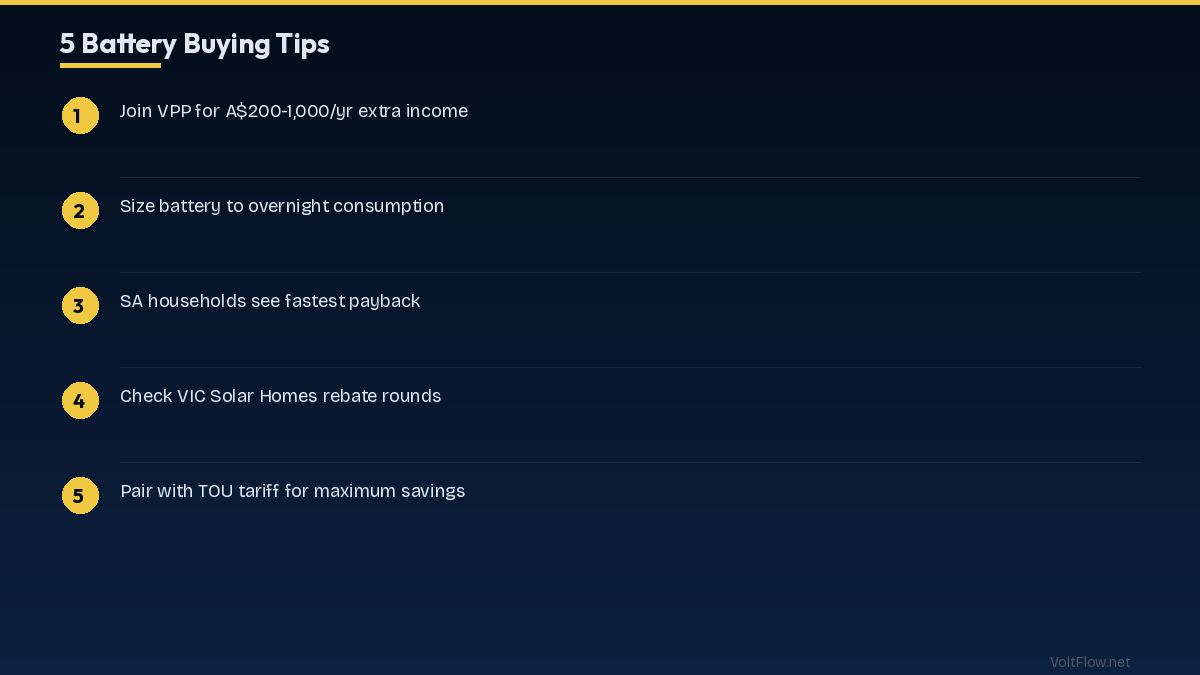
VPP programs aggregate thousands of home batteries into a virtual power station that stabilizes the grid during peak demand. In return, you receive payments. Tesla Energy Plan: Available in SA and expanding to other states. Imports/exports at wholesale price plus bonuses for grid support. Typical earnings: A$350-700/year on top of normal battery savings. AGL Virtual Power Plant: A$200-400/year in credits. Dispatches your battery during high-demand events (typically 5-20 events per year, 1-2 hours each). Amber Electric + Battery: Amber passes through wholesale prices. During price spikes (A$1-15/kWh wholesale), your battery exports earn incredible rates. Annual VPP-equivalent: A$300-1,000+ depending on spike frequency. Reposit Power: AI-managed VPP that predicts and responds to grid conditions. Typical earnings: A$200-500/year. Key consideration: VPP programs use your battery capacity for grid support, which means slightly more charge/discharge cycles and potentially faster degradation. Most programs cap dispatch to protect battery health, but factor this into your decision. The financial benefit usually outweighs the marginal degradation impact.
Choosing the Right Battery Size
The right battery size depends on your evening consumption pattern. Method: Check your electricity bill or monitoring app for consumption between 5 PM and 10 PM (when solar stops producing and you'd draw from battery). A typical Australian household uses 8-15 kWh during this window. Small battery (5-7 kWh): Covers light evening use — lighting, cooking, entertainment. Leaves heavier loads (AC, EV charging) on grid. Cost: A$5,000-8,000. Best for: budget-conscious households, low evening consumption, apartments. Medium battery (10-14 kWh): Covers most evening needs for an average household. The sweet spot for value. Tesla Powerwall 2 (13.5 kWh) and BYD 12.8 kWh fit here. Cost: A$9,000-13,000. Best for: typical 3-4 person households. Large battery (15-25 kWh): Near-total grid independence in summer, significant coverage in winter. Required for homes with high AC use, EVs, or pool pumps. Cost: A$13,000-20,000. Best for: large households, off-grid ambitions, multiple EVs. Rule of thumb: Size your battery to cover 80-90% of your overnight consumption for the best ROI. Oversizing wastes capacity in summer when nights are short.
Frequently Asked Questions
How much does a home battery cost in Australia?
Home batteries cost A$5,000-15,000 installed in 2026. A Tesla Powerwall 2 (13.5 kWh) is A$11,000-13,000. BYD HVS (10 kWh) is A$7,500-10,000. Prices are falling 8-12% per year.
Do home batteries pay for themselves in Australia?
Payback is 5-11 years depending on your state, tariff, and VPP participation. SA households see the fastest payback (5-7 years). Total savings with VPP: A$1,100-2,600/year.
Is the Victoria battery rebate still available?
The VIC Solar Homes program offers A$2,950 battery rebates in periodic funding rounds. Check solarvictoria.vic.gov.au for current availability — rounds often fill within days of opening.
What is a VPP and how much does it pay?
A Virtual Power Plant aggregates home batteries for grid support. Payments range from A$200-1,000/year depending on the program (Tesla Energy, AGL, Amber Electric).
How long do home batteries last?
Most batteries are warranted for 10 years or 10,000 cycles with 70% capacity guarantee. Expected useful life is 12-15 years with gradual capacity decline.