Electricity Rates Australia 2026 — State-by-State Price Guide
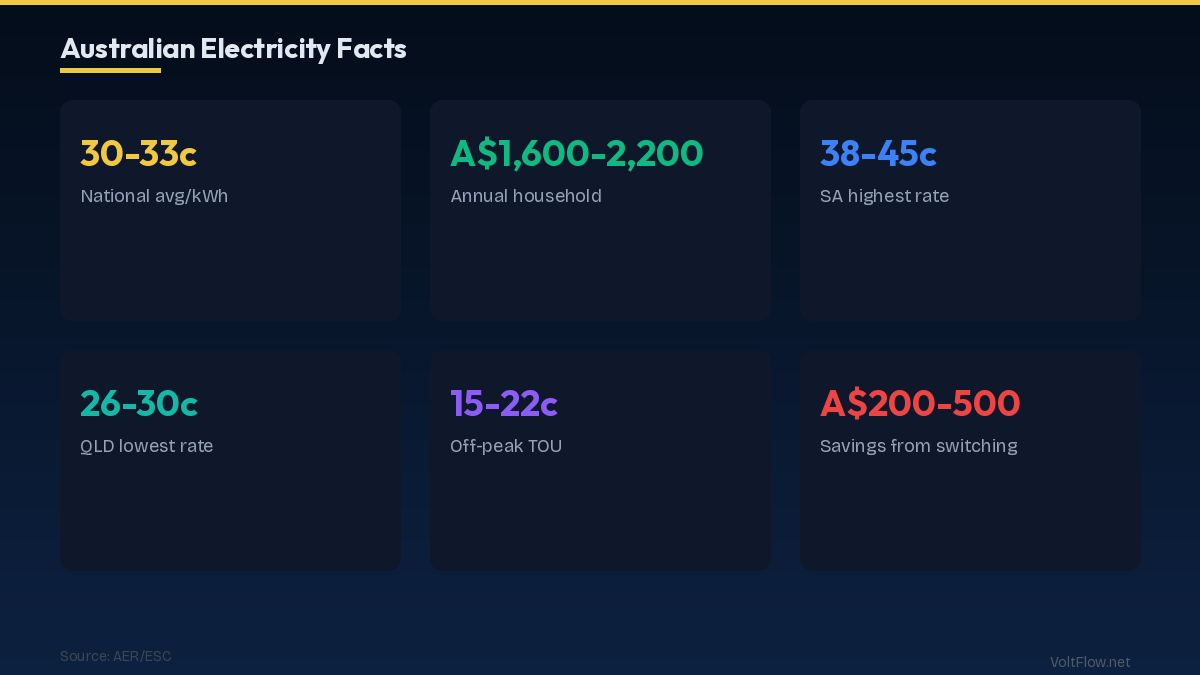
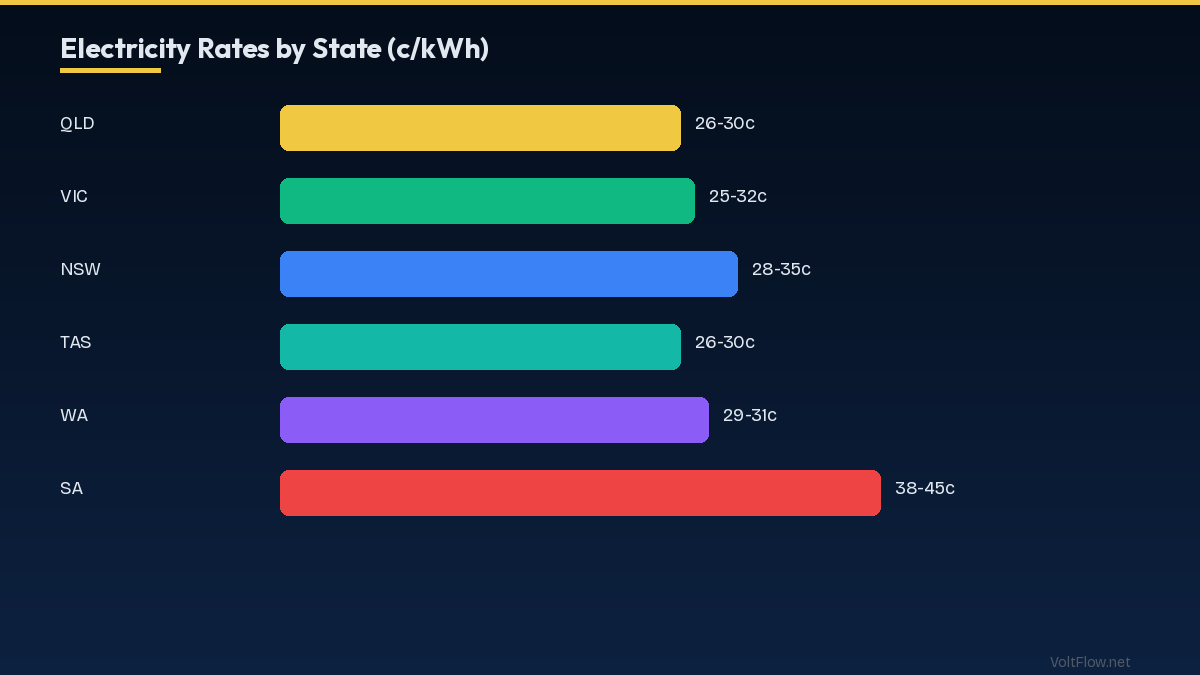
Australian electricity prices range from 25c to 45c per kWh in 2026 depending on your state, retailer, and tariff type. South Australia remains the most expensive at 38-45c/kWh, while Queensland offers the best value at 26-30c/kWh for most households. With the Default Market Offer (DMO) and Victorian Default Offer (VDO) setting price caps, there's still significant room to save by comparing plans.
NSW Electricity Rates: 28-35c/kWh
New South Wales households pay 28-35c/kWh on usage with daily supply charges of 90c-A$1.20. The DMO reference price for 2025-26 is set by the AER at approximately A$1,600/year for a representative household. The three distribution zones (Ausgrid, Endeavour, Essential) have different network charges affecting your final bill. Best deals: Market offers from retailers like Energy Australia, AGL, and Origin typically undercut the DMO by 15-25%. Time-of-Use (TOU) tariffs offer off-peak rates of 15-22c/kWh between 10 PM and 7 AM — excellent if you have an EV, heat pump hot water, or battery storage. Solar feed-in rates have declined to 5-8c/kWh in NSW, making self-consumption far more valuable than export. The AER estimates 60% of NSW customers could save A$200-500/year by switching to a better plan. Use the government's Energy Made Easy comparison tool at energymadeeasy.gov.au to find the best offer for your usage profile. If your annual consumption exceeds 5,000 kWh, negotiate directly with retailers — they often have unpublished rates for higher-volume customers.
Victoria Electricity Rates: 25-32c/kWh
Victoria has the most competitive retail electricity market in Australia with over 20 active retailers. Usage rates range from 25-32c/kWh under the Victorian Default Offer (VDO), which the ESC sets annually. The VDO for 2025-26 is approximately A$1,500/year for a typical household. Victorian consumers benefit from: strong retailer competition (some offers 20-30% below VDO), mandatory clear pricing, and the Victorian Energy Compare website. Citipower distribution zone (inner Melbourne) typically has the lowest network charges, while Powercor (western VIC) and AusNet (eastern VIC) areas pay more. Controlled load tariffs for hot water (16-20c/kWh) are available on dedicated circuits — switching your hot water to controlled load saves A$200-400/year. Victoria's minimum solar feed-in tariff is 4.2c/kWh (set by ESC), but some retailers offer 8-12c for the first 10kWh exported daily.
Queensland Electricity Rates: 26-30c/kWh
Queensland offers some of the most affordable electricity in Australia at 26-30c/kWh for most households. The key difference: QLD has two distinct zones. Southeast QLD (Energex area) — deregulated market with retailer competition, usage rates 26-30c/kWh, supply charges 85c-A$1.10/day. Regional QLD (Ergon area) — regulated prices set by QCA, slightly higher at 28-32c/kWh but with government subsidy (Uniform Tariff Policy) ensuring regional customers don't pay more than SEQ. QLD also benefits from excellent solar irradiance — Brisbane gets 4.7 kWh/kWp/day, making rooftop solar highly productive. Feed-in tariffs: 5-8c/kWh in SEQ (varies by retailer), 7-10c in regional areas. The Queensland Government's A$1,000 electricity rebate for 2024-25 provided relief, and similar rebates may continue. For pool owners, controlled load tariff (Tariff 33) at 17-20c/kWh for off-peak pool pumps saves A$300-500/year compared to running on the general tariff.
South Australia, WA, and Tasmania: Extreme Range
South Australia: 38-45c/kWh — the most expensive state for electricity. Despite having the highest rooftop solar penetration in Australia (40%+ of homes), SA's reliance on gas peaking plants and network costs keeps retail prices high. The silver lining: SA has the strongest economic case for batteries and solar. A 6.6kW solar system with 10kWh battery can reduce an A$2,500/year bill to under A$500. Western Australia: 29-31c/kWh — Synergy (the state-owned retailer) dominates the market with limited competition. The DEBS solar buyback rate is only 2.25c/kWh — making battery storage almost essential for solar households. The WA government's Household Electricity Credit (A$400 in 2024-25) helps offset costs. Tasmania: 26-30c/kWh — Aurora Energy is the sole retailer. Tas has 90%+ renewable generation (hydro) but still charges mainland-comparable rates. Controlled load tariffs (16-18c) are excellent for hot water systems.
Time-of-Use Tariffs: How to Save 20-40%
TOU tariffs split pricing into peak (35-50c), shoulder (25-32c), and off-peak (15-22c) time bands. If you can shift 40-50% of your consumption to off-peak, you'll save 20-40% vs flat rate tariffs. Best appliances to shift: EV charging (10 PM-6 AM saves A$800-1,200/year vs peak), heat pump hot water (set timer for off-peak), dishwasher and washing machine (delay start), and pool pump (Tariff 33 or off-peak timer). Battery storage maximizes TOU savings — charge from solar during the day, discharge during peak 3-9 PM window. A 10kWh battery can shift A$1-2/day of consumption, saving A$400-700/year on top of solar savings. Smart home systems (Home Assistant, Amber Electric's SmartShift) automate this optimization. Amber Electric passes through wholesale prices — power can drop to 0-5c/kWh during sunny midday periods and spike to A$1+ during evening peaks, offering massive savings to those who can time their usage.
How to Find the Cheapest Electricity Plan
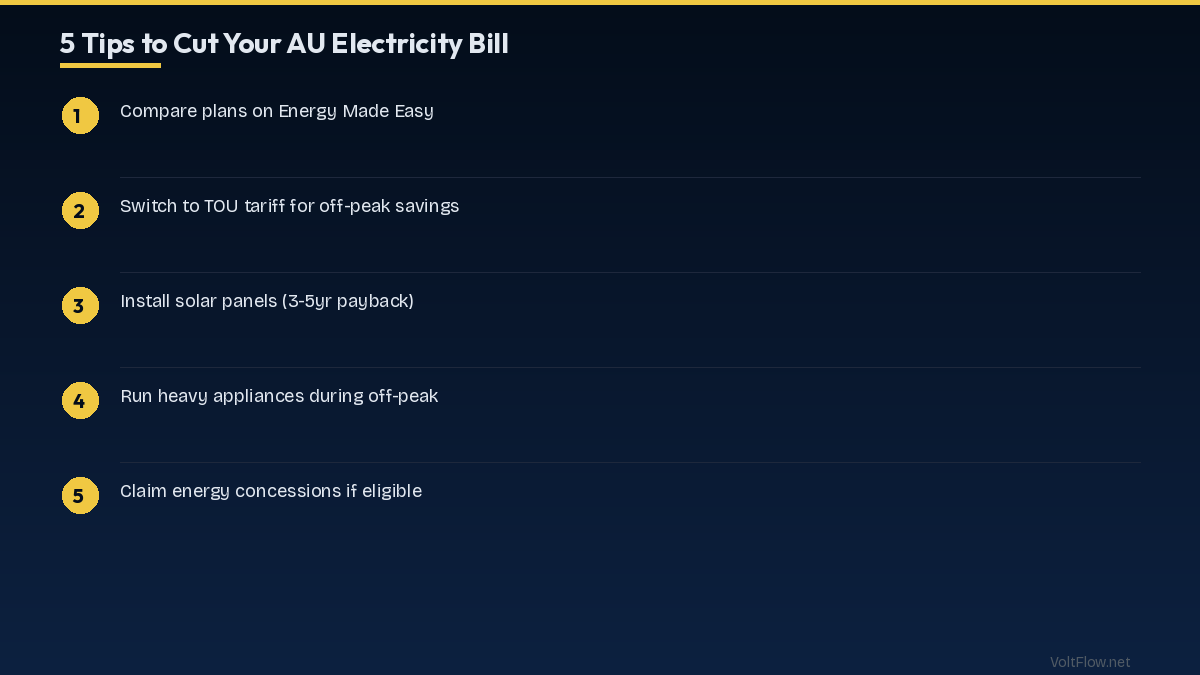
Use the government comparison tools: Energy Made Easy (energymadeeasy.gov.au) for NSW, QLD, SA, TAS, and ACT; Victorian Energy Compare (compare.energy.vic.gov.au) for VIC. Enter your actual usage from a recent bill (daily kWh and supply charge) for accurate comparisons. Key comparison tips: Ignore percentage discounts — compare the estimated annual cost. Check contract terms: some cheap plans have exit fees of A$50-200. Look for plans with solar feed-in bonuses if you have panels. Ask about controlled load rates for hot water. Consider retailers offering wholesale pricing (Amber Electric, Localvolts) if you have solar + battery — you can earn A$1-15/kWh during price spikes by exporting stored energy. Review your plan annually — the cheapest retailer changes frequently. Switching takes 1-2 business days with no interruption to supply. If you're spending over A$2,000/year, negotiate with your retailer — retention teams often have unpublished discounts.
Frequently Asked Questions
What is the average electricity rate in Australia in 2026?
The national average is approximately 30-33c/kWh. Rates vary significantly: QLD 26-30c, VIC 25-32c, NSW 28-35c, SA 38-45c, WA 29-31c.
Which Australian state has the cheapest electricity?
Queensland generally has the cheapest electricity at 26-30c/kWh, followed by Victoria (25-32c) and Tasmania (26-30c). South Australia is consistently the most expensive at 38-45c.
How can I reduce my electricity bill in Australia?
Compare plans on Energy Made Easy/Victorian Energy Compare, switch to TOU tariff and shift usage to off-peak, install solar panels, and consider a battery. These steps can reduce bills by 30-60%.
What is the Default Market Offer (DMO)?
The DMO is a price cap set annually by the AER for NSW, QLD, and SA. It ensures a fair benchmark price. Most market offers are 10-25% below the DMO.
Is it worth switching electricity providers in Australia?
Yes. The AER estimates the average household saves A$200-500/year by switching to a better plan. Switching is free, takes 1-2 days, and causes no supply interruption.