Solar Panel Cost Australia 2026 — System Prices by Size
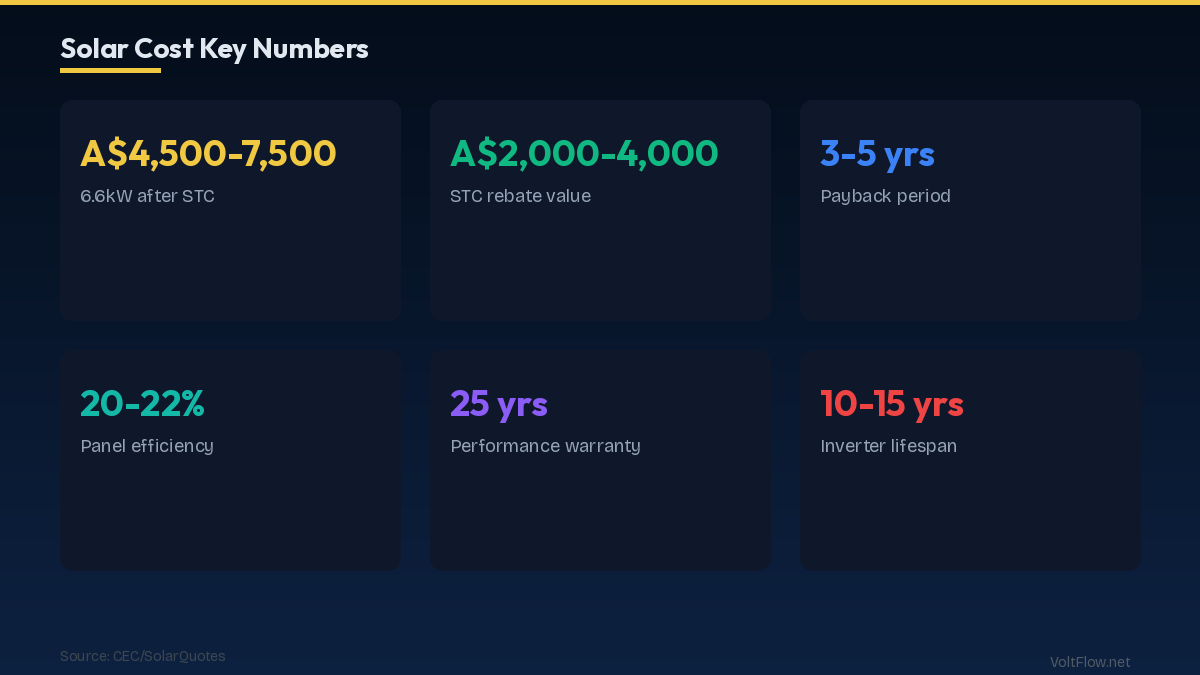
A 6.6kW solar system in Australia costs A$4,500-7,500 after the STC rebate in 2026. Premium systems with tier-1 panels (SunPower, REC, LONGi) cost more but deliver better efficiency and longer warranties. Payback: 3-5 years depending on state tariff and self-consumption.
Solar System Prices by Size (After STC Rebate)
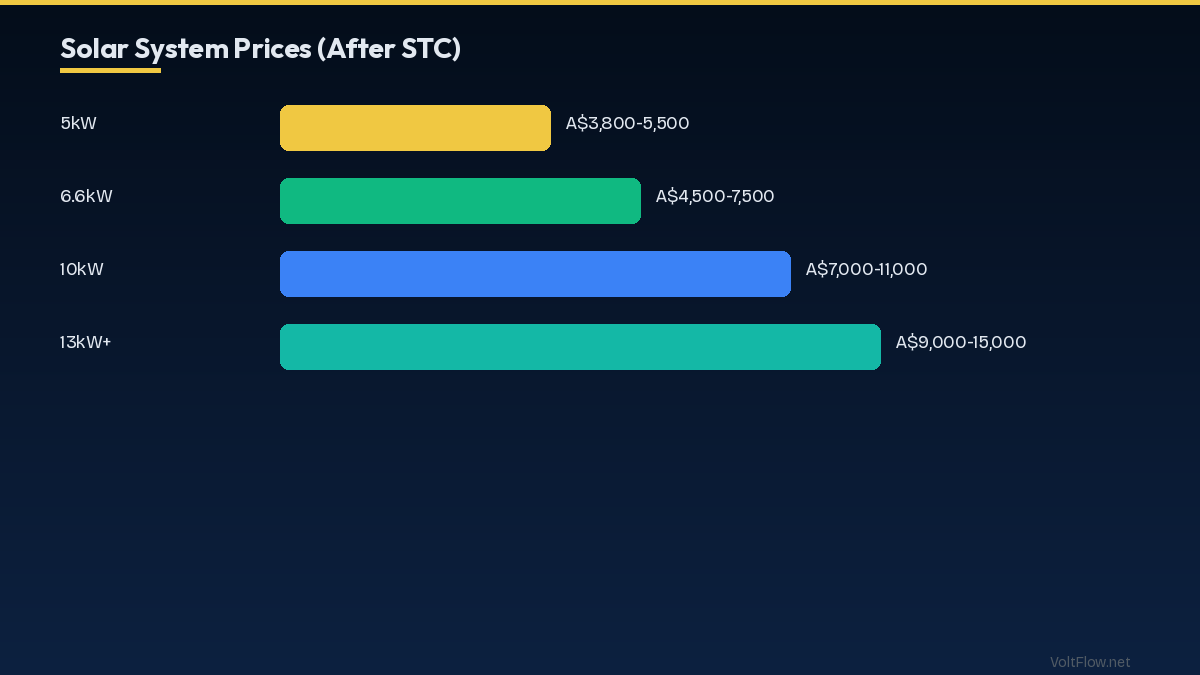
The Small-scale Technology Certificate (STC) rebate reduces upfront cost by A$2,000-4,000 depending on system size and location. Here are typical installed prices after STC in 2026: 5kW system: A$3,800-5,500 — suits small households (2-3 people) with low daytime usage. 6.6kW system: A$4,500-7,500 — the most popular residential size, maximizes the 5kW inverter limit with oversized panel array. 10kW system: A$7,000-11,000 — for larger homes, pool owners, or EV charging households. 13kW+ system: A$9,000-15,000 — requires 3-phase power and council approval in some areas. Prices vary by 20-30% between states: QLD and SA tend to be cheapest (highest installer competition), while TAS and regional areas cost more. The STC rebate decreases by approximately A$300-500 each year as the scheme winds down toward 2030, so installing sooner saves more.
Panel Quality: Budget vs Premium
Budget tier (A$4,500-5,500 for 6.6kW): Chinese-manufactured panels (Jinko, Trina, Canadian Solar) with 15-year product warranty and 25-year performance warranty. These panels perform well and dominate 70% of the Australian market. Efficiency: 20-21%. The risk: warranty claims can be slow if the manufacturer exits Australia. Mid tier (A$5,500-6,500): Established brands with strong Australian distribution (LONGi, Q Cells, Risen). Better warranty support and slightly higher efficiency (21-22%). The sweet spot for most households. Premium tier (A$6,500-8,000): SunPower Maxeon (25-year full product warranty, 22.8% efficiency), REC Alpha (25-year warranty, 22.3%), or LG (before exit, now Qcells Premium). These panels produce 5-10% more energy per square metre and have industry-leading warranty terms. Worth it if roof space is limited or you want maximum long-term output. Inverters matter too: Fronius, SMA, and Enphase microinverters (A$1,500-3,000 premium) are the gold standard. Huawei and Sungrow offer excellent value at lower cost.
Solar Payback Period by State
South Australia: 2.5-3.5 years — highest electricity costs (38-45c/kWh) make solar payback the fastest in Australia. A 6.6kW system saving A$1,800-2,400/year pays for itself quickly despite low feed-in tariffs (3-6c). NSW: 3-4 years — moderate tariffs (28-35c) with good solar irradiance (4.2-4.5 kWh/kWp/day). Sydney homes typically save A$1,400-2,000/year. Victoria: 3.5-4.5 years — competitive tariffs (25-32c) but lower irradiance (3.8-4.0 kWh/kWp/day) extends payback slightly. Melbourne summer vs winter production varies significantly (6:1 ratio). Queensland: 3-4 years — excellent irradiance (4.5-5.0 kWh/kWp/day) compensates for lower tariffs (26-30c). Brisbane and north QLD see the best production. WA: 4-5 years — decent irradiance (4.8-5.2 kWh) but the very low DEBS buyback (2.25c) means you must maximize self-consumption. Battery storage essential for good ROI. Tasmania: 4-5 years — lower irradiance (3.5-3.8 kWh) and moderate tariffs. Still worthwhile but longest payback nationally.
STC Rebate: How the Solar Subsidy Works
The Small-scale Renewable Energy Scheme (SRES) provides upfront rebates through STCs. Each STC represents 1 MWh of expected generation over the system's deemed lifetime (now calculated to 2030). A 6.6kW system in Sydney generates approximately 85-95 STCs. At the current trading price of A$38-40 per STC, that's a A$3,200-3,800 discount applied at point of sale. You don't need to deal with STC trading — your installer factors it into the quoted price. Important: The STC value decreases each year as the deeming period shortens. In 2027, the same system will generate fewer STCs, reducing the rebate by A$300-500. By 2030, the scheme ends entirely. Additionally, some state governments offer extra rebates: Victoria Solar Homes provided interest-free loans (check current status); SA Home Battery Scheme offers A$2,000-4,000 for battery installation; NSW Peak Demand Reduction Scheme may offer payments for solar + battery systems that reduce evening peak demand.
Solar + Battery: Is It Worth It in 2026?
A 10kWh battery (Tesla Powerwall 2, BYD, Alpha ESS) costs A$10,000-14,000 installed in 2026. Without a battery, a 6.6kW solar system typically exports 40-60% of generation at 3-8c/kWh. With a battery, you store that energy and use it during the evening peak (35-50c/kWh on TOU tariffs). The value of stored energy: (40c - 5c) × 8 kWh/day = A$2.80/day saved = A$1,020/year. At A$12,000 cost, battery payback is approximately 8-12 years — the battery warranty period. Batteries make more financial sense in: SA (highest tariffs, fastest payback), homes on TOU tariffs (bigger peak/off-peak spread), areas with very low feed-in rates (WA at 2.25c), and for blackout protection value. The economics improve if you have an EV — charging your car from solar-stored battery energy at night saves A$1,000-1,500/year vs grid charging at peak rates. Virtual Power Plant (VPP) programs from Tesla, AGL, and Origin offer A$200-1,000/year in payments for allowing grid operators to discharge your battery during peak demand events.
How to Choose a Solar Installer
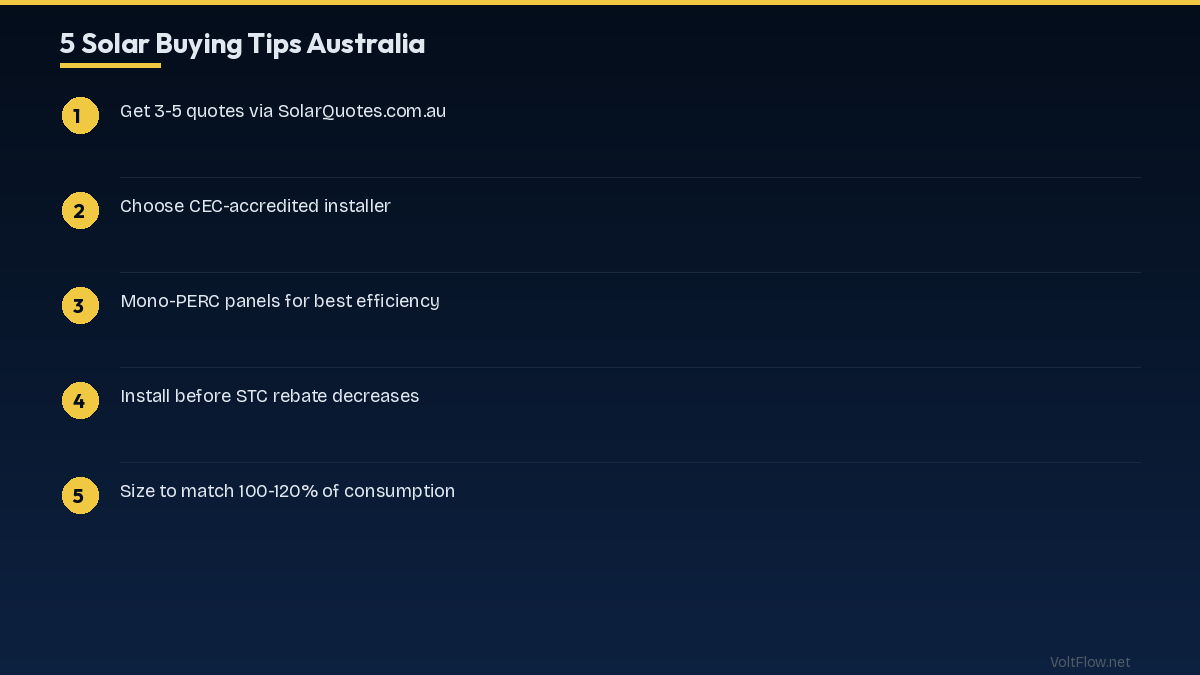
Australia has over 6,000 CEC-accredited solar installers. Quality varies enormously. Must-haves: CEC (Clean Energy Council) accredited installer and designer; minimum 5-year workmanship warranty (10-year is better); positive reviews on SolarQuotes, Google, and ProductReview; they handle all paperwork (STC, grid connection, DNSP approval). Red flags: Door-to-door sales with high-pressure tactics; quotes significantly below market (likely using sub-standard components or subcontracting to unqualified crews); no site inspection before quoting; no mention of panel orientation, tilt angle, or shading analysis. Get 3-5 quotes through SolarQuotes.com.au — the most trusted comparison platform in Australia. Compare total system cost, component brands, warranty terms, and estimated annual production. Ask about monitoring — systems with app-based monitoring (Fronius, Enphase, Huawei) let you track performance and detect issues early. Average installation time is 1 day for a standard 6.6kW system, with grid connection taking an additional 1-4 weeks depending on your DNSP.
Frequently Asked Questions
How much does a 6.6kW solar system cost in Australia?
A 6.6kW system costs A$4,500-7,500 after the STC rebate in 2026, depending on panel quality and installer. Budget systems start around A$4,500 while premium systems with SunPower or REC panels cost A$6,500-8,000.
What is the STC rebate for solar in Australia?
The STC rebate provides A$2,000-4,000 off the upfront cost of a solar system. The exact amount depends on system size, location, and current STC trading price. It decreases annually until the scheme ends in 2030.
Is solar worth it in Melbourne/Victoria?
Yes. Despite lower irradiance than northern states, a 6.6kW system in Melbourne saves A$1,200-1,800/year with a payback of 3.5-4.5 years. The competitive retail market and TOU tariffs make solar particularly valuable.
How long do solar panels last in Australia?
Solar panels come with 25-year performance warranties (guaranteeing 80%+ output). Most panels last 30+ years. Inverters typically last 10-15 years and may need one replacement.
Should I add a battery to my solar system?
Battery payback is 8-12 years at current prices. It makes most sense in SA (high tariffs), on TOU tariffs, with an EV, or if you value blackout protection. VPP programs can improve battery economics by A$200-1,000/year.