Solar Feed-In Tariff Australia 2026 — Rates by State
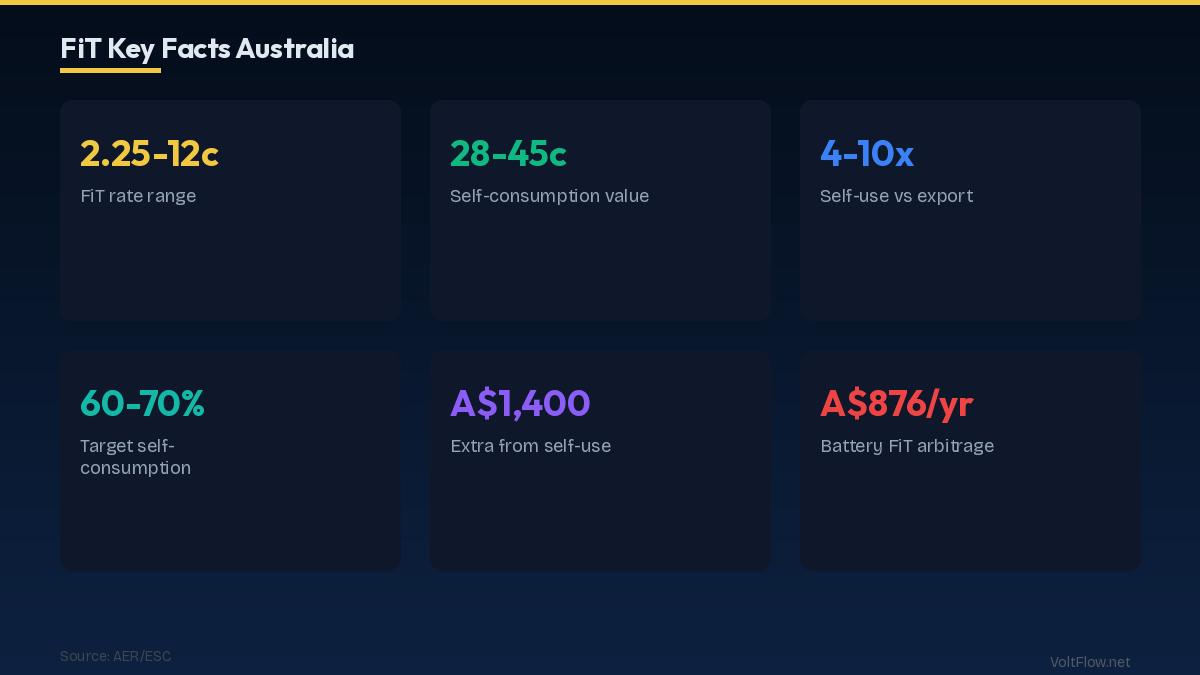
Australian solar feed-in tariffs range from 2.25c to 12c/kWh in 2026 — far below the 60c premium rates of a decade ago. With retail electricity at 28-45c/kWh, self-consumption saves 3-10x more than export. Here's every state's rates and strategies to maximize solar value.
Feed-In Tariff Rates by State
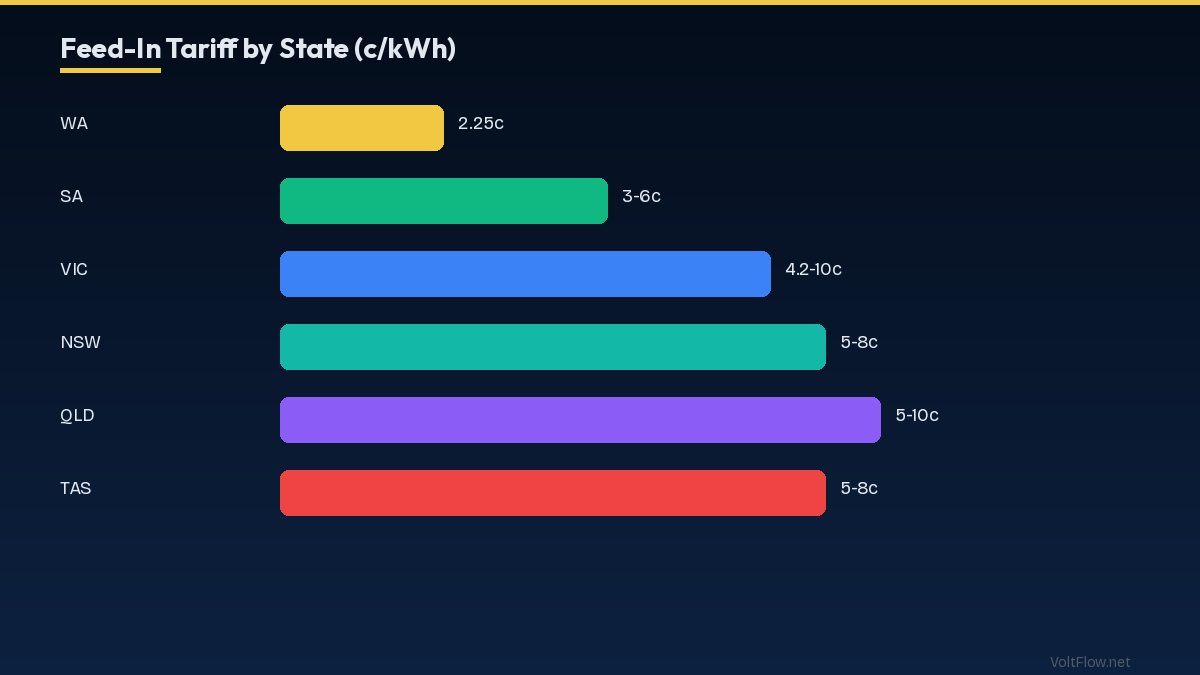
NSW: 5-8c/kWh — varies by retailer. AGL and Origin typically offer 5-6c, while smaller retailers like ReAmped and Amber offer 6-8c. Some plans offer higher FiT but increase usage rates — always compare the total annual cost, not just FiT. VIC: 4.2c minimum (ESC-set) to 10c — the ESC mandates a minimum FiT that retailers must pay. Some retailers offer premium tariffs of 8-10c for the first 10-15 kWh/day exported, then drop to the minimum for additional exports. QLD: 5-8c/kWh (Energex), 7-10c (Ergon regional) — regional QLD offers slightly better rates. SA: 3-6c/kWh — lowest mainland FiT due to solar saturation. During midday, wholesale prices frequently go negative, meaning solar exports can actually cost retailers money. WA: 2.25c/kWh (Synergy DEBS) — the lowest in Australia and arguably uneconomical for export. WA solar households must focus on self-consumption or battery storage. TAS: 5-8c/kWh — Aurora Energy offers competitive FiT given the state's hydro-dominated grid.
Why Self-Consumption Is Now the Strategy
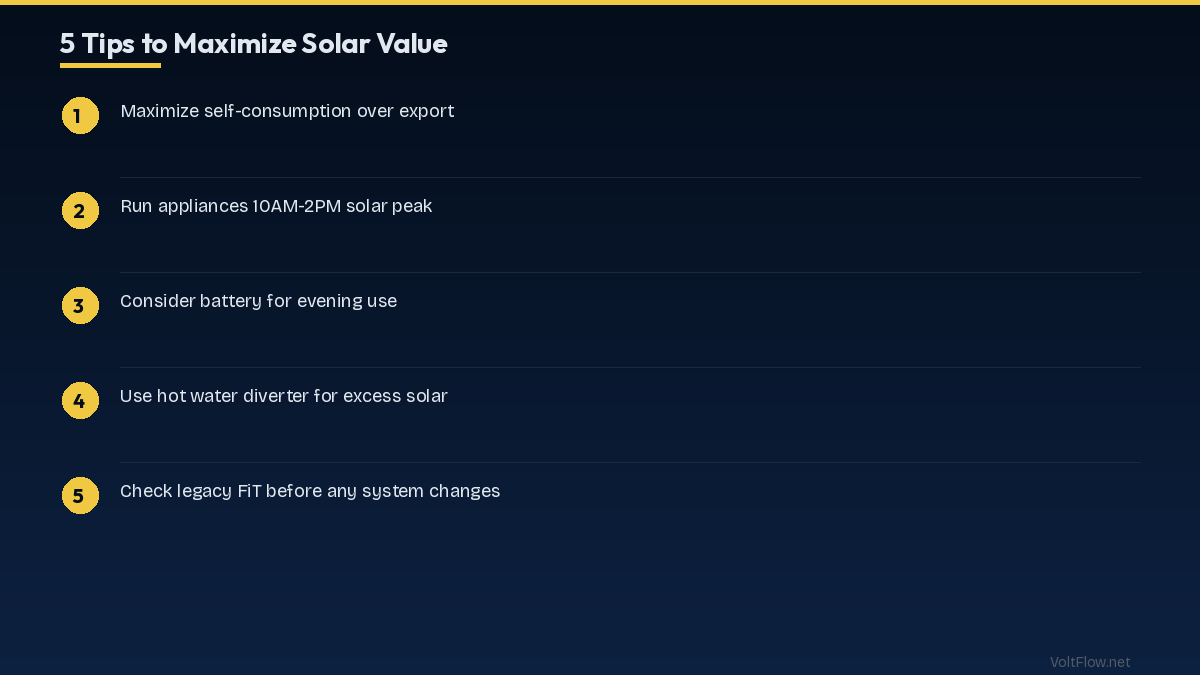
When feed-in tariffs were 44-60c/kWh (pre-2012 premium schemes), exporting everything made sense. In 2026, the math has completely flipped. Exporting earns 3-8c/kWh. Self-consuming saves 28-45c/kWh. Every kWh you use yourself instead of exporting saves you 4-10x more. For a 6.6kW system generating 25 kWh/day in NSW: if you export 60% (15 kWh at 6c = 90c earned) vs self-consume 60% (15 kWh at 32c = A$4.80 saved), the difference is A$3.90/day or A$1,424/year. How to increase self-consumption: Run dishwasher, washing machine, and dryer during 10 AM - 2 PM solar peak. Heat your hot water during the day (switch to a timer on your HWS circuit). Charge EVs during solar hours if possible. Pre-cool or pre-heat your home during solar hours. Use a smart home system to automate appliance scheduling. Most households can increase self-consumption from 30-40% to 60-70% with these simple changes — adding A$600-1,200/year in value.
Battery Storage: Maximizing FiT Value
A 10kWh battery stores excess daytime solar for evening use, effectively converting 3-8c export energy into 28-45c self-consumed energy. The daily value: 8 kWh × (35c - 5c) = A$2.40/day = A$876/year. With battery prices at A$10,000-14,000 installed, the payback purely from FiT arbitrage is 8-12 years. However, add TOU tariff optimization (charging off-peak, discharging peak) and the savings increase by A$300-500/year, bringing payback to 6-9 years. Virtual Power Plant participation adds A$200-1,000/year in payments. In SA, where tariff spreads are largest (off-peak 20c vs peak 50c+), battery payback can be as fast as 5-7 years. Victoria Solar Homes previously offered interest-free battery loans — check current program status. Bottom line: batteries are approaching economic viability in 2026 but aren't yet a slam-dunk purely on FiT savings. They make most sense for SA households, TOU tariff users, EV owners, and those who value blackout protection.
Solar Export Limiting: When Your DNSP Caps Export
Many DNSPs (Distribution Network Service Providers) now impose export limits on new solar installations — typically 5kW or 1.5kW per phase. This doesn't affect how much you generate, but it caps how much you can send back to the grid at any instant. For a 6.6kW system generating 5kW at peak, a 5kW export limit is usually fine. But for larger systems (10-13kW), you may be losing potential export revenue. Solutions: Install a battery to capture excess generation that can't be exported. Use a hot water diverter (A$500-1,000) like Catch Power or SolarEdge DERMS that automatically redirects excess solar to your hot water system instead of curtailing. Install a smart EV charger that absorbs surplus solar. Some areas now offer Dynamic Export Connection — a newer DNSP option that allows higher exports during periods of low network congestion while reducing exports during high-congestion periods, using smart inverter communication.
Legacy Premium Feed-In Tariffs: What to Know
Several hundred thousand Australian households still receive legacy premium FiT rates from schemes that closed to new applicants years ago. NSW Solar Bonus Scheme: 60c/kWh or 20c/kWh — these ended in 2016. If you're still on one, never modify your system without checking the impact on your grandfathered rate. VIC Premium FiT: 60c/kWh — closed 2011, payments run until 2024 (now expired for most). QLD Solar Bonus: 44c/kWh — closed 2012, grandfathered rates continue until the meter or system is changed. SA Premium FiT: 44c/kWh — similar grandfathering rules. If you have a legacy FiT: Do NOT change your meter, inverter, or panel configuration without confirming with your retailer and DNSP that your legacy rate will be preserved. Adding a battery or EV charger may or may not affect your FiT depending on metering configuration — get written confirmation before any changes. In some cases, households earning 44-60c/kWh on a legacy FiT actually benefit from maximizing export (the opposite of current advice), as the legacy rate exceeds retail electricity prices.
Frequently Asked Questions
What is the solar feed-in tariff in NSW in 2026?
NSW feed-in tariffs range from 5-8c/kWh depending on your retailer. AGL and Origin offer 5-6c, while smaller retailers may offer 6-8c.
Is it better to use solar or export it?
Self-consumption is 4-10x more valuable than export. Using 1 kWh yourself saves 28-45c; exporting it earns only 3-8c. Focus on maximizing daytime self-consumption.
Will feed-in tariffs go up in Australia?
Unlikely. Feed-in tariffs have been declining for a decade and are expected to continue falling as solar penetration increases. Self-consumption, batteries, and smart export strategies are the future of solar value.
What is the WA solar feed-in tariff?
Synergy's DEBS (Distributed Energy Buyback Scheme) pays 2.25c/kWh — the lowest in Australia. WA solar owners should prioritize self-consumption and consider battery storage.
Will adding a battery affect my solar feed-in tariff?
For current FiT rates, adding a battery typically doesn't affect your tariff. However, if you have a legacy premium FiT (44-60c), check with your retailer before making any changes to avoid losing the grandfathered rate.