Smart Home Electrical Requirements Australia 2026
A smart home electrical setup in Australia costs A$2,000-10,000 depending on scope. From smart switches and lighting to EV chargers, solar, and whole-home automation — here's what you need, what it costs, and the AS/NZS 3000 requirements.
Smart Lighting: The Entry Point to Home Automation
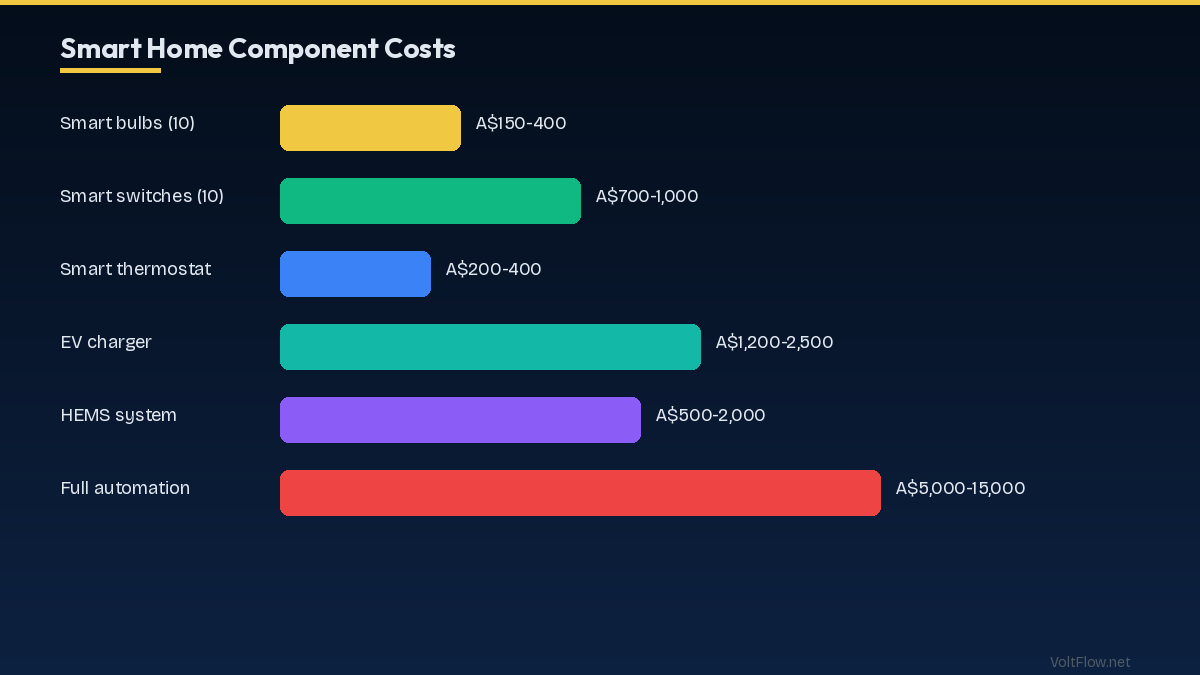
Smart lighting is the easiest and cheapest smart home upgrade. Smart bulbs (A$15-40 each): Screw-in replacements that connect via WiFi or Zigbee. Brands: Philips Hue (premium, A$30-80), IKEA TRÅDFRI (budget, A$10-20), TP-Link Tapo (mid-range, A$15-25). No electrician needed — just screw in and connect via app. Controllable by voice (Alexa, Google Home), app, or automation. Smart switches (A$40-80 each + installation): Replace your existing light switches with WiFi-connected versions. Better than smart bulbs because they work with any light fitting and don't lose connectivity when the switch is off. Brands: Clipsal Iconic (A$60-100, Australian standard), Shelly (A$40-60, fits behind existing switches), Aqara (A$50-70, Zigbee). Important: Smart switches require a neutral wire at the switch location. Many older Australian homes only have active and earth at the switch. Check before purchasing — if no neutral, use Shelly modules that can work without neutral (some models) or have an electrician run a neutral wire (A$100-200 per switch). Installation: Replacing a light switch is electrical work in Australia and legally requires a licensed electrician. Cost: A$50-100 per switch installed, or A$300-600 for a whole-house conversion (10-15 switches).
Smart Energy Management: Solar, Battery, and EV Integration
Solar monitoring (included with inverter): All modern inverters (Fronius, Huawei, Enphase, Sungrow) include apps showing real-time generation, consumption, and export. This is your first smart energy tool — use it to understand when you generate vs consume. Home Energy Management Systems (HEMS): Integrate solar, battery, EV charger, and hot water into a single automated system. Fronius Wattpilot manages EV charging from solar surplus. Huawei LUNA optimizes battery charge/discharge based on TOU pricing. SMA Sunny Home Manager balances all loads automatically. Cost: A$500-2,000 on top of existing solar/battery systems. Smart EV chargers: Zappi (A$2,000-2,500) reads your smart meter and charges only from solar surplus or during off-peak. Wallbox Pulsar Plus (A$1,200-1,500) has scheduling and solar integration. Tesla Wall Connector works with Tesla vehicles' built-in scheduling. Solar diverters: Catch Power Green (A$800-1,000) automatically sends excess solar to your hot water. Zero waste, zero effort — install it and forget. Pays for itself in 1-2 years. Full automation stack: Home Assistant (free, runs on Raspberry Pi or NUC) connects everything — solar, battery, EV, hot water, lighting, HVAC — into one automated system. Advanced users can achieve 80-90% energy self-sufficiency.
Smart HVAC: Heating and Cooling Automation
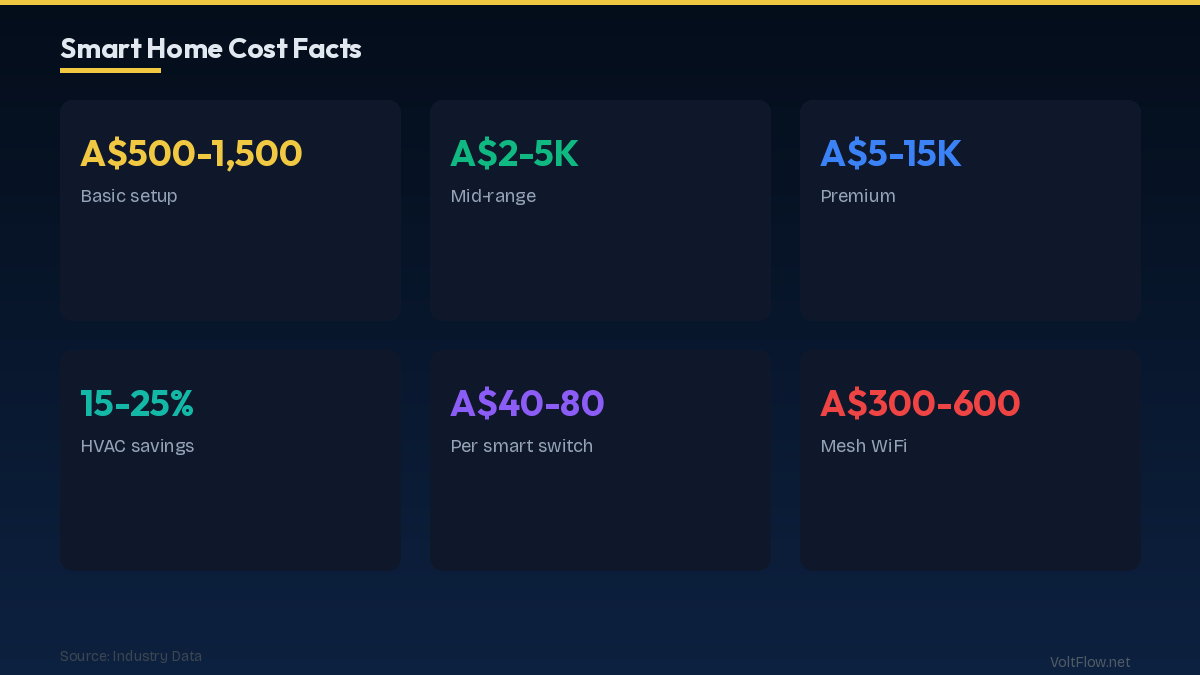
Smart thermostats (A$200-400): Control your reverse-cycle AC from your phone with scheduling, geofencing (turns off when you leave, on when you return), and energy reporting. Brands: Sensibo (A$150-250, works with any split system via IR), Mitsubishi WiFi control (A$200-350, built-in for newer units), Daikin WiFi (A$200-300, integrated). Sensibo is the most versatile — it works with any brand by emulating the IR remote. Savings: Smart HVAC control typically saves 15-25% on heating/cooling costs by eliminating forgotten-on AC and optimizing schedules. For a household spending A$800-1,200/year on HVAC: savings of A$150-300/year. Zoning: Smart zoning systems (A$2,000-5,000 installed) let you heat/cool individual rooms rather than the whole house. Myair, iZone, and ActronAir smart zoning close dampers to unused rooms, reducing energy use by 25-40%. Worth it for homes with ducted systems and rooms that are often unoccupied. Pre-conditioning on TOU: Program your AC to cool/heat during shoulder or off-peak hours, then coast through peak. A well-insulated home holds temperature for 3-4 hours. Automated via smart thermostat + TOU schedule.
Whole-Home Smart Hub and Wiring
Choosing a smart home hub: Your hub connects all smart devices. Options: Google Home/Nest (free with Google speaker, easy setup, limited automation), Amazon Alexa (similar to Google, broad device compatibility), Apple HomeKit (excellent privacy, limited to Apple ecosystem), Home Assistant (free, self-hosted, most powerful automation but requires technical setup). For most Australians, Google Home or Alexa is sufficient for lighting, HVAC, and basic automation. Home Assistant is the choice for advanced energy management. WiFi considerations: Smart homes rely on stable WiFi. A mesh WiFi system (A$300-600 for 3-pack) ensures coverage throughout. Brands: TP-Link Deco, Google Nest WiFi, Ubiquiti. Zigbee/Thread devices (Philips Hue, IKEA, Aqara) use a separate mesh network that doesn't load your WiFi. Structured wiring for new builds: If building new, install Cat6 ethernet to every room (A$50-100/point), centralised home automation panel, and conduit for future wiring. This is far cheaper during construction than retrofitting. Total structured wiring cost in a new build: A$2,000-5,000 depending on home size. Electrical considerations: Smart devices need power. Smart switches need neutral wires. CCTV cameras need PoE (Power over Ethernet) or hardwired power. Outdoor smart devices need weatherproof outlets. Plan these during construction or renovation.
Costs, Regulations, and Getting Started
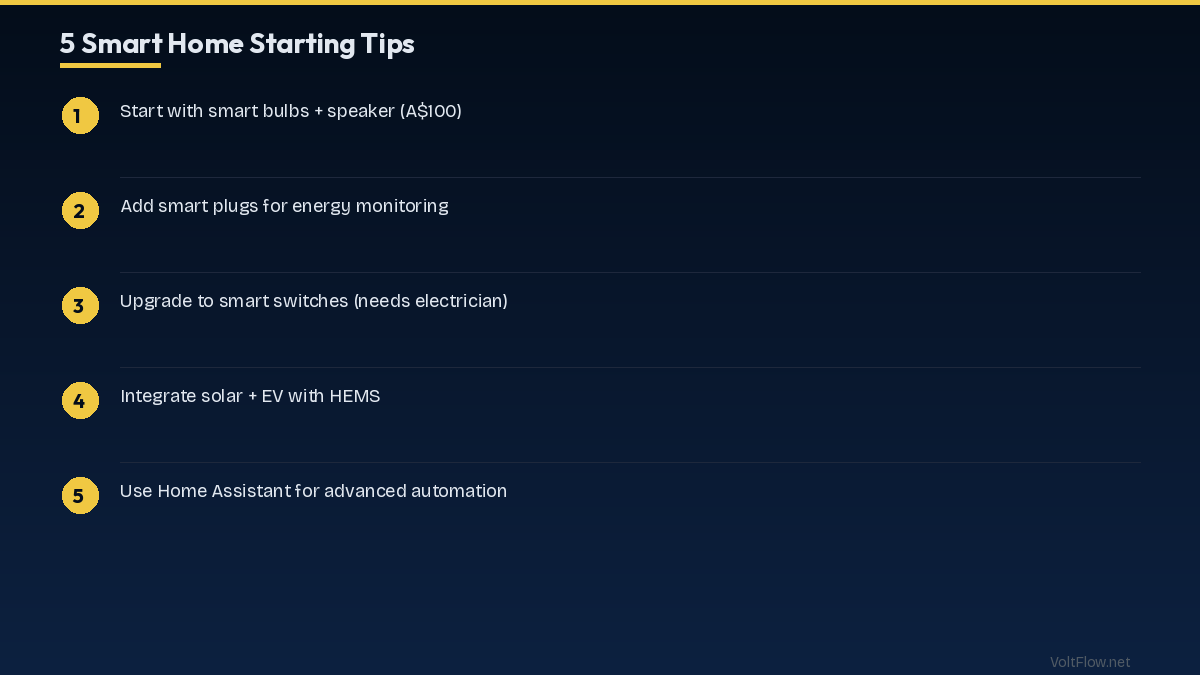
Budget smart home (A$500-1,500): 10 smart bulbs + 2 smart plugs + smart speaker + Sensibo for AC. Control lighting, heating, and a couple of appliances by voice and schedule. No electrician needed. Mid-range smart home (A$2,000-5,000): Smart switches throughout + smart EV charger + solar diverter + mesh WiFi + smart thermostat. Requires electrician for switches and EV charger. Saves A$500-1,000/year in energy. Premium smart home (A$5,000-15,000): Home Assistant on dedicated hardware + full smart switch retrofit + HEMS + automated blinds + smart locks + security cameras + structured wiring. Maximum automation and energy savings. AS/NZS 3000 compliance: All hardwired smart devices (switches, EV chargers, wired sensors) must be installed by a licensed electrician in Australia. Plug-in devices (smart bulbs, smart plugs, speakers) don't require an electrician. Ensure all devices are SAA/RCM approved (look for the regulatory compliance mark). Getting started: Start with smart bulbs and a speaker (A$100-200 total). Learn the ecosystem. Then add smart plugs for monitoring and scheduling. Once comfortable, invest in smart switches and energy management. Don't try to automate everything at once.
Frequently Asked Questions
How much does a smart home setup cost in Australia?
Basic: A$500-1,500 (smart bulbs, plugs, speaker). Mid-range: A$2,000-5,000 (smart switches, EV charger, solar integration). Premium: A$5,000-15,000 (whole-home automation with HEMS).
Do smart switches need a neutral wire in Australia?
Most smart switches require a neutral wire. Older Australian homes often lack neutral at switch locations. Options: run neutral wire (electrician, A$100-200/switch) or use Shelly modules that work without neutral.
Can I install smart switches myself in Australia?
No. All mains voltage electrical work requires a licensed electrician in Australia. Smart bulbs and plug-in devices can be installed by anyone. Hardwired switches, EV chargers, and sensors require professional installation.
What is the best smart home hub for Australia?
Google Home or Alexa for ease of use. Home Assistant for advanced energy automation. Apple HomeKit for privacy-focused Apple users. Most energy-saving features work best with Home Assistant.
How much energy can a smart home save?
Smart lighting saves 10-15% on lighting costs. Smart HVAC saves 15-25% on heating/cooling. TOU automation saves 20-40% overall. Total: A$500-1,500/year for an actively managed smart home.