EV Charging Cost Australia 2026 — Home vs Public Pricing
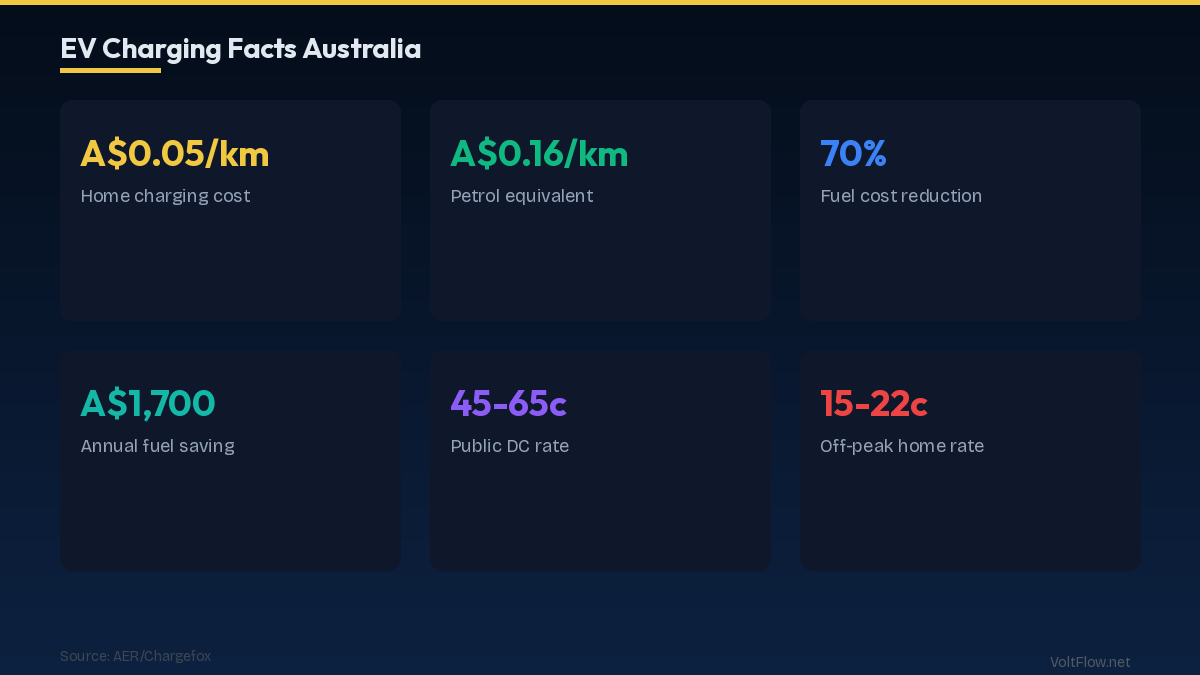
Charging an EV in Australia costs A$0.05/km at home (30c/kWh) vs A$0.16/km for petrol. Public DC fast charging costs 45-65c/kWh. Off-peak home charging can drop to A$0.03/km. Annual fuel savings: A$1,000-2,000 compared to a petrol car.
Home Charging Costs: The Cheapest Way to Fuel Your EV
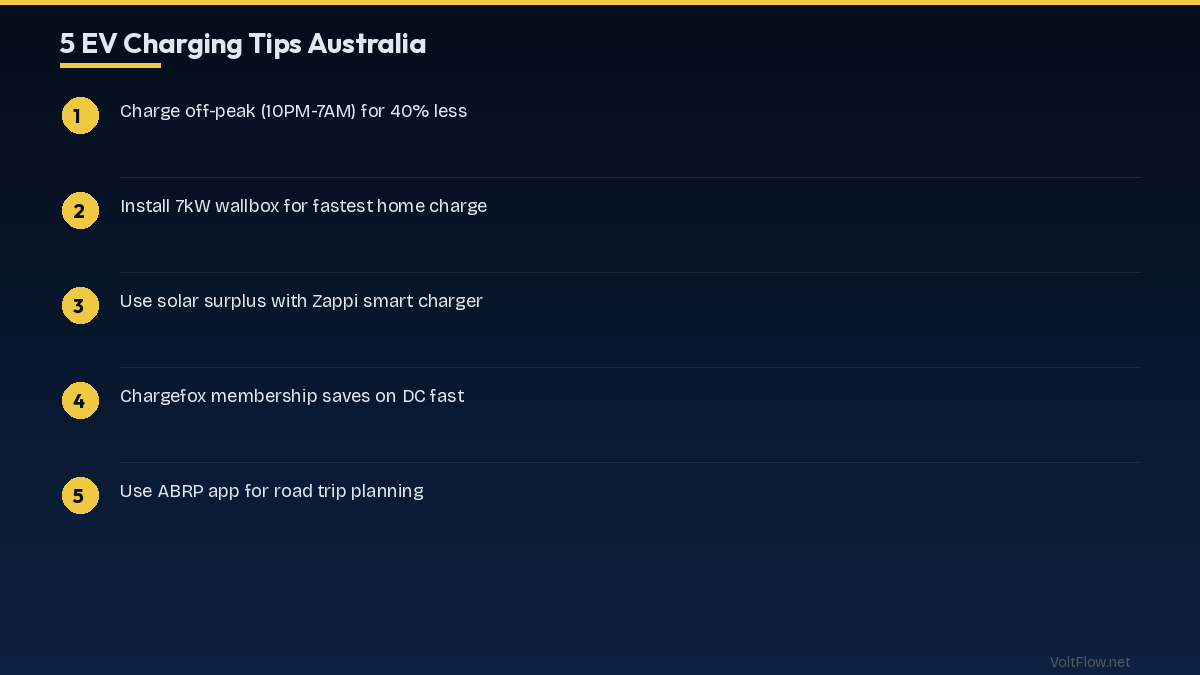
Home charging via a Level 2 wallbox (7kW) is the most economical option. At the average Australian residential rate of 30c/kWh, a typical EV consuming 15-18 kWh/100km costs A$4.50-5.40 per 100km — or about A$0.05/km. Compare to a petrol car averaging 8L/100km at A$2/L: A$16 per 100km (A$0.16/km). That's a 70% fuel cost reduction. For 15,000 km/year: EV home charging costs A$675-810 vs petrol A$2,400 — saving A$1,600-1,700/year. Off-peak TOU tariffs (15-22c/kWh, typically 10 PM - 7 AM) reduce costs further to A$0.03/km or A$450-550/year. All modern EVs support scheduled charging — set your car to start charging at 10 PM or whenever off-peak begins. A dedicated Level 2 wallbox (A$1,000-2,500 installed) is recommended over the included trickle charger (2.4kW). The wallbox charges 3x faster (7kW) and is safer for nightly use than a standard power outlet.
Public Charging: AC vs DC Fast Pricing
Public AC chargers (7-22kW): Often free or low-cost at shopping centres, council car parks, and workplaces. When paid, rates are 25-40c/kWh — comparable to home charging. Charging time: 2-6 hours for a meaningful top-up. Good for destination charging while shopping or at work. Public DC fast chargers (50-350kW): The premium option for road trips and quick top-ups. Pricing in 2026: Chargefox 45-60c/kWh (with membership discounts), Tesla Supercharger 45-55c/kWh (Model 3/Y owners), Evie Networks 50-65c/kWh, AmpCharge/JOLT varies by location. A 10-80% charge on a 60kWh battery at 50c/kWh costs approximately A$21 for 250-300km of range. That's A$0.07-0.08/km — still cheaper than petrol but 40-60% more than home charging. Tip: Chargefox Premium membership (A$9.90/month) offers discounted rates and is worthwhile if you DC fast-charge more than twice monthly. Some networks offer free charging promotions for new EV buyers.
Solar-Powered EV Charging: Drive on Sunshine
If you have rooftop solar, charging your EV during the day is essentially free fuel. A 6.6kW solar system generates 25-35 kWh/day in summer — enough to charge an EV by 120-180km of range daily. Over a year, solar-charged EV driving saves A$800-1,200 compared to grid-charged home rates. The economics are compelling: instead of exporting surplus solar at 3-8c/kWh, you're using it to displace electricity you'd buy at 30c+ or petrol at A$2/L equivalent. Each kWh diverted from export to EV saves 22-27c. For workers who charge overnight, a solar + battery + EV setup maximizes savings: solar charges the battery during the day, battery charges the EV overnight. Total annual cost: A$100-200 for the small amount of grid electricity needed in winter. Smart EV chargers like Zappi (A$2,000-2,500) can automatically adjust charging power based on available solar surplus — ensuring you only draw from solar when it's available.
Cost Comparison: EV vs Petrol vs Hybrid
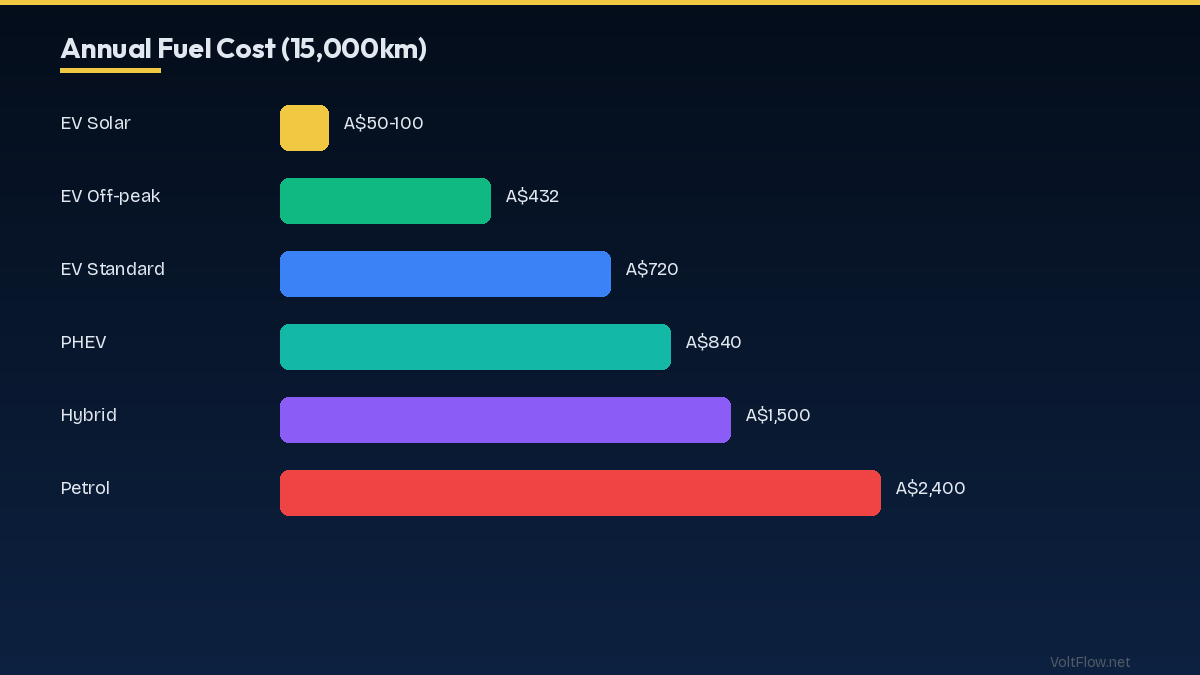
Let's compare annual fuel costs for 15,000 km driving: Petrol car (8L/100km at A$2.00/L): A$2,400/year. Hybrid (5L/100km): A$1,500/year. Plug-in hybrid (2L/100km + 12kWh/100km electric): A$840/year (A$300 petrol + A$540 electricity). BEV home charging (16kWh/100km at 30c): A$720/year. BEV off-peak charging (at 18c/kWh): A$432/year. BEV solar charging: A$50-100/year. The annual savings grow over vehicle lifetime. Over 10 years and 150,000km, a BEV with home charging saves A$16,800 in fuel costs vs petrol. Adding maintenance savings (no oil changes, less brake wear): A$22,000-28,000 total savings over a decade. These savings offset the typical A$5,000-15,000 EV purchase premium. With the FBT exemption for EVs under A$91,387 (LCT threshold), salary-sacrificed EVs save an additional A$5,000-15,000 in tax.
Charging Infrastructure: Australia's Network in 2026
Australia has approximately 5,000+ public charging locations in 2026 with coverage along all major highway corridors. Chargefox: Largest network with 100+ ultra-rapid stations (350kW) along highways. Good coverage on major routes (Hume, Pacific, Bruce). Tesla Supercharger: 80+ stations, now open to non-Tesla vehicles at many locations. Reliable and well-maintained. Evie Networks: Growing network of 50kW and 350kW chargers, often at BP service stations. NRMA: Extensive NSW/ACT network including many free chargers. JOLT: Free 7kWh per charge at selected locations in major cities. Key routes: Sydney-Melbourne (Hume Highway) has chargers every 100-150km. Sydney-Brisbane (Pacific Highway) is well covered. Melbourne-Adelaide has gaps — plan carefully. Perth-Margaret River-Esperance has growing but sparse coverage. For road trips, use the PlugShare or Chargefox app to plan stops. Most EVs now have 400-500km real-world range, making intercity travel comfortable with 1-2 charging stops.
Frequently Asked Questions
How much does it cost to charge an EV at home in Australia?
At the average rate of 30c/kWh, home charging costs about A$0.05/km or A$720/year for 15,000km. Off-peak rates (18c/kWh) reduce this to A$432/year.
Is it cheaper to charge an EV or fill up with petrol?
An EV is 65-80% cheaper to fuel. Annual cost for 15,000km: EV A$432-720 vs petrol A$2,400. That saves A$1,700-2,000/year.
How much does public DC fast charging cost in Australia?
Public DC fast charging costs 45-65c/kWh in 2026. A typical charge from 10-80% on a 60kWh battery costs about A$21 for 250-300km range.
Can I charge my EV from solar panels?
Yes. A 6.6kW solar system produces enough daily surplus to add 120-180km of EV range. A smart charger like Zappi can automatically use only solar surplus, making EV fuel essentially free.
How long does it take to charge an EV at home?
A 7kW Level 2 wallbox adds about 40km of range per hour. Overnight charging (8 hours) adds 280+ km — more than enough for daily driving needs.