Off-Peak Electricity Rates Australia 2026 — TOU Rates by State
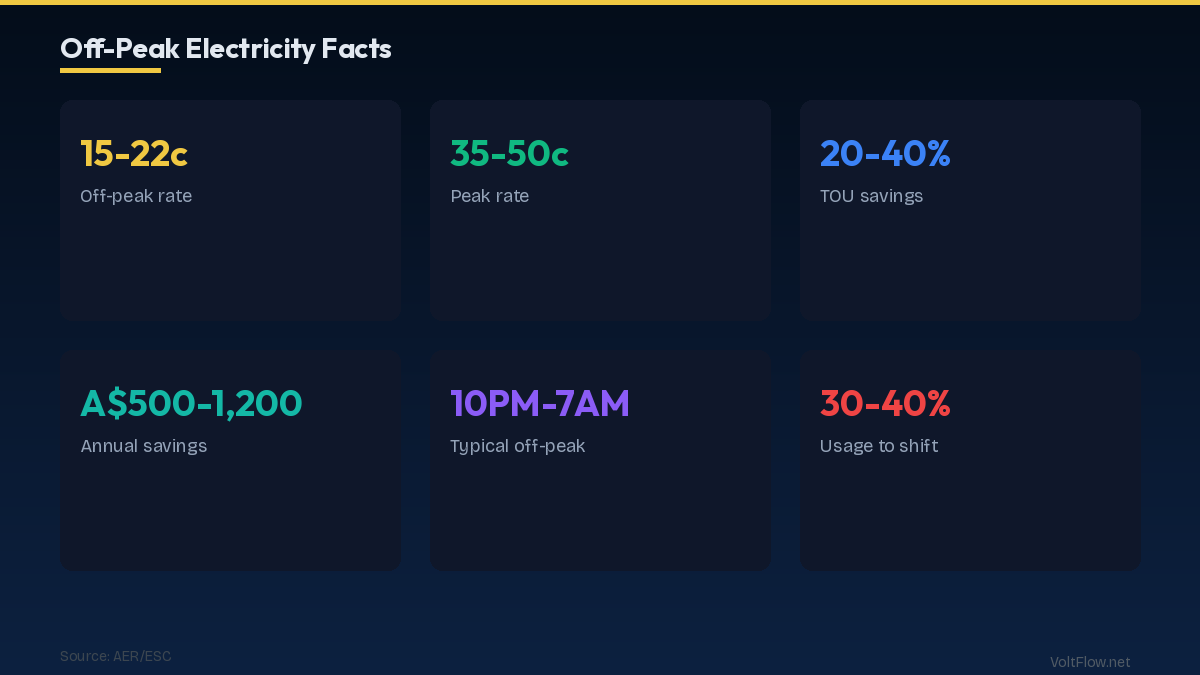
Off-peak electricity in Australia costs 15-22c/kWh compared to 35-50c during peak hours. Time-of-Use (TOU) tariffs let you save 20-40% on your bill by shifting heavy usage to cheap overnight and weekend periods. Every state offers TOU options with a smart meter.
How TOU Tariffs Work: Peak, Shoulder, and Off-Peak
Time-of-Use tariffs split the day into pricing windows based on grid demand. Peak (3-9 PM weekdays): 35-50c/kWh — when everyone comes home and turns on appliances, cooking, heating, and cooling simultaneously. This is the most expensive window and the one to avoid for heavy loads. Shoulder (7 AM-3 PM, 9 PM-10 PM weekdays; 7 AM-10 PM weekends): 25-32c/kWh — moderate pricing during daytime and weekend hours. Solar self-consumption during shoulder is effective. Off-peak (10 PM-7 AM daily): 15-22c/kWh — the cheapest window, typically 50-60% less than peak rates. Ideal for EV charging, hot water heating, pool pumps, and timer-controlled appliances. The exact time windows vary by state and distributor. Check your retailer's plan details for precise hours. The key insight: if you shift just 30-40% of your total consumption from peak to off-peak, you save 20-40% on your annual bill — potentially A$500-1,200/year for a typical household.
Off-Peak Rates by State
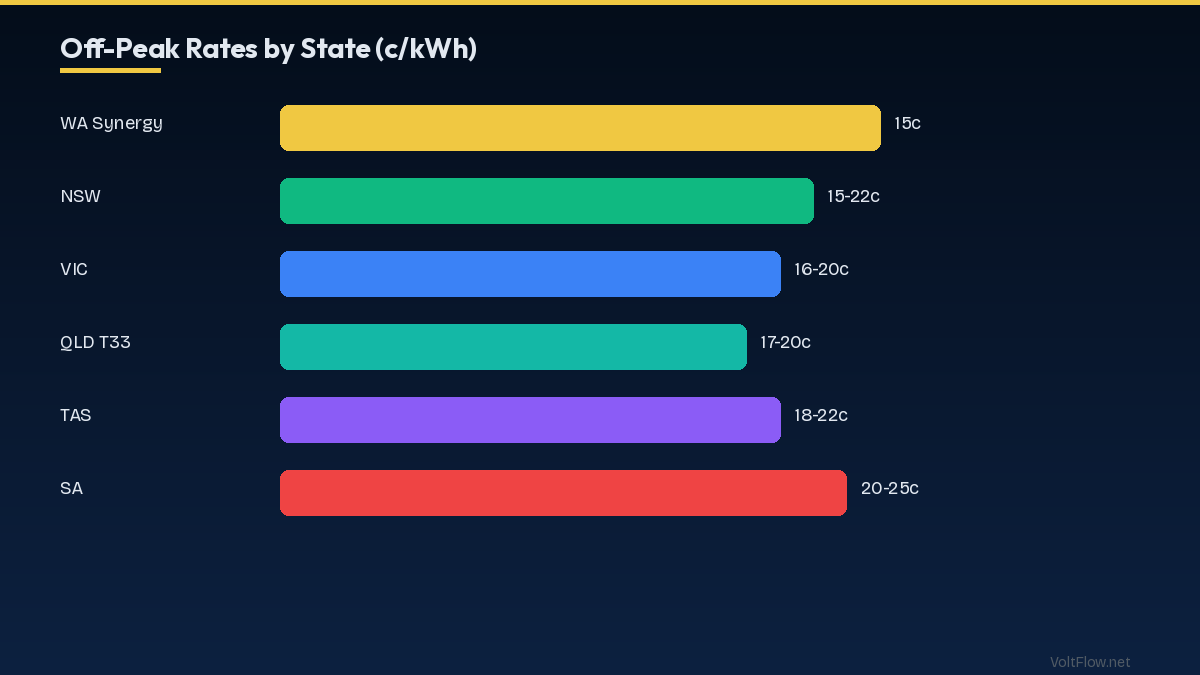
NSW: Off-peak 15-22c/kWh (Ausgrid, Endeavour, Essential zones). Peak 38-50c. Shoulder 25-32c. Windows: off-peak 10 PM-7 AM daily. TOU is available from all major retailers with a smart meter. Victoria: Off-peak 16-20c/kWh. Peak 35-48c. Shoulder 22-30c. Victoria has 100% smart meter coverage, making TOU the easiest to access nationally. The ESC mandates minimum protections on TOU plans. Queensland: Off-peak 18-23c/kWh (Energex zone). Limited TOU availability compared to southern states, but growing. Controlled load Tariff 33 (17-20c) is excellent for pool pumps and hot water on dedicated circuits. South Australia: Off-peak 20-25c/kWh. Peak 42-55c. SA has the largest peak-to-off-peak spread in Australia, making TOU savings the most dramatic — potentially A$800-1,500/year for high-consumption households. Western Australia: Synergy Smart Home Plan offers off-peak at 15-18c/kWh (9 PM-7 AM). Peak 55c (3-9 PM). The spread is Australia's widest on this plan. Tasmania: Aurora Energy offers TOU with off-peak 18-22c. Limited retailer competition but Aurora's TOU option is well-structured.
Best Appliances to Shift to Off-Peak
EV charging (saves A$800-1,500/year): The single biggest TOU win. Charging at off-peak (18c) vs peak (45c) saves 27c per kWh. For a typical EV using 15 kWh/100km and driving 15,000km/year: peak charging costs A$1,013, off-peak costs A$405. Annual saving: A$608. All modern EVs support scheduled charging — set departure time or charge window in the car app. Hot water system (saves A$200-500/year): Switch your electric hot water to a controlled load or off-peak tariff. Most distributors offer dedicated off-peak circuits at 16-20c/kWh. Your hot water heats overnight and stays warm throughout the day. No lifestyle change required — just a timer or tariff switch by your electrician. Dishwasher (saves A$80-160/year): Use the delay-start function to run at 10 PM. Most dishwashers use 1.2-1.8 kWh per cycle. At 365 cycles: peak cost A$250, off-peak A$100. Washing machine and dryer (saves A$100-200/year): Run overnight or early morning. Hang clothes to dry during the day if possible. Pool pump (saves A$300-600/year): Timer for off-peak or controlled load tariff. A single-speed pump running 8 hours uses 8-16 kWh/day — shifting to off-peak saves A$1-3/day.
Smart Home Automation for TOU Optimization
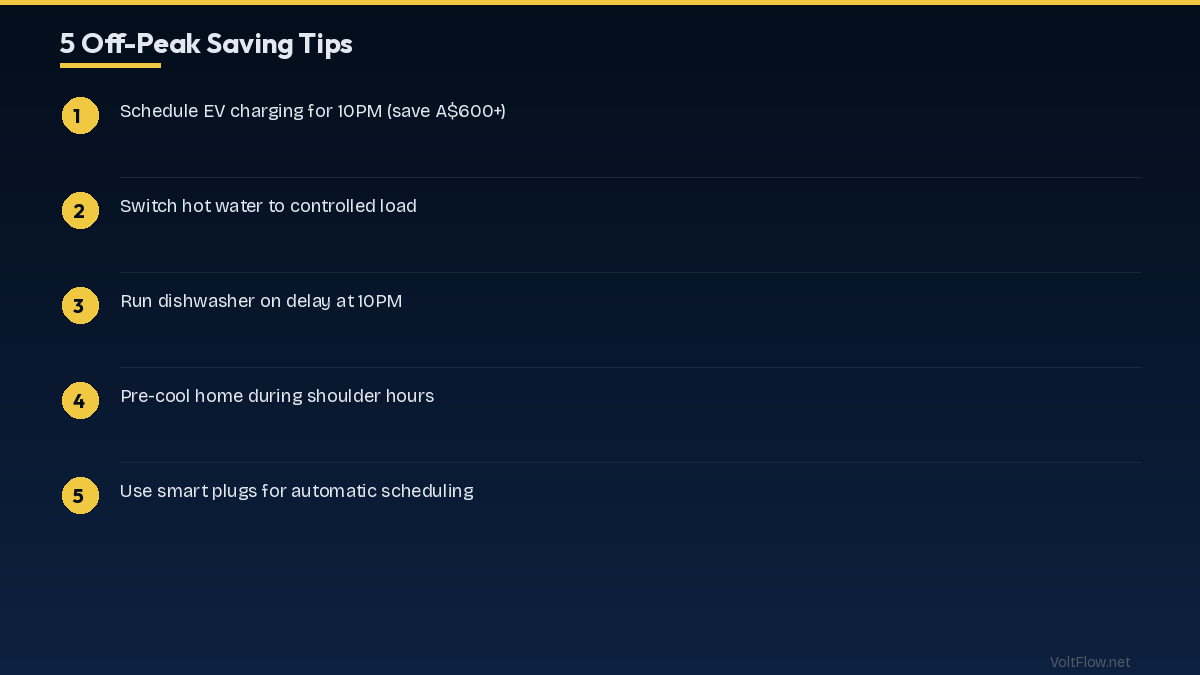
Manually remembering to shift appliances is unsustainable — automation is the key to consistent TOU savings. Smart plugs (A$25-50 each): WiFi-connected plugs with scheduling. Set your dishwasher, washing machine, or portable heater to turn on at 10 PM automatically. Brands: TP-Link Tapo, Shelly, IKEA DIRIGERA. Home Assistant (free software): Open-source home automation platform that can read your smart meter data (via Amber Electric API or retailer app) and automatically control appliances based on current electricity price. Advanced but powerful — some users save A$500-1,000/year with fully automated homes. Amber Electric: A retailer that passes through wholesale electricity prices. Prices swing from 0-5c/kWh during sunny midday to A$1-15/kWh during peak demand spikes. Their SmartShift feature automatically schedules your EV charging, hot water, and battery for the cheapest periods. If you have solar + battery + EV, Amber can save you more than any traditional retailer. Smart EV chargers: Zappi (A$2,000-2,500) detects solar surplus and off-peak windows. Wallbox Pulsar Plus has scheduling. Tesla Wall Connector integrates with Tesla's own scheduling. Set once, save every day.
TOU vs Flat Rate: Which Is Better for You?
Choose TOU if: You can shift 30%+ of usage to off-peak (night owl lifestyle, work from home with flexible schedule, EV owner, pool pump). You have solar panels (generate during shoulder, use off-peak overnight). You have a battery (charge from solar, discharge during peak). You use smart plugs or home automation. Stick with flat rate if: Your usage is heavily concentrated during 3-9 PM and you can't shift it (large family cooking, kids homework, AC running all evening). You don't have a smart meter yet (request one from your retailer). You have medical equipment that must run 24/7 on specific circuits. How to test without risk: Most retailers let you switch between TOU and flat rate with no penalty. Try TOU for one billing cycle — if your bill goes up, switch back. Use your smart meter data (via retailer app) to analyze your usage pattern before switching. If more than 35% of your consumption falls outside peak hours, TOU will save you money. The math: Average household using 5,500 kWh/year on flat rate at 30c = A$1,650. Same household on TOU (40% off-peak, 30% shoulder, 30% peak) = A$1,270. Saving: A$380/year without changing any habits. With active shifting: A$600-1,000 saved.
Frequently Asked Questions
What are off-peak electricity hours in Australia?
Off-peak hours are typically 10 PM to 7 AM daily in most states. Some states include weekends as shoulder or off-peak. Exact hours vary by distributor and plan — check your retailer.
How much can I save with TOU tariff in Australia?
Most households save A$300-700/year by shifting 30-40% of usage to off-peak. With an EV, savings can exceed A$1,000/year. SA households with large peak-off-peak spreads save the most.
Do I need a smart meter for TOU tariff?
Yes. TOU tariffs require half-hourly metering that only smart meters provide. Victoria has 100% coverage. Other states install smart meters on request — usually free or A$100-200.
Is off-peak electricity cheaper for EV charging?
Yes. Charging at off-peak (15-22c/kWh) vs peak (35-50c) saves 50-60%. For 15,000km/year driving, off-peak EV charging saves A$600-1,000 compared to peak rates.
What is controlled load tariff in Australia?
Controlled load (sometimes called Tariff 31 or 33) is a dedicated off-peak circuit for specific appliances like hot water or pool pumps. Rates are 16-22c/kWh — cheaper than general off-peak.