Pool Pump Running Cost Australia 2026 — Save A$500-900/Year
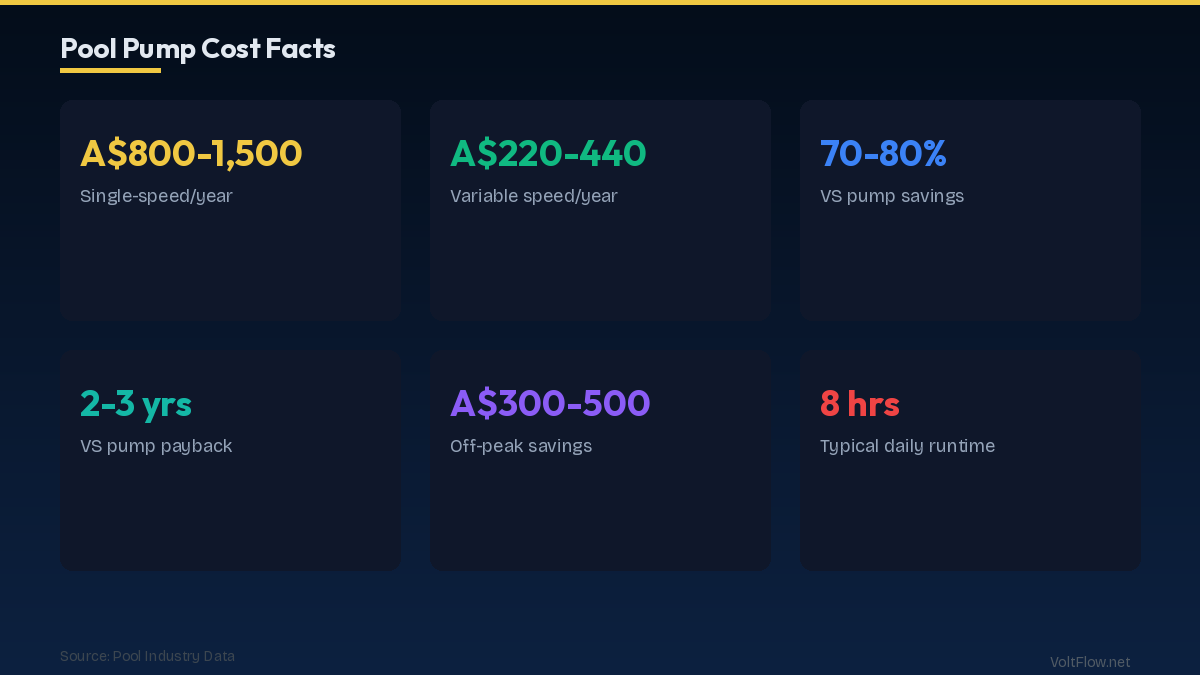
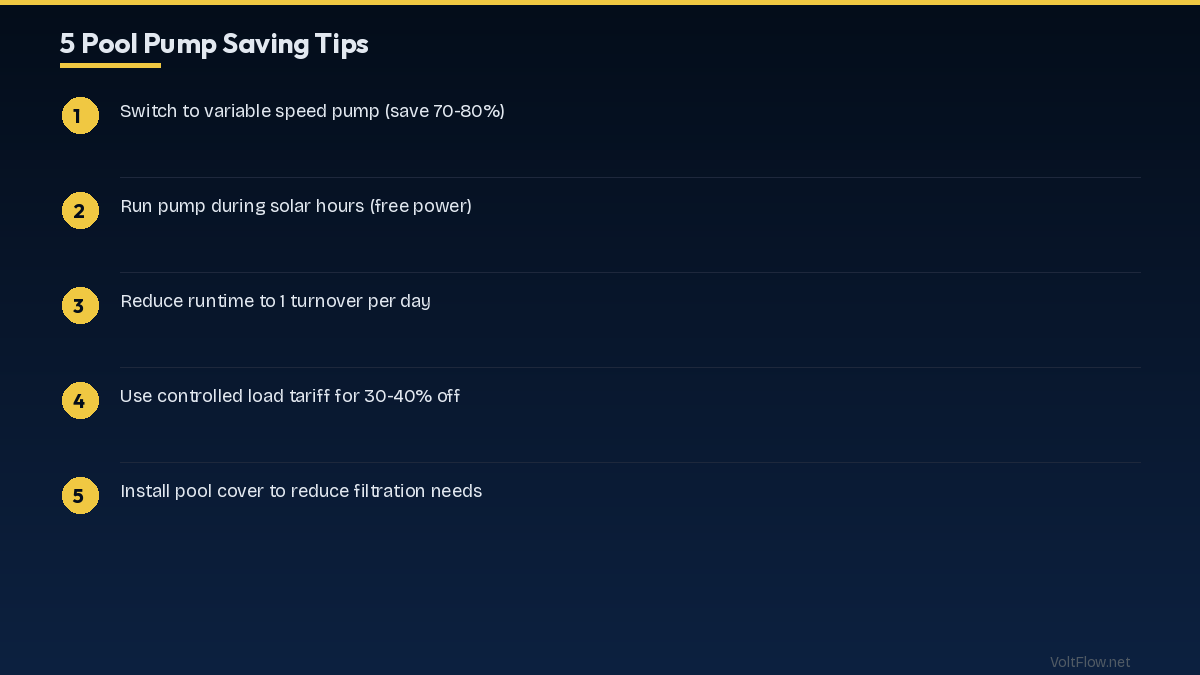
A standard pool pump costs A$800-1,500/year to run in Australia — one of the biggest electricity expenses after HVAC and hot water. Switching to a variable speed pump saves 70-80%, and running on off-peak tariff saves 30-40%. Here's exactly how much your pump costs and how to slash it.
Running Cost: Single-Speed vs Variable Speed
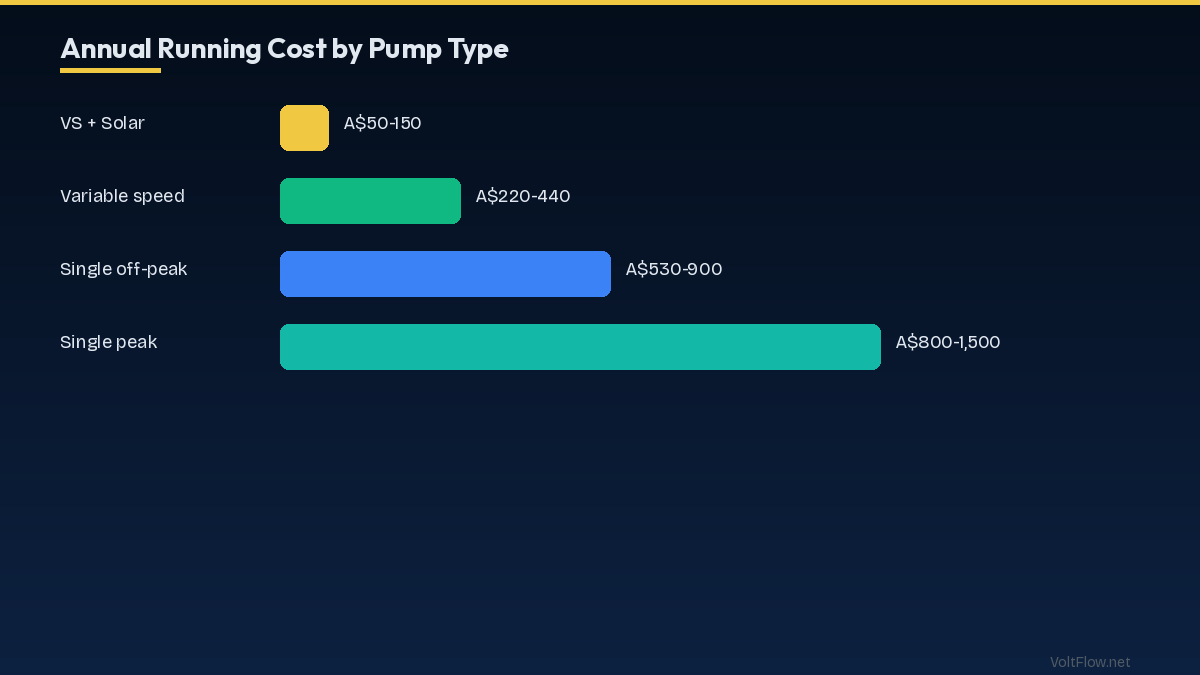
Single-speed pump (750W-1,500W): Running 8 hours/day at full speed: 6-12 kWh/day. At 30c/kWh: A$1.80-3.60/day = A$660-1,314/year. Most pools in Australia still have single-speed pumps. They run at 100% power regardless of the filtration need — like driving a car with the accelerator floored all the time. Variable speed pump (100W-1,500W): Adjusts speed to match the required flow rate. For daily filtration, a medium-low speed (400-600W) is sufficient. Running 8 hours at 500W: 4 kWh/day. At 30c: A$1.20/day = A$438/year. At low speed for 10 hours: 2-3 kWh/day = A$220-330/year. Savings: A$500-900/year compared to single-speed. Why variable speed saves so much: The pump affinity law means halving the pump speed reduces energy consumption by approximately 87.5% (power scales with the cube of speed). A pump running at half speed uses only 12.5% of the energy of full speed — but still moves enough water for adequate filtration. This is why variable speed pumps are the single best pool investment after the pool itself.
Off-Peak Tariff: Save 30-40% Without Changing Your Pump
If you're not ready to replace your pump, switching to an off-peak or controlled load tariff cuts costs immediately. How it works: A pool pump timer (A$50-150 for a manual timer, A$150-300 for a smart timer) schedules your pump to run during off-peak hours (typically 10 PM-7 AM or during solar hours). Your electrician connects the pump circuit to a controlled load tariff (Tariff 33 in QLD, controlled load in NSW/VIC/SA). Cost comparison for a 1kW single-speed pump, 8 hours/day: Peak tariff (30c): A$876/year. Off-peak tariff (18c): A$526/year. Savings: A$350/year. Best timing strategy: If you have solar panels, run the pump during 10 AM-2 PM to use free solar energy. If no solar, run overnight on off-peak. Some pool owners split: 4 hours during solar peak + 4 hours overnight off-peak. Solar-powered pumping: A solar pump controller (A$300-600) senses available solar power and adjusts pump speed accordingly. On sunny days, the pump runs entirely on solar. On cloudy days, it slows down or switches to grid backup. Annual running cost with solar: A$50-150.
Pool Pump Sizing: Are You Over-Pumping?
Many Australian pools have oversized pumps — using more energy than necessary. Sizing rule: Your pump needs to turn over the entire pool volume once per day (or twice for heavily used pools). A typical backyard pool is 40,000-50,000 litres. At a flow rate of 250 L/min, that takes about 3 hours for one turnover. Yet many pumps run 8-10 hours — turning over the water 2-3 times. Over-filtration wastes energy. If your pool chemistry is well-maintained (proper chlorine, pH, and regular cleaning), one turnover per day is sufficient for most residential pools. Reducing from 8 hours to 5 hours saves 37.5% on pumping costs — potentially A$300-500/year. Right-sizing your pump: A 0.75 HP (560W) variable speed pump is sufficient for most pools up to 50,000L. A 1.0 HP (750W) handles larger pools and those with water features. 1.5 HP (1,100W) is typically only needed for pools with spa jets, large water features, or pool heating systems requiring high flow. Ask your pool technician to assess whether your current pump is oversized. Downsizing from a 1.5 HP to a 0.75 HP variable speed saves A$600-1,000/year.
Best Variable Speed Pumps in Australia
Davey SilencePool (A$1,500-2,200): Australian-made, ultra-quiet (45 dB), 8-speed settings, WiFi-optional. Excellent for suburban pools where noise matters. Energy Star rated. Zodiac FloPro VS (A$1,200-1,800): Popular, reliable, 3 programmable speeds. Good value for money. Compatible with most Zodiac pool automation systems. Astral Viron P520 (A$1,800-2,500): Premium variable speed with built-in automation. Energy monitoring via app. Very efficient motor design. Pentair IntelliFlo VS (A$2,000-2,800): Top-tier American brand. Ultra-efficient permanent magnet motor. 8 programmable speeds. Built-in scheduling. Payback calculation: If your current single-speed pump costs A$1,200/year to run and a VS pump costs A$350/year, the annual saving is A$850. A mid-range VS pump at A$1,800 installed pays for itself in just over 2 years. Over its 8-10 year lifespan, total savings: A$6,000-8,000. Installation: A licensed electrician must install the new pump and connect it properly. Cost: A$200-400 for installation on top of pump price. Total: A$1,400-3,200 installed.
Additional Pool Energy Saving Tips
Pool cover (A$200-1,500): A solar/thermal pool cover reduces heat loss by 50-70%, reducing heating costs (if you heat your pool) by A$500-1,500/year. It also reduces evaporation (saving water costs) and reduces debris (meaning less filtration needed). The cheapest high-impact pool upgrade. Solar pool heating (A$3,000-6,000): Roof-mounted solar collectors heat your pool using free solar energy. Extends the swimming season by 2-3 months. Running cost: only the circulation pump power. Payback vs gas heating: 2-4 years. LED pool lights (A$100-300): Replace old halogen pool lights (300W) with LED (35-50W). Saves A$30-50/year and the LEDs last 10x longer. Optimise chemical management: Well-maintained water chemistry means less filtration is needed. Use a salt chlorinator with adjustable output rather than over-chlorinating. Automated chemical dosing (A$800-2,000) maintains perfect chemistry with minimal pump run time. Timer + thermostat for heated pools: Only run the heater to a target temperature, then let the cover retain heat. Running a gas or heat pump pool heater without a cover is like heating your home with the windows open.
Frequently Asked Questions
How much does a pool pump cost to run in Australia?
A single-speed pump costs A$800-1,500/year (8 hrs/day at 30c/kWh). A variable speed pump costs A$220-440/year. Off-peak tariff reduces any pump cost by 30-40%.
Is a variable speed pool pump worth it?
Yes. A variable speed pump saves A$500-900/year in electricity. At A$1,500-2,500 installed, payback is 2-3 years. Total savings over 10 years: A$5,000-9,000.
How many hours should I run my pool pump?
Enough to turn over the pool volume once daily. For a 40,000-50,000L pool at 250 L/min flow: about 3-4 hours. Most pumps run far longer than necessary — reducing hours saves 25-40%.
Can I run my pool pump on solar power?
Yes. Run your pump during 10 AM-2 PM to use solar surplus. A solar pump controller (A$300-600) automatically adjusts speed to available solar. Annual cost drops to A$50-150.
What tariff should my pool pump be on?
Controlled load or off-peak tariff (16-22c/kWh) vs general supply (28-35c). Your electrician can connect the pump circuit to a dedicated off-peak meter for A$150-400. Saves A$300-500/year.