Switchboard Upgrade Cost Australia 2026 — When & Why
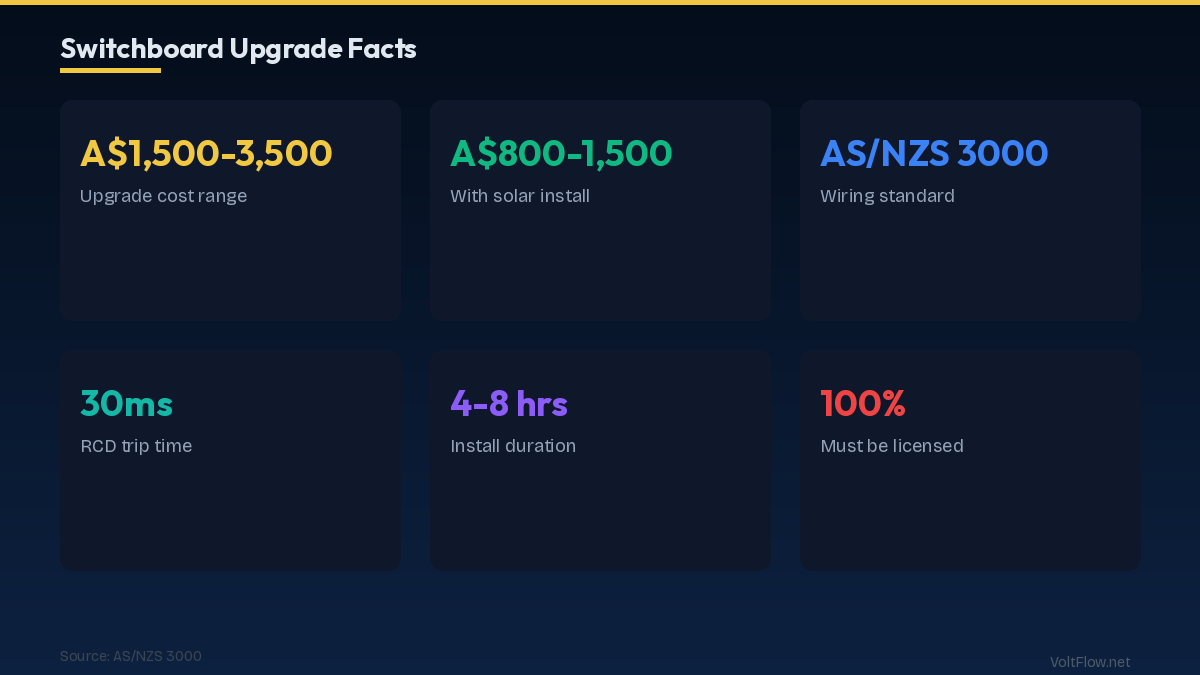
A switchboard upgrade in Australia costs A$1,500-3,500 in 2026. It's required when adding solar panels, EV chargers, or upgrading to safety switches (RCDs). Old ceramic fuse boards are a fire risk and must be replaced. Here's when you need an upgrade and what it involves.
When Is a Switchboard Upgrade Required?
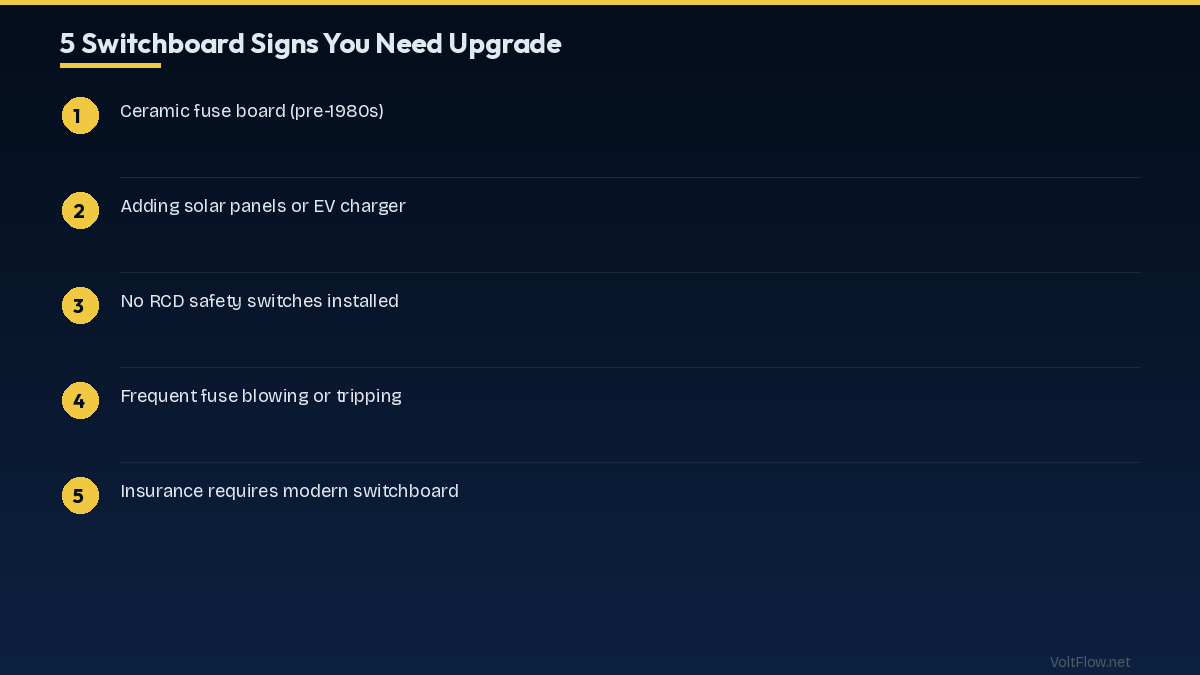
A switchboard upgrade is necessary in several common situations: Adding solar panels: Most solar installations require a switchboard with RCDs (Residual Current Devices) and sufficient space for the solar inverter circuit breaker. If your board is the old ceramic fuse type, it must be replaced. Cost impact: typically bundled into solar installation (adds A$800-1,500 to quote). Installing an EV charger: A dedicated 32A circuit for a 7kW wallbox needs a modern switchboard with adequate capacity. The electrician must verify your total demand doesn't exceed the main switch rating. Renovation or extension: Adding circuits for new rooms, air conditioning, or kitchen appliances often requires more space and a modern board. Safety compliance: AS/NZS 3000 (Wiring Rules) now requires RCDs on all final subcircuits. If your switchboard doesn't have RCDs, any new work triggers an upgrade requirement. Insurance: Some insurers require switchboard upgrades for homes built before 1980 with original wiring. An old fuse board may void your home insurance if it causes a fire.
Cost Breakdown: What You'll Pay
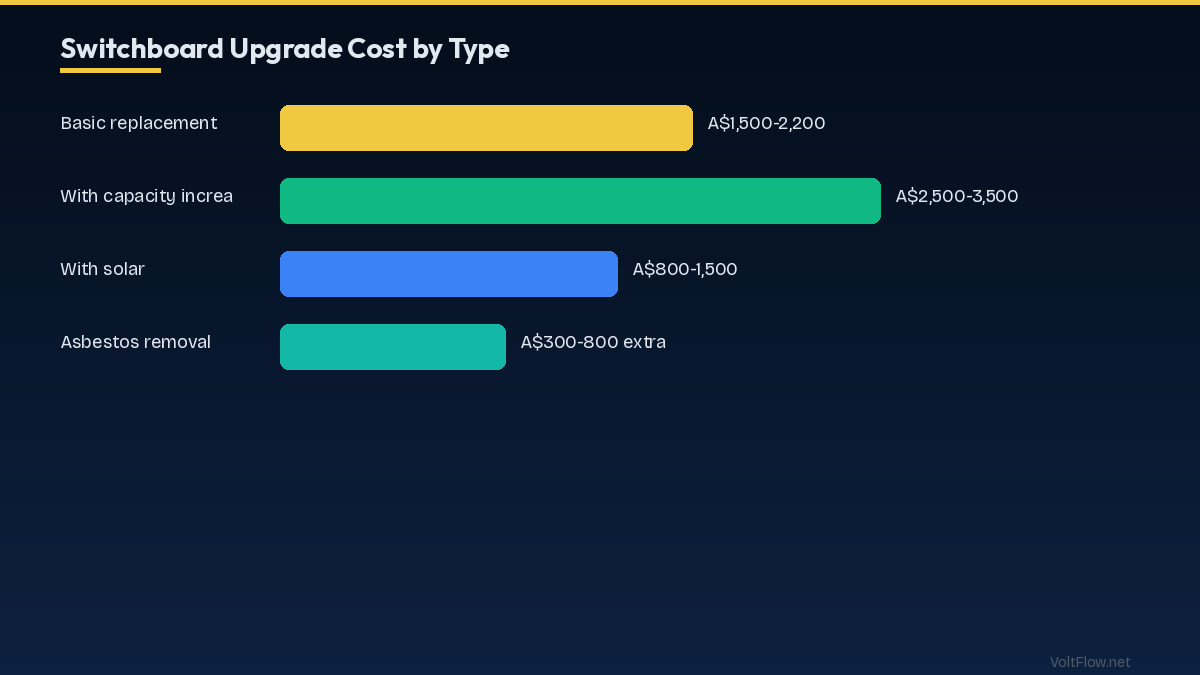
Basic switchboard replacement (like-for-like upgrade with modern MCBs and RCDs): A$1,500-2,200. Includes: new switchboard enclosure, main switch, RCDs for all circuits, MCBs (miniature circuit breakers), labelling, testing, and compliance certificate. Full upgrade with capacity increase (3-phase upgrade, additional circuits, higher main switch): A$2,500-3,500. Often needed for homes adding solar, battery, EV charger, and air conditioning. May require DNSP metering upgrades. Metering changes: If your meter is the old rotating-disc type, the DNSP will replace it with a smart meter (usually free or A$100-200 admin fee). This happens automatically when your switchboard is upgraded or solar is installed. Cost factors: Location (metro vs regional adds A$200-500), asbestos switchboard backing (removal adds A$300-800), complexity of existing wiring, and whether the main supply cable needs upgrading. Always get 3 quotes from licensed electricians with AS/NZS 3000 certification.
RCDs and Safety Switches: The Legal Requirements
RCDs (Residual Current Devices), also called safety switches, are legally required on all new or modified circuits under AS/NZS 3000:2018. They detect current leakage (indicating a fault or shock risk) and trip within 30 milliseconds — fast enough to prevent electrocution. Current requirements: All power point circuits must be RCD protected. All lighting circuits must be RCD protected (since 2018 amendment). Air conditioning, hot water, and other fixed appliances must be RCD protected. Types of RCDs: Type AC — basic, protects against AC faults. Sufficient for most residential circuits. Type A — also protects against pulsating DC faults. Required for EV charger circuits and some solar inverters. Costs A$30-50 more than Type AC. Testing: Test your RCDs quarterly by pressing the test button. They should trip immediately and reset cleanly. If they don't trip, call an electrician. RCDs have a 15-20 year lifespan and should be replaced proactively.
Ceramic Fuse Boards: Why They Must Be Replaced
Homes built before the 1980s often have ceramic fuse boards — the type where you manually replace or rewire fuse elements. These boards are dangerous for several reasons: No RCD protection: Ceramic fuses only protect against overcurrent (short circuits, overloads), not earth faults or electric shock. Rewireable elements: Homeowners sometimes replace fuse wire with the wrong size — too large and the circuit won't protect against overloads, creating fire risk. No circuit breakers: After a fuse blows, you must manually replace the element in the dark. MCBs simply flip a switch to reset. Overloaded circuits: Older homes often have fewer circuits, with multiple rooms on a single fuse. Modern usage (AC, appliances, charging) frequently overloads these circuits. Asbestos backing: Many pre-1980 switchboards have asbestos fibre backing boards. Professional removal (A$300-800 extra) is required — do not disturb asbestos yourself. Insurance risk: Increasingly, home insurers are requiring switchboard upgrades or refusing claims related to old wiring. A modern switchboard is a worthwhile safety and financial investment.
What to Expect During the Upgrade Process
A standard switchboard upgrade takes 4-8 hours for a residential property. Pre-work: Electrician inspects existing wiring, identifies circuits, and checks the main supply cable condition. They may need to coordinate with your DNSP for temporary disconnection and smart meter install. Day of work: Power is disconnected for 2-6 hours (usually). The old switchboard is removed (asbestos handling if applicable). New switchboard is installed with main switch, RCDs, and MCBs. All circuits are reconnected, labelled, and tested. Earth and bonding connections are verified. Completion: The electrician provides a Certificate of Compliance (required by law in all states). This document proves the work meets AS/NZS 3000 standards. Keep it — you'll need it for selling your home, insurance claims, or future electrical work. Smart meter: Your DNSP typically replaces the meter within 1-2 weeks of notification. Solar systems won't be connected until the smart meter is active. Tips: Charge devices, prepare cooler with food, and plan around the power outage. If you work from home, schedule the upgrade on a day you can be elsewhere.
Frequently Asked Questions
How much does a switchboard upgrade cost in Australia?
A basic upgrade costs A$1,500-2,200. A full upgrade with capacity increase costs A$2,500-3,500. Solar installation often bundles switchboard work for A$800-1,500 extra.
Do I need a switchboard upgrade for solar panels?
Usually yes if your switchboard is the old ceramic fuse type or lacks RCDs. Modern switchboards with available circuit space may not need upgrading.
Are safety switches required by law in Australia?
Yes. AS/NZS 3000:2018 requires RCDs on all final subcircuits for new installations and modifications. Most states require RCDs on all power point circuits at minimum.
How long does a switchboard upgrade take?
A standard residential upgrade takes 4-8 hours. Power is off for 2-6 hours during the work. The electrician provides a Certificate of Compliance upon completion.
Is an old ceramic fuse board dangerous?
Yes. Ceramic fuse boards lack RCD protection, use rewireable fuse elements prone to incorrect sizing, and may have asbestos backing. They should be replaced for safety, insurance compliance, and to support modern electrical loads.