Cable Sizing Australia — AS/NZS 3000 Wiring Rules Guide
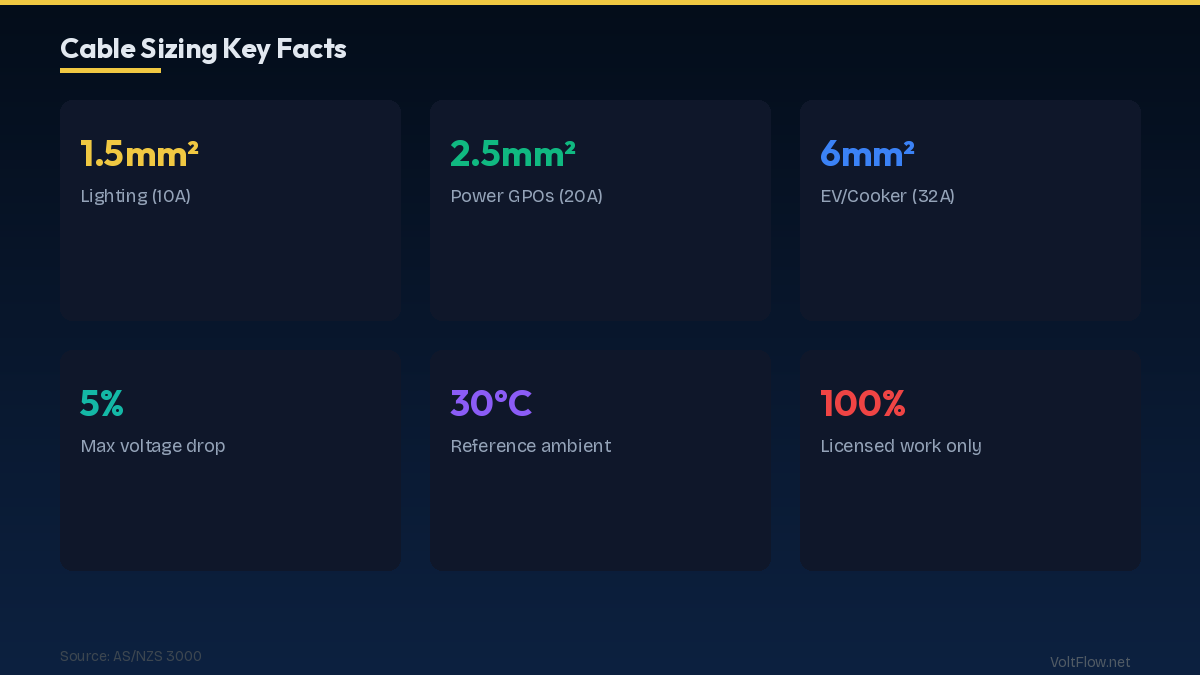
Australian cable sizing follows AS/NZS 3000 (Wiring Rules). Standard sizes: 1.5mm² for lighting (10A), 2.5mm² for power circuits (20A), 4-6mm² for cookers, AC, and EV chargers. Temperature correction factors are critical in Australian heat, where ambient temperatures regularly exceed the 30°C reference.
Standard Cable Sizes for Residential Circuits
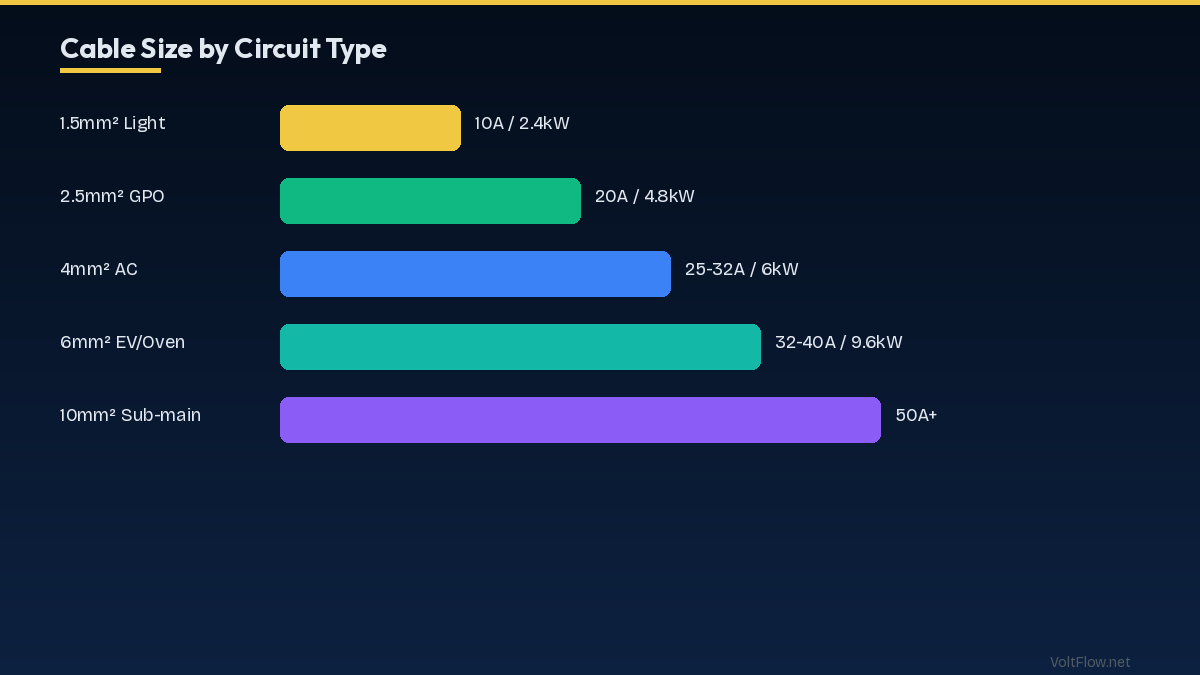
AS/NZS 3000 specifies minimum cable sizes based on circuit current rating and installation method. 1.5mm² TPS (Twin & Earth): Used for lighting circuits rated at 10A. Maximum circuit load: 2,400W at 240V. Suitable for up to 12 light points per circuit (Rule 4.5). Cost: approximately A$1.50-2.50/metre. 2.5mm² TPS: Standard for general power outlet (GPO) circuits rated at 20A. Maximum circuit load: 4,800W. Typically limited to 10-12 outlets per circuit. Cost: A$2.50-4.00/metre. 4mm² TPS: Used for higher-load circuits: dedicated air conditioning (up to 25A/6kW), electric cooktops (up to 32A with appropriate protection), and some workshop circuits. Cost: A$4.00-6.00/metre. 6mm² TPS: Used for 32-40A circuits: large cooktops/ovens, EV charger wallbox (7.4kW at 32A), hot water systems (if dedicated circuit), and sub-main supplies to outbuildings. Cost: A$6.00-9.00/metre. 10mm²: Sub-mains, 3-phase supply runs, large workshop equipment. 16mm²+: Main supply cables from meter to switchboard.
Temperature Correction: Critical in Australian Climate
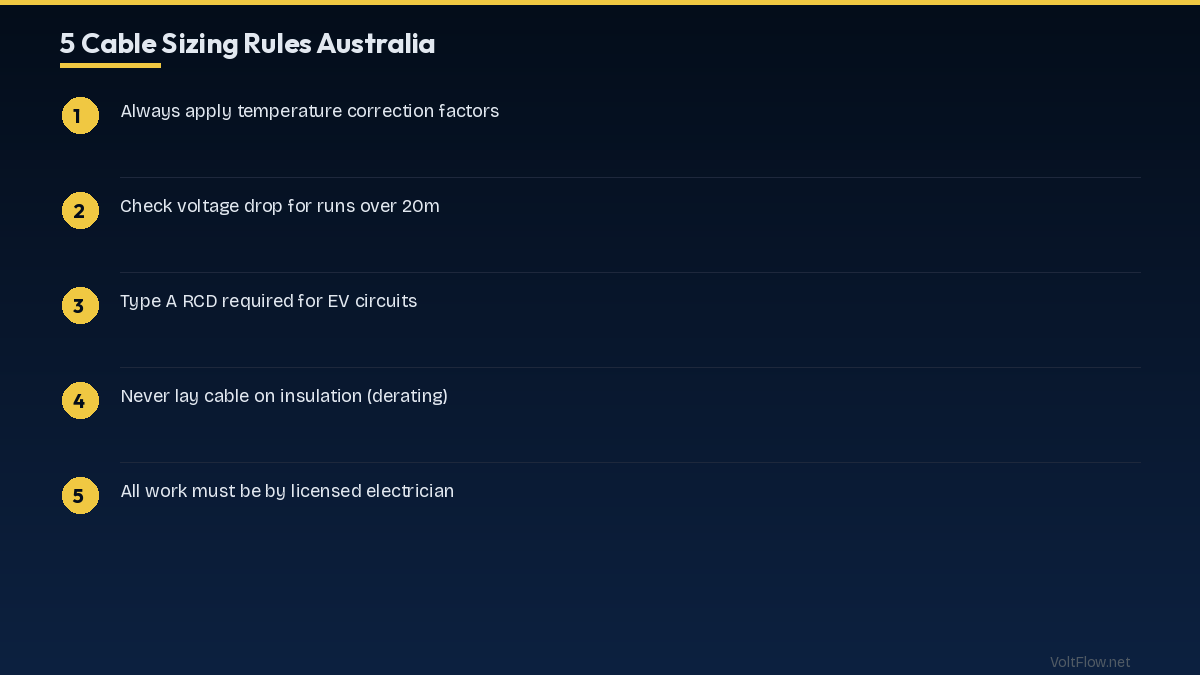
AS/NZS 3000 rates cable current capacity at a reference ambient temperature of 30°C in air or 25°C in ground. In much of Australia, ambient temperatures regularly exceed these references — roof spaces in summer can reach 50-70°C. Correction factors (Table C4 of AS/NZS 3000): At 35°C ambient: multiply current capacity by 0.94. At 40°C: multiply by 0.87. At 45°C: multiply by 0.79. At 50°C: multiply by 0.71. Practical impact: A 2.5mm² cable rated at 23A at 30°C can only safely carry 16.3A (23 × 0.71) at 50°C in a roof space. This means a standard 20A power circuit may need to be upgraded to 4mm² cable if run through a hot roof space. Installation methods matter: Cables clipped to surfaces (Method B) have different ratings than cables in conduit (Method A) or enclosed in insulation (Method G — heavily derated, sometimes 50%+). Never lay cable directly on or in thermal insulation — this is a common error that reduces current capacity dramatically and creates fire risk.
Voltage Drop Calculations per AS/NZS 3000
Maximum voltage drop: 5% from the point of supply to the point of utilisation (Rule 3.6.2). For a 240V supply, that's 12V maximum across the entire circuit. In practice, 3% is recommended for long runs. Voltage drop formula: Vd = (mV/A/m × I × L) / 1000, where mV/A/m is the millivolt drop per amp per metre (from Table C7), I is the design current in amps, and L is the one-way cable length in metres. Common scenarios: A 20A circuit on 2.5mm² TPS with a 30m run: Vd = 18.1 × 20 × 30 / 1000 = 10.86V (4.5%). This just passes the 5% limit but would fail at 35m. Solution: upgrade to 4mm² cable (Vd = 11.3 × 20 × 30 / 1000 = 6.78V = 2.8%). EV charger circuits are particularly sensitive — a 32A load on a long 6mm² run to a garage can exceed voltage drop limits. Calculate before running cable. For solar inverter circuits: 16A at up to 50m from inverter to switchboard — verify voltage drop doesn't reduce feed-in efficiency. Use a cable sizing calculator or refer to AS/NZS 3000 Table C7 for precise values.
Circuit Protection: MCB and RCD Selection
Every circuit must have appropriate overcurrent protection (MCB) and fault protection (RCD). MCB sizing rule: The MCB rating must not exceed the cable's current capacity (after correction factors). A 20A MCB on a 2.5mm² circuit (rated 23A at 30°C) is fine at 30°C but may need reassessment if the cable runs through a 50°C roof space (derated to 16.3A — a 16A MCB would be required). MCB types: Type B — trips at 3-5× rated current. Standard for resistive loads (heaters, lighting, GPOs). Type C — trips at 5-10× rated current. Required for motor loads with high inrush (AC compressors, large pumps, power tools). Type D — trips at 10-20× rated current. For heavy industrial motors, welding equipment. RCD selection: 30mA sensitivity for personal protection (all residential circuits). Type AC for standard circuits. Type A for EV charger circuits and some electronic equipment. Test RCDs quarterly via the test button. AFDD (Arc Fault Detection Devices): Not yet mandatory in Australia but recommended for bedroom circuits and areas with ageing wiring. AFDDs detect dangerous arcing that MCBs and RCDs cannot.
Licensed Electrician Requirement: DIY vs Professional
In Australia, ALL electrical work must be performed by a licensed electrician. This is law in every state and territory. There are no DIY exemptions for mains voltage wiring — unlike some other countries. What you CAN do yourself: Replace light bulbs and plug-in appliances. Install extra-low voltage (ELV) systems under 50V (garden lights, data cabling, some security cameras). Change power point cover plates (but NOT the socket mechanism). What requires a licensed electrician: Any work on 240V circuits (including replacing a power point or light switch). Switchboard modifications. Running new cables. Installing ceiling fans (hardwired). EV charger installation. Solar panel and inverter installation. Penalties for unlicensed work: Fines of A$5,000-50,000 depending on state. Void home insurance. Personal liability for any injury or fire. Cannot sell your home without compliance certificate for visible modifications. Finding a licensed electrician: Check your state's licensing register (e.g., NSW Fair Trading, VIC Energy Safe). Get 3 quotes, verify licence numbers, and ensure they provide a Certificate of Compliance on completion.
Frequently Asked Questions
What size cable for a 20A power circuit in Australia?
2.5mm² TPS is standard for 20A power circuits at 30°C ambient. If the cable runs through a hot roof space (above 40°C), upgrade to 4mm² to maintain adequate current capacity.
What cable do I need for an EV charger in Australia?
A 7.4kW (32A) EV charger requires 6mm² cable for runs up to 25m. For longer runs, use 10mm² to avoid voltage drop issues. Type A RCD protection is required.
Can I do my own electrical wiring in Australia?
No. All mains voltage (240V) electrical work in Australia must be performed by a licensed electrician. DIY electrical work is illegal, voids insurance, and can result in fines of A$5,000-50,000.
What is the maximum voltage drop allowed in Australia?
AS/NZS 3000 allows a maximum 5% voltage drop from supply to utilisation point (12V on a 240V circuit). 3% is recommended for optimal performance.
Why do cables need temperature correction in Australia?
Cables are rated at 30°C ambient. Australian conditions often exceed this — roof spaces can reach 50-70°C. Without correction, cables may overheat, degrading insulation and creating fire risk.