EV Rebates Australia 2026 — FBT Exemption & State Incentives
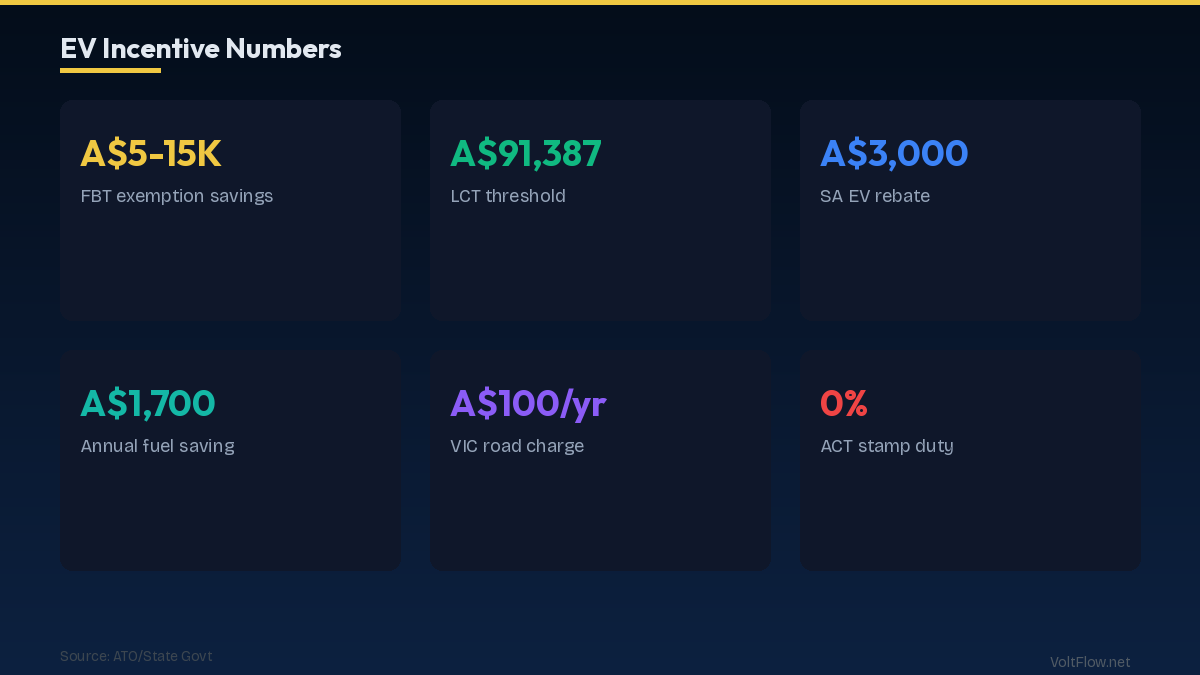
Australia offers a Fringe Benefits Tax (FBT) exemption for EVs under A$91,387, saving buyers A$5,000-15,000 through salary sacrifice. Some states add stamp duty and registration discounts. Here's every EV incentive available in 2026.
Federal FBT Exemption: The Biggest EV Incentive
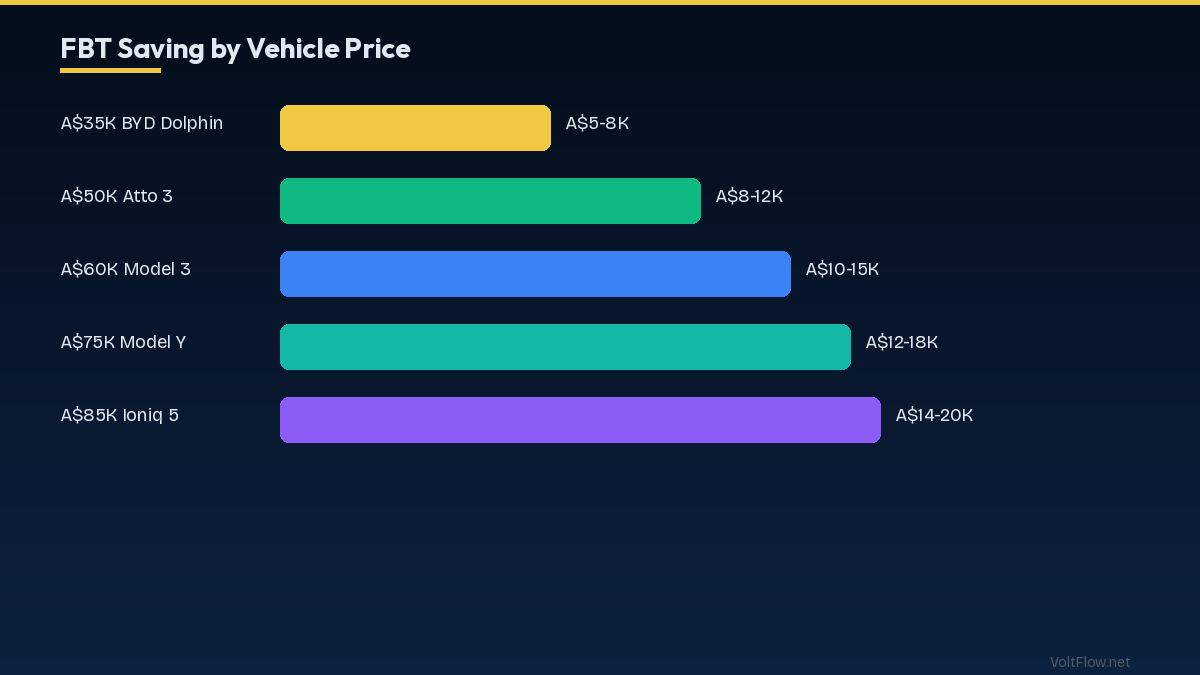
The Electric Car Discount exempts battery-electric and plug-in hybrid vehicles (first used after 1 July 2022) from Fringe Benefits Tax when provided through a salary sacrifice arrangement. The vehicle must be below the Luxury Car Tax threshold for fuel-efficient vehicles (A$91,387 in 2025-26). How the savings work: Under a novated lease, your employer pays for the car from your pre-tax salary. Without FBT exemption, the taxable benefit would attract FBT at 47% of the vehicle value. With exemption, FBT is zero. For a A$60,000 Tesla Model 3, the FBT saving is approximately A$10,000-15,000 over a 3-year lease, effectively reducing the cost to A$45,000-50,000 (compared to buying outright). Your take-home pay reduction is also lower because you're paying from pre-tax dollars — saving income tax and GST. For someone earning A$120,000, a A$60,000 EV through novated lease costs roughly A$800-900/month including insurance, rego, and charging vs A$1,200-1,400/month for the same car purchased with after-tax dollars.
State-by-State EV Incentives
NSW: Stamp duty exemption for EVs under A$78,000 (saving A$1,500-3,000). No separate rebate but the FBT exemption applies. Registration discount considered. Victoria: A$100/year road user charge (Zero and Low Emission Vehicle Distance Charge) — this is actually a tax, not a rebate. VIC was first to introduce an EV road tax, upheld by the High Court. Some EV advocates argue it discourages adoption. Queensland: Previously offered A$6,000 EV rebate for vehicles under A$68,000 — check if extended into 2026. Stamp duty concession available. ACT: 2 years free registration (saving A$600-1,000), stamp duty exemption, and discounted green vehicle loans. The ACT has Australia's most generous state-level EV incentives. South Australia: A$3,000 rebate (check current availability), 3-year registration discount. Western Australia: Registration rebate and consideration for additional incentives. Tasmania: Stamp duty exemption for EVs. Check each state's current program status — incentives change frequently with budget cycles.
How to Set Up a Novated Lease for Maximum Savings
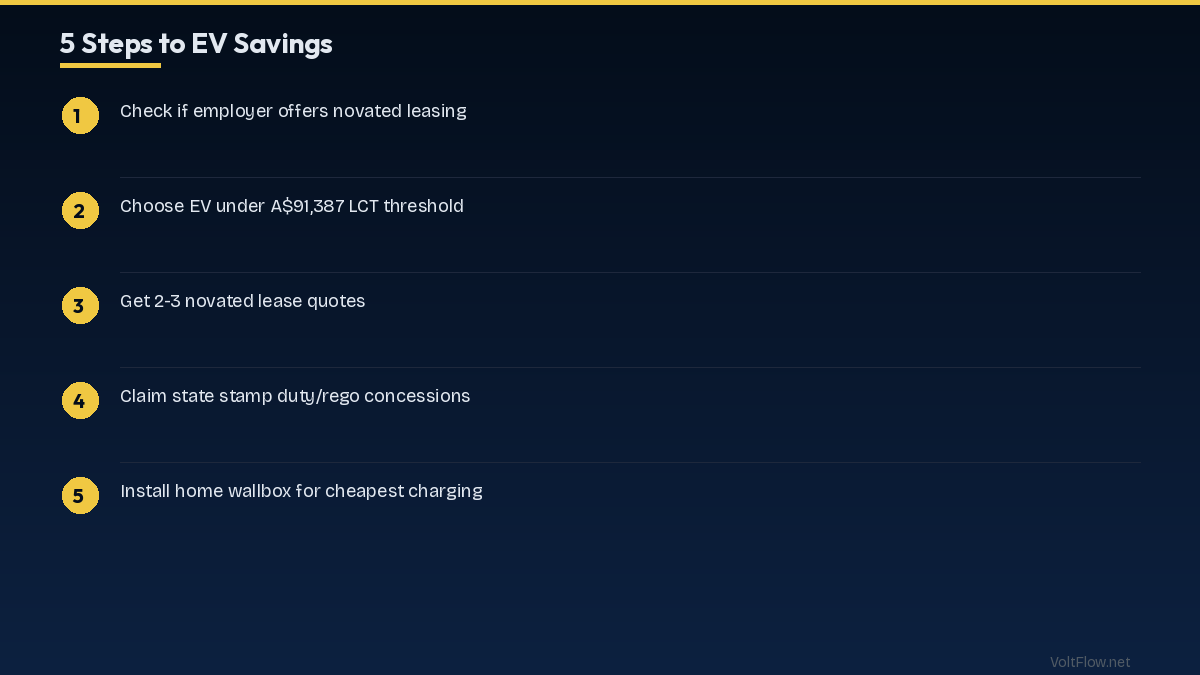
A novated lease is a three-way agreement between you, your employer, and a leasing company. Your employer deducts lease payments from your pre-tax salary. With the EV FBT exemption, the process becomes highly tax-efficient. Step 1: Check if your employer offers novated leasing (most large employers do; ask HR). Step 2: Choose your EV — ensure it's under the LCT threshold (A$91,387). Popular choices: Tesla Model 3 (A$55,000-65,000), BYD Atto 3 (A$45,000-50,000), MG ZS EV (A$38,000-43,000), Hyundai Ioniq 5 (A$65,000-75,000). Step 3: Get quotes from 2-3 novated lease providers (Maxxia, SG Fleet, Smartleasing, LeasePlan). Compare total cost including GST savings, running costs, and residual value. Step 4: Your provider handles all paperwork — insurance, registration, maintenance, and charging costs are bundled into the lease and paid pre-tax. Typical savings example: A$60,000 Tesla Model 3 on a 4-year novated lease costs roughly A$700-850/month from your pay packet (vs A$1,100-1,300 if purchased with after-tax dollars). You save A$15,000-20,000 over the lease period through combined FBT exemption, income tax reduction, and GST savings.
Total Cost of EV Ownership in Australia
Looking beyond purchase incentives, EVs offer ongoing savings that make the total cost of ownership compelling even without rebates. Fuel: A$450-720/year (home charging at 30c/kWh for 15,000km) vs A$2,400/year petrol — saving A$1,700-1,950/year. Maintenance: EVs have no oil changes, simpler brakes (regenerative braking reduces pad wear), no timing belts, no exhaust system. Annual maintenance: A$200-400 vs A$800-1,200 for ICE — saving A$400-800/year. Registration: Some states offer EV discounts. Even without, registration is flat regardless of fuel type. Insurance: EV insurance is 10-20% higher due to higher repair costs (specialised shops, battery concerns). A$1,200-1,800/year vs A$1,000-1,400 for comparable ICE. Depreciation: Improving as the used EV market matures. Tesla Model 3 retains 65-75% after 3 years. Net annual savings (EV vs petrol): A$1,800-2,500/year in running costs. Over 10 years, that's A$18,000-25,000 — plus the FBT savings at purchase.
Best Value EVs in Australia 2026
The Australian EV market has matured significantly with options across all price points. Under A$45,000: MG ZS EV (A$38,000, 320km range, good value), BYD Dolphin (A$35,000-40,000, 340-427km, excellent city car). A$45,000-65,000: Tesla Model 3 (A$55,000-65,000, 491-629km, best Supercharger network), BYD Atto 3 (A$45,000-50,000, 420km, loaded with features), Hyundai Kona Electric (A$48,000-55,000, 484km, excellent warranty). A$65,000-90,000: Hyundai Ioniq 5 (A$65,000-75,000, 451-507km, ultra-fast charging), Tesla Model Y (A$65,000-75,000, most popular EV globally), Kia EV6 (A$70,000-80,000, sporty, fast charging). All these qualify for the FBT exemption under the A$91,387 threshold. For salary sacrifice, the A$55,000-65,000 range offers the best balance of savings and capability. Budget buyers should watch for Chinese brands (BYD, GWM, Chery) disrupting the market with competitive pricing and features.
Frequently Asked Questions
How much does the FBT exemption save on an EV?
The FBT exemption saves A$5,000-15,000 over a typical 3-4 year novated lease, depending on the vehicle price and your tax bracket.
What is the EV price cap for FBT exemption?
The vehicle must be below the Luxury Car Tax threshold for fuel-efficient vehicles — A$91,387 in 2025-26. This covers most popular EVs including Tesla Model 3, Model Y, and BYD models.
Does Victoria have an EV tax?
Yes. Victoria charges a A$100/year road user charge for zero-emission vehicles. It's the first state to tax EVs for road use.
What is the cheapest EV in Australia?
The BYD Dolphin starts around A$35,000 and the MG ZS EV around A$38,000. Both offer 300+ km range and qualify for FBT exemption through novated leasing.
Is it worth buying an EV in Australia in 2026?
Yes. With FBT savings (A$5,000-15,000), fuel savings (A$1,700/year), and lower maintenance, EVs are cost-competitive with ICE cars over 5+ years of ownership.