Solar Panels UK — Are They Worth It in 2026?
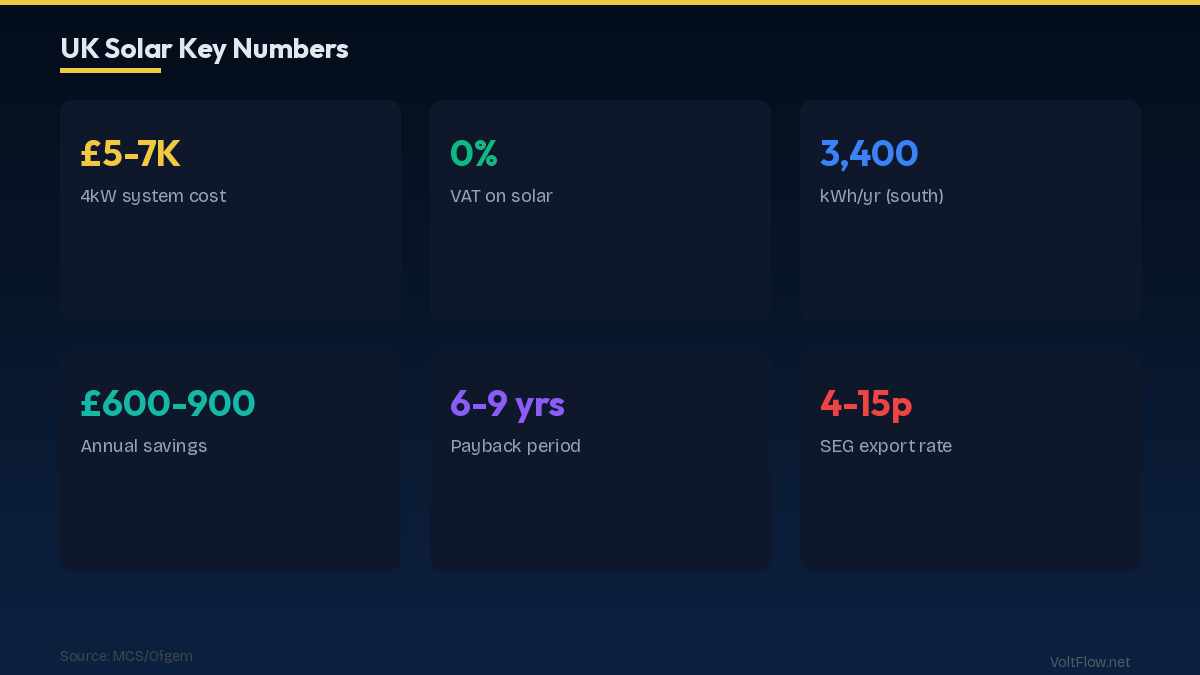
A 4kW solar system in the UK costs £5,000-8,000 installed in 2026 and generates 3,000-3,800 kWh/year depending on location. With electricity at 24.5p/kWh, annual savings are £600-900. Payback: 6-9 years. Then 15+ years of near-free electricity.
Solar Panel Costs in the UK 2026
3kW system: £4,000-5,500. Suits small homes (1-2 people) with low daytime usage. 8-10 panels. Generates 2,500-2,900 kWh/year. 4kW system: £5,000-7,000. Most popular residential size. 10-12 panels. Generates 3,000-3,800 kWh/year. Covers 40-60% of typical household consumption. 5-6kW system: £6,500-9,000. For larger homes, EV owners, or heat pump households. 14-18 panels. Generates 4,000-5,500 kWh/year. Price includes: Panels, inverter, mounting, installation, scaffolding, DNOP notification, and MCS certification. VAT: Solar installations on residential properties are VAT-free (0% rate extended), saving an additional 20% compared to standard-rate goods. Quality tiers: Budget (£5,000-5,500 for 4kW) uses tier-2 panels and string inverters. Premium (£6,500-8,000) uses high-efficiency panels (SunPower, REC) and microinverters or optimizers. The premium tier produces 5-10% more energy annually and comes with stronger warranties.
How Much Energy Do Solar Panels Produce in the UK?
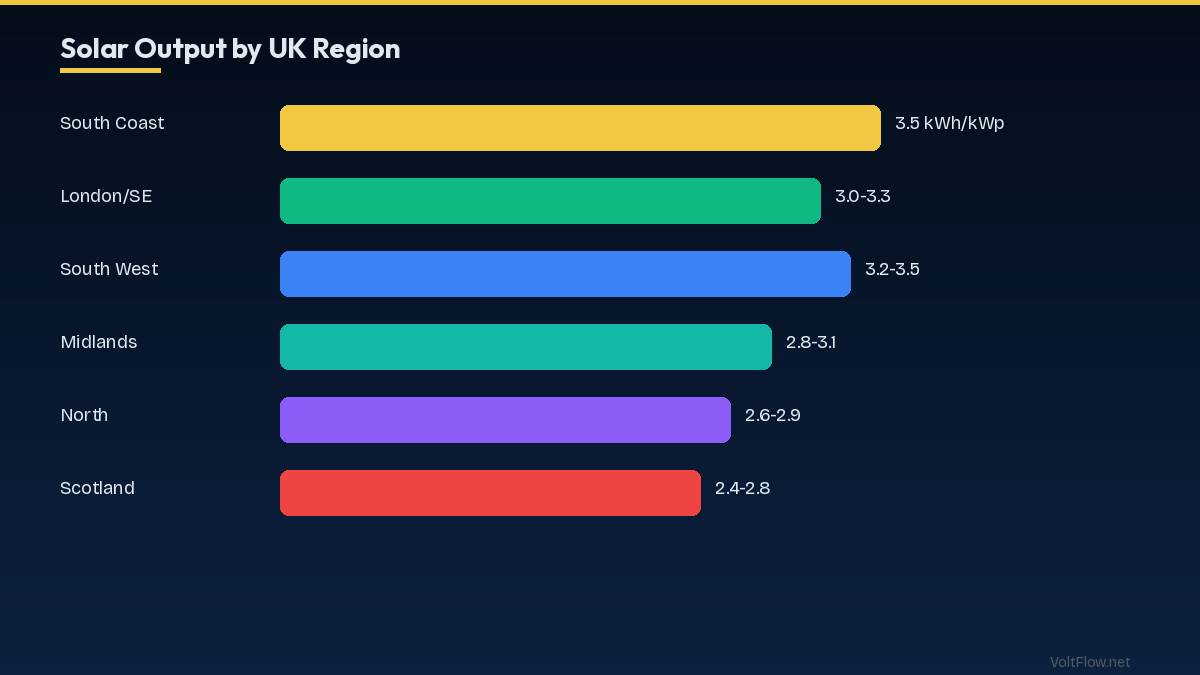
UK solar output varies significantly by region. Southern England (London, Brighton, Southampton): 3.2-3.5 kWh/kWp/day (1,150-1,280 kWh/kWp/year). A 4kW system produces 3,400-3,800 kWh/year. Midlands (Birmingham, Nottingham): 2.9-3.2 kWh/kWp/day (1,050-1,170 kWh/year per kWp). A 4kW system produces 3,000-3,400 kWh/year. Northern England (Manchester, Leeds): 2.7-3.0 kWh/kWp/day. 4kW produces 2,800-3,200 kWh/year. Scotland: 2.4-2.8 kWh/kWp/day. 4kW produces 2,500-2,900 kWh/year. Lower irradiance but longer summer days partially compensate. Seasonal pattern: May-August: 4-5 kWh/kWp/day (70% of annual generation). November-January: 0.5-1.2 kWh/kWp/day. The UK solar year is heavily front-loaded to summer. Orientation impact: South-facing roof at 30-40° tilt = 100% of optimal output. East/west facing = 85-90%. North-facing = 50-60% (generally not recommended). Flat roof with tilt frame = 90-95%.
Financial Analysis: Savings, SEG, and Payback
Self-consumption savings: Every kWh you use from solar instead of buying from the grid saves 24.5p. If you self-consume 50% of 3,400 kWh: 1,700 × 24.5p = £417/year saved. Smart Export Guarantee (SEG): You earn money for every kWh exported to the grid. Rates in 2026: 4-15p/kWh depending on supplier. Octopus Energy typically offers the best rates (12-15p). For 1,700 kWh exported at 12p: £204/year earned. Total annual benefit: £621/year (self-consumption + SEG). On a £6,000 system, payback: 9.7 years. How to improve payback: Increase self-consumption to 70% using timers, battery, or running appliances during solar hours. At 70% self-consumption: £583 saved + £122 SEG = £705/year, payback 8.5 years. With a battery (storing solar for evening use, shifting to 85% self-consumption): £730-850/year total, payback 7-8 years (including battery cost). Electricity price escalation: If rates increase 5% annually (conservative), your Year 10 savings are £1,000+ because you're avoiding increasingly expensive grid power. 25-year total savings: £15,000-25,000 on a £6,000 investment.
Battery Storage: Worth Adding in the UK?
A 5-10 kWh battery costs £4,000-8,000 installed in the UK. GivEnergy 5.2kWh: £4,000-5,000. Popular, well-supported, good app. Tesla Powerwall 2 13.5kWh: £8,000-10,000. Premium with excellent VPP integration. SolarEdge Energy Bank: £5,000-7,000. Good integration with SolarEdge inverters. Financial case: Without battery, you export 50% of solar at 12p. With battery, you use that energy at 24.5p — saving an additional 12.5p per kWh stored and used. For 5 kWh/day shifted: 5 × 12.5p × 365 = £228/year additional savings. Battery payback: £5,000 ÷ £228 = 22 years on self-consumption alone. Improving battery economics: Octopus Intelligent Go + battery: charge battery from grid at 7.5p overnight, use during 24.5p daytime. Saving: 17p × 5kWh × 365 = £310/year from tariff arbitrage alone. Combined with solar shifting: £500-600/year total. Payback: 8-10 years. Conclusion: Batteries are not yet a slam-dunk in the UK purely on economics. They make sense for: energy independence, blackout protection, Octopus Agile/Go users, and households wanting to maximize self-sufficiency.
How to Get Solar Installed in the UK
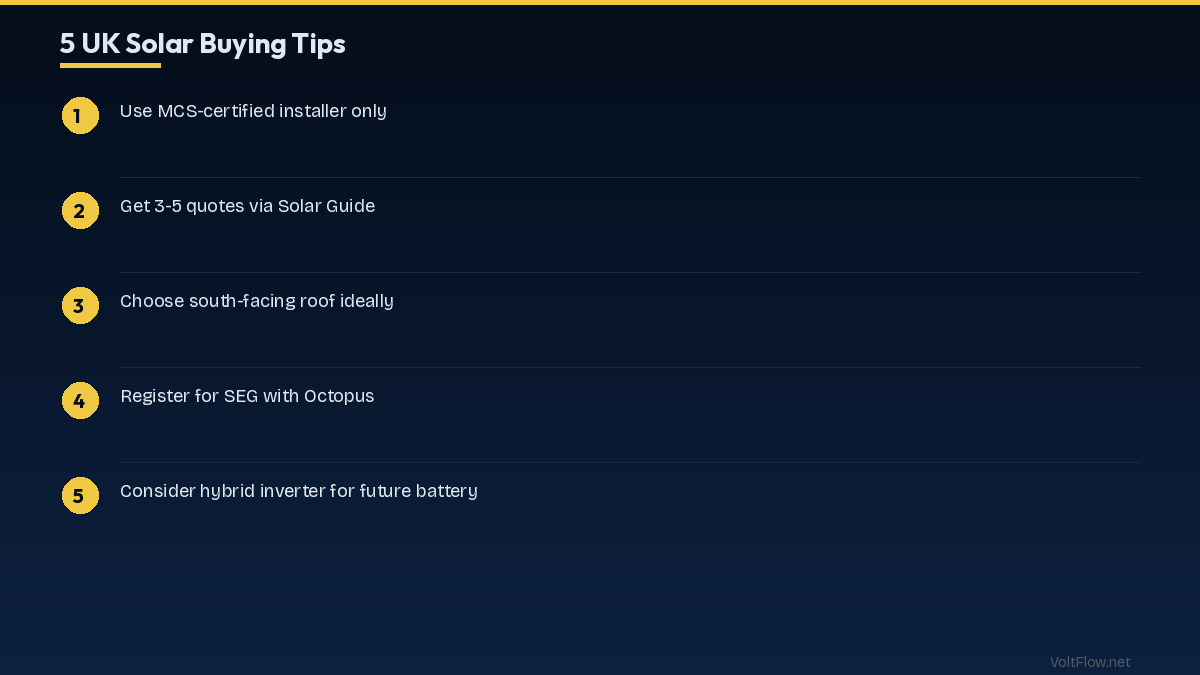
Step 1: Get 3-5 quotes. Use MCS-certified installers only (mandatory for SEG eligibility). Comparison platforms: Solar Guide, Checkatrade, MyBuilder. Avoid door-to-door sales — they typically charge 30-50% more. Step 2: Check your roof. South-facing roof with 30-40° pitch is ideal. Minimum 15-20m² of unshaded roof space for a 4kW system. Your installer will assess structural integrity, shading, and orientation. Step 3: DNOP notification. Your installer notifies your Distribution Network Operator (DNO) before installation. For systems under 3.68kW, this is a simple notification. Above 3.68kW, the DNO may impose export limitations. Step 4: Installation. Typically 1-2 days. Scaffolding goes up day before. Panels, inverter, and wiring installed. System commissioned and tested. Handover with MCS certificate. Step 5: Register for SEG. Your installer provides the MCS certificate. Register with your chosen SEG supplier (doesn't have to be your electricity supplier). Octopus Energy typically offers the best export rates. Step 6: Monitor and optimize. Use your inverter app (GivEnergy, SolarEdge, Enphase) to track generation and consumption. Adjust usage patterns to maximize self-consumption. Planning permission: Solar panels on residential roofs are usually Permitted Development — no planning needed. Exceptions: listed buildings, conservation areas, and panels that protrude more than 200mm from the roof plane.
Frequently Asked Questions
Are solar panels worth it in the UK in 2026?
Yes. A 4kW system costs £5,000-7,000 and saves £600-900/year. Payback is 6-9 years, then you get 15+ years of near-free electricity. 25-year total savings: £15,000-25,000.
How much do solar panels cost in the UK?
A 4kW system costs £5,000-7,000 installed (0% VAT for residential). A 3kW costs £4,000-5,500. A 6kW costs £6,500-9,000. Prices include panels, inverter, installation, and MCS certification.
How much does solar generate in the UK?
A 4kW system generates 3,000-3,800 kWh/year depending on location. Southern England produces most (1,150-1,280 kWh/kWp), Scotland least (900-1,050 kWh/kWp).
What is the Smart Export Guarantee?
SEG pays you for electricity exported to the grid from your solar panels. Rates range from 4-15p/kWh depending on supplier. Octopus Energy typically offers the best rates at 12-15p/kWh.
Do I need planning permission for solar panels in the UK?
Usually no. Solar panels on residential roofs are Permitted Development. Exceptions apply for listed buildings, conservation areas, and panels protruding more than 200mm from the roof.