Battery Storage UK 2026 — Cost, Best Systems & Is It Worth It?
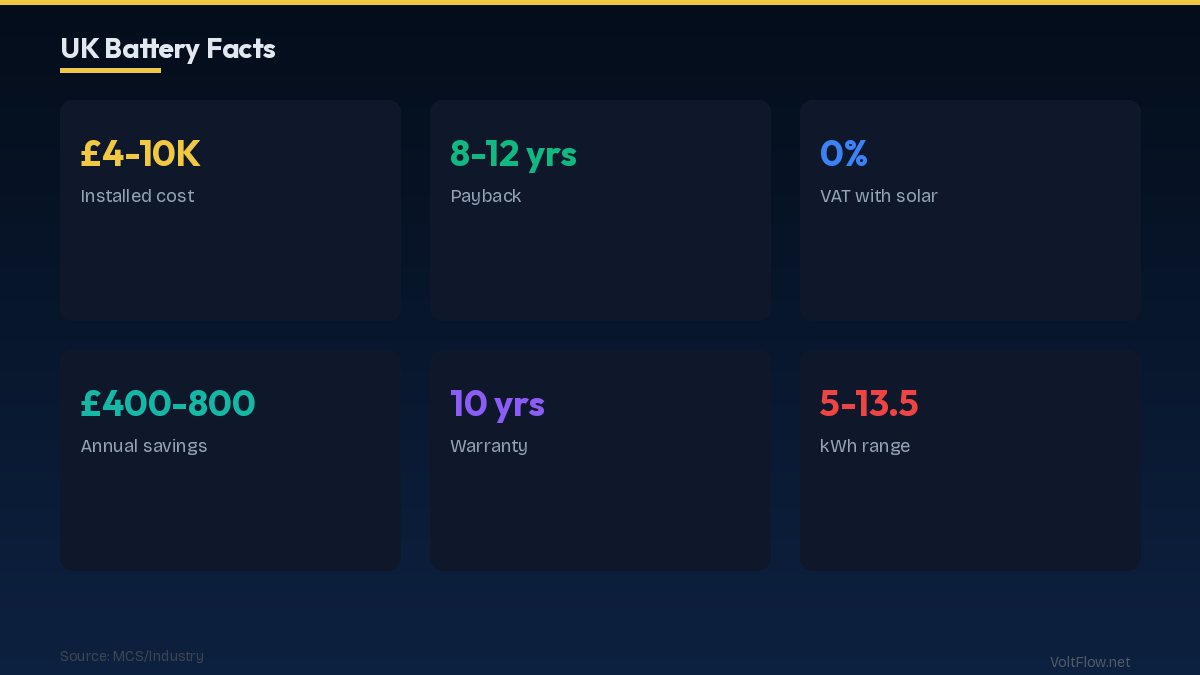
Home battery storage in the UK costs £4,000-10,000 installed in 2026. Combined with solar panels and smart tariffs, batteries can save £400-800/year. Payback: 8-12 years. Best value with Octopus Agile or Intelligent Go tariffs.

Battery Costs and Popular Systems
GivEnergy 5.2kWh (£4,000-5,500 installed): The UK's most popular home battery. Excellent app and monitoring. Compatible with GivEnergy hybrid inverters. Expandable — add modules later. 10-year warranty, 6,000 cycles. Tesla Powerwall 2 (13.5kWh, £8,000-10,500 installed): Premium option with the largest capacity in a single unit. Excellent app, Storm Watch feature, VPP-ready. 10-year warranty. Best for larger homes and maximum self-sufficiency. SolarEdge Energy Bank (4.6-9.2kWh, £4,500-7,500): Integrates seamlessly with SolarEdge optimized solar systems. Modular. Good for existing SolarEdge installations. Pylontech US5000 (4.8kWh, £3,000-4,000): Budget-friendly lithium iron phosphate (LFP) battery. Very long cycle life (6,000+). Often paired with Solis or SolaX hybrid inverters. Fox ESS (various sizes, £3,500-7,000): Growing in popularity. Good value, decent app. VAT: Batteries installed with or within 5 years of a solar system are 0% VAT. Standalone battery (no solar): standard 20% VAT applies.
Financial Analysis: Do Batteries Pay for Themselves?
Scenario 1: Solar + battery, flat tariff (24.5p): Battery stores 5 kWh/day of excess solar (worth 5-8p export) and uses it during evening (worth 24.5p). Daily saving: 5 × (24.5p - 6p) = 93p = £339/year. On a £5,000 battery: payback 14.7 years. Not great. Scenario 2: Solar + battery, Octopus Agile: Export during expensive evening windows (20-40p) + import during cheap periods (5-10p). Battery arbitrage value: £1-3/day depending on price swings. Annual value: £500-800. Payback: 6-10 years. Much better. Scenario 3: No solar, battery only, Octopus Go: Charge at 7.5p (12:30-4:30 AM). Use during day at 24.5p equivalent. 5 kWh shifted: 5 × 17p = 85p/day = £310/year. On a £5,000 battery: payback 16 years. Not worthwhile without solar. Best case: Solar + battery + Agile + EV: Combined optimization: £600-1,000/year total battery + solar + EV value. Payback on battery: 5-8 years. Conclusion: Batteries make financial sense in the UK primarily when combined with solar AND a smart TOU tariff. Without both, payback exceeds the warranty period.
Smart Tariff Optimization: Where Batteries Shine
Octopus Agile + battery: Agile prices change every 30 minutes. A battery allows you to: charge during negative or very low price periods (sometimes you're paid 5-10p/kWh to charge), store energy for use during expensive windows (35-60p/kWh evenings), and export solar/battery during peak prices for maximum SEG value. GivEnergy and Tesla batteries integrate with Agile pricing via Octopus API. Octopus Intelligent Go + battery: Not officially supported (Intelligent Go is designed for EVs), but some users pair a battery for whole-home optimization. The battery charges at 7.5p alongside the EV. Grid services and VPPs: Tesla Powerwall owners can join Tesla Energy's grid services program — earning payments for allowing grid operators to use their battery during demand peaks. Payments: £50-200/year depending on events and battery size. Social Energy, Octopus's Kraken platform, and National Grid ESO are all developing residential battery aggregation programs.
Installation and Technical Considerations
Indoor vs outdoor: Most UK batteries (GivEnergy, Pylontech, Fox ESS) are designed for indoor installation — garage, utility room, or under-stairs cupboard. Temperature range: 0-45°C. Tesla Powerwall is rated for outdoor installation (IP67 waterproof). Hybrid inverter required: A battery needs a hybrid inverter that manages solar generation, battery charging/discharging, and grid import/export. If adding a battery to an existing solar system with a standard (non-hybrid) inverter, you need either: an AC-coupled battery with its own inverter (e.g., Tesla Powerwall, Enphase), or replace your solar inverter with a hybrid model (GivEnergy, SolarEdge, SolaX). Retrofit vs new install: Adding a battery to existing solar: £4,500-8,000 (includes new hybrid inverter if needed). Battery installed with new solar: £3,000-6,000 additional (shared labour and inverter cost). MCS certification: Required for SEG eligibility. Your installer must be MCS-certified and register the battery system. Planning permission: Not required for batteries within the building. External battery housings may need planning approval in conservation areas.
Future-Proofing: Why Battery Economics Will Improve
Falling battery prices: UK home battery prices have dropped 30-40% since 2020 and continue declining 8-15% annually. A battery that costs £5,000 today cost £8,000 three years ago. By 2028, expect prices of £3,000-4,000 for a 5kWh system — making payback significantly shorter. Rising electricity prices: If electricity increases to 30p/kWh (plausible by 2028), the value of stored energy increases proportionally. Every 1p/kWh increase adds £18-25/year in battery savings. Vehicle-to-home (V2H): Some EVs (Nissan Leaf, MG ZS EV, upcoming models) can power your home from their battery via a bi-directional charger. A 60 kWh EV battery dwarfs any home battery. V2H effectively gives you free home battery storage worth £10,000+. As V2H chargers become available (Wallbox Quasar 2, Indra Smart PRO), home batteries may become unnecessary for EV owners. Grid flexibility payments: As the UK grid integrates more renewables (target: 100% clean power by 2035), grid balancing services will pay increasing premiums for flexible home batteries. Current payments are modest (£50-200/year) but expected to grow significantly.
Frequently Asked Questions
Common question about Battery Storage UK 2026?
See the detailed section on Battery Costs and Popular Systems above for comprehensive information.
Common question about Battery Storage UK 2026?
See the detailed section on Financial Analysis: Do Batteries Pay for Themselves? above for comprehensive information.
Common question about Battery Storage UK 2026?
See the detailed section on Smart Tariff Optimization: Where Batteries Shine above for comprehensive information.
Common question about Battery Storage UK 2026?
See the detailed section on Installation and Technical Considerations above for comprehensive information.
Common question about Battery Storage UK 2026?
See the detailed section on Future-Proofing: Why Battery Economics Will Improve above for comprehensive information.