Solar Panel Output UK by Region 2026 — kWh by Location
UK solar output ranges from 2.4 to 3.5 kWh per kWp per day depending on region. Southern England leads with 1,150-1,280 kWh/kWp/year, while Scotland averages 900-1,050 kWh. A 4kW system in London produces ~4,600 kWh/year, saving £900+ annually.

Solar Output by Region: Annual and Daily Averages
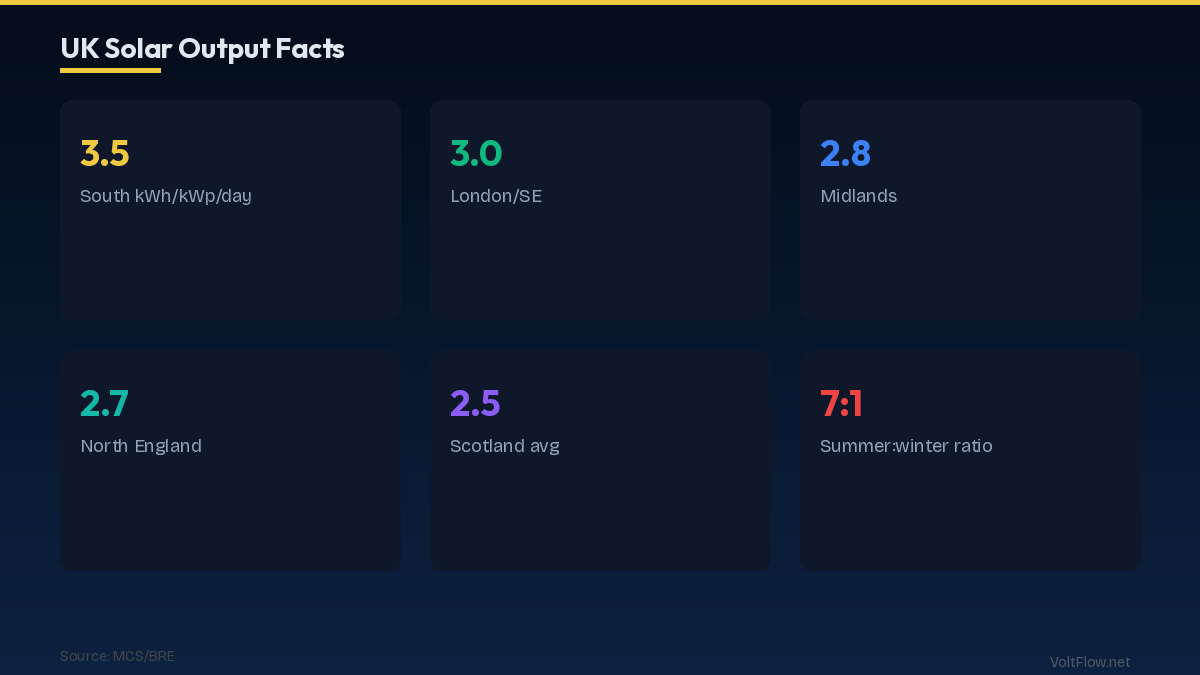
South Coast and Channel Islands: 3.3-3.5 kWh/kWp/day (1,200-1,280 kWh/year per kWp). Best UK solar resource. Bournemouth, Brighton, Southampton, Isle of Wight. A 4kW system: 4,800-5,120 kWh/year. London and South East: 3.0-3.3 kWh/kWp/day (1,100-1,200 kWh/year). London, Canterbury, Oxford, Reading. A 4kW system: 4,400-4,800 kWh/year. South West: 3.2-3.5 kWh/kWp/day (1,170-1,280 kWh/year). Cornwall, Devon, Bristol, Bath. Excellent solar resource despite being further west. A 4kW system: 4,680-5,120 kWh/year. Midlands: 2.8-3.1 kWh/kWp/day (1,020-1,130 kWh/year). Birmingham, Nottingham, Leicester. A 4kW system: 4,080-4,520 kWh/year. North England: 2.6-2.9 kWh/kWp/day (950-1,060 kWh/year). Manchester, Leeds, Newcastle. A 4kW system: 3,800-4,240 kWh/year. Scotland: 2.4-2.8 kWh/kWp/day (880-1,020 kWh/year). Edinburgh: 2.7. Glasgow: 2.5. Inverness: 2.4. A 4kW system in Edinburgh: 3,520-4,080 kWh/year. Wales: 2.7-3.1 kWh/kWp/day. Cardiff: 3.0. Swansea: 2.9. Snowdonia: 2.6.
Seasonal Variation: Summer Abundance, Winter Scarcity
The UK has extreme seasonal variation in solar output — more so than most countries at this latitude due to cloud cover and short winter days. Southern England seasonal pattern: June: 5.0-5.5 kWh/kWp/day (16+ hours daylight). December: 0.5-0.8 kWh/kWp/day (8 hours daylight, low sun angle, frequent cloud). Ratio: approximately 7:1 summer to winter. Scotland seasonal pattern: June: 4.0-4.5 kWh/kWp/day (18+ hours daylight — longer days partially compensate for lower irradiance). December: 0.3-0.5 kWh/kWp/day (6-7 hours daylight). Ratio: approximately 10:1. Practical implications: May-August produces 55-65% of annual generation. November-February produces only 8-12%. In winter, a 4kW system may only generate 2-5 kWh/day — barely enough to cover daytime standby loads. This is why batteries and winter tariff strategies are important. Monthly breakdown for 4kW in London: Jan: 120 kWh. Feb: 180. Mar: 330. Apr: 450. May: 530. Jun: 550. Jul: 540. Aug: 480. Sep: 370. Oct: 230. Nov: 130. Dec: 90. Total: ~4,000 kWh/year.
Factors Affecting Your Specific Output
Roof orientation: South-facing at 30-40° tilt: 100% of optimal output. South-east or south-west: 95%. East or west: 85-90%. North-east or north-west: 65-75%. North: 55-60% (generally not recommended). Tilt angle: Optimal for annual production: 30-40° (most UK roof pitches are 30-35°, conveniently close to optimal). Flat roof with tilt frame: 90-95% of optimal. Vertical (wall-mounted): 65-70% annual but relatively better in winter. Shading: Even partial shading dramatically reduces output. A shadow on one panel can reduce an entire string's production by 20-40%. Trees, chimneys, neighbouring buildings, and satellite dishes are common shade sources. Solutions: microinverters (£500-1,000 premium) or DC optimizers allow each panel to operate independently, minimizing shading impact on the overall system. Panel technology: Standard efficiency panels (20-21%): adequate for most installations. High-efficiency panels (22-23%): produce 5-10% more per square metre. Worth it when roof space is limited. Bifacial panels: capture reflected light on the rear side, adding 5-15% output on light-colored surfaces or flat-roof installations.
Is Solar Worth It in Northern England and Scotland?
Short answer: yes. While output is 15-25% less than southern England, the economics still work well. Edinburgh example (4kW system): Annual output: ~3,800 kWh. Self-consumption (50%): 1,900 × 24.5p = £466 saved. SEG export (50%): 1,900 × 12p = £228 earned. Total annual benefit: £694. System cost: £5,500. Payback: 7.9 years. Compare to London (4kW): Annual benefit: £815. Payback: 7.4 years. The difference is only 0.5 years — hardly significant over a 25-year panel life. Scotland has additional advantages: Home Energy Scotland offers 0% interest loans up to £7,500 for solar (+ £6,000 for battery). This makes solar cash-flow positive from day one — monthly loan repayment is less than monthly savings. Longer summer days (18+ hours in June vs 16 in southern England) produce surprising peak output. Less summer overheating (panels are more efficient in cooler temperatures). Northern England: Similar economics to Scotland with strong returns, especially for homes with higher-than-average consumption (EV owners, heat pump users, home workers).
Maximizing Output: Tips for Any UK Location
1. Choose the right system size. Match your system to your annual consumption for best self-consumption ratio. Over-sizing leads to more export at lower SEG rates. A 4kW system suits the average household; 5-6kW for EV owners or heat pump homes. 2. Optimize self-consumption. Run appliances during solar hours (10 AM - 3 PM). Use timers for dishwashers, washing machines, and immersion heaters. A solar diverter for hot water captures surplus that would otherwise be exported. Target 50-70% self-consumption for best economics. 3. Consider a battery. In the UK, a battery shifts solar from daytime surplus to evening use, converting 6-12p export into 24.5p self-consumption. Best paired with a smart TOU tariff for maximum value. 4. Monitor and maintain. Use your inverter app to track daily, monthly, and annual output. Compare against expected values — a sudden drop may indicate a panel fault, inverter issue, or new shading (tree growth). Clean panels annually if they're accessible (UK rain usually handles most cleaning, but bird droppings and lichen can accumulate). 5. Plan for the future. Install a hybrid inverter now even if you don't add a battery immediately. Run conduit for future EV charger cable if building or renovating. Future-proofing saves thousands in later modification costs.

Frequently Asked Questions
Common question about Solar Panel Output UK by Region 2026?
See the detailed section on Solar Output by Region: Annual and Daily Averages above for comprehensive information.
Common question about Solar Panel Output UK by Region 2026?
See the detailed section on Seasonal Variation: Summer Abundance, Winter Scarcity above for comprehensive information.
Common question about Solar Panel Output UK by Region 2026?
See the detailed section on Factors Affecting Your Specific Output above for comprehensive information.
Common question about Solar Panel Output UK by Region 2026?
See the detailed section on Is Solar Worth It in Northern England and Scotland? above for comprehensive information.
Common question about Solar Panel Output UK by Region 2026?
See the detailed section on Maximizing Output: Tips for Any UK Location above for comprehensive information.