How Much Does It Cost to Run a Space Heater? — 2026 Guide
A standard 1500W space heater costs about $0.20 per hour to run at the US average electricity rate of 16¢/kWh. Running it 8 hours daily costs $1.60/day or $48/month. At 24 hours daily, it hits $4.80/day or $144/month. Your actual cost depends on your state's electricity rate, heater wattage, and daily usage hours.
Space Heater Cost Per Hour: The Simple Math
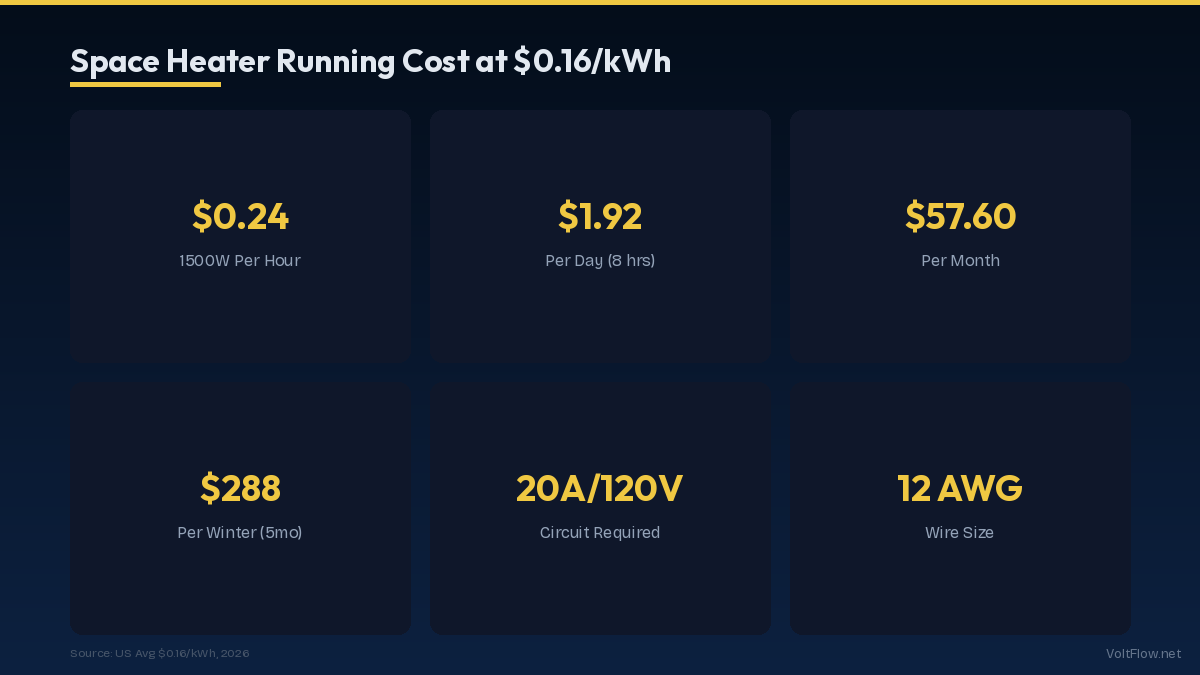
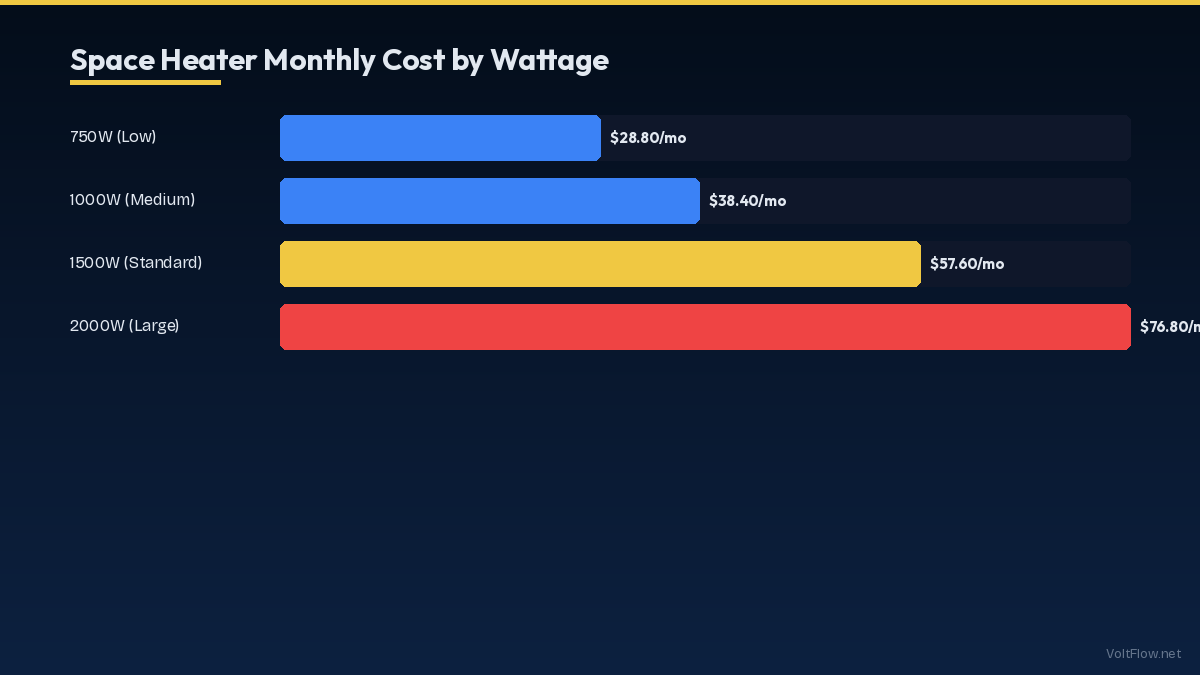
The cost formula is straightforward: Cost = (Watts ÷ 1000) × Rate × Hours. A 1500W heater running for 1 hour uses 1.5 kWh of electricity. At the US average rate of approximately 16¢/kWh, that's $0.24 per hour. But rates vary dramatically by state. Cheap electricity states (8-12¢/kWh): Louisiana: 1500W heater costs $0.12-0.14/hour. Idaho: $0.12/hour. Washington: $0.11/hour. Oklahoma: $0.13/hour. Expensive electricity states (20-35¢/kWh): California: $0.38-0.53/hour (tiered rates). Connecticut: $0.33/hour. Massachusetts: $0.35/hour. Hawaii: $0.50/hour. New York: $0.30/hour. The range is massive: Running the same 1500W heater for 8 hours costs $0.88 in Washington but $4.24 in Hawaii — nearly 5x difference. This is why knowing your local rate matters more than any national average. Check your electricity bill for your exact ¢/kWh rate, or look up your state rate on our Electricity Cost Calculator. Different wattage heaters: Not all space heaters are 1500W. Small personal ceramic heaters run 250-750W. Medium radiant heaters run 750-1000W. Large room heaters run 1000-1500W. Oil-filled radiators run 600-1500W with thermostatic cycling. The cost scales linearly with wattage — a 750W heater costs exactly half as much to run as a 1500W heater.
Monthly Cost by Usage: Real-World Scenarios
Most people don't run a space heater 24/7. Here are realistic monthly costs for different usage patterns at the US average rate of 16¢/kWh. Light use (4 hours/day, morning warmup): 1500W: 6 kWh/day × 30 days = 180 kWh/month × $0.16 = $28.80/month. 750W: 3 kWh/day × 30 = 90 kWh × $0.16 = $14.40/month. Moderate use (8 hours/day, evening heating): 1500W: 12 kWh/day × 30 = 360 kWh × $0.16 = $57.60/month. 750W: 6 kWh/day × 30 = 180 kWh × $0.16 = $28.80/month. Heavy use (12 hours/day, work from home): 1500W: 18 kWh/day × 30 = 540 kWh × $0.16 = $86.40/month. Continuous (24/7 operation): 1500W: 36 kWh/day × 30 = 1,080 kWh × $0.16 = $172.80/month. Reality check: That continuous 1500W operation adds more to your electric bill than most central heating systems cost in gas. Space heaters are efficient for heating ONE room but extremely expensive for heating an entire home. If you find yourself running multiple space heaters simultaneously, central heating (even electric) is almost always cheaper because it is designed for whole-house efficiency. Thermostat-equipped heaters save 30-50%: Oil-filled radiators and ceramic heaters with built-in thermostats cycle on and off to maintain temperature. Instead of running at full 1500W continuously, they average 800-1000W effective consumption. This cuts costs by 30-50% compared to a heater without a thermostat.
Space Heater vs Central Heating: Which Is Cheaper?
The answer depends on how many rooms you are heating. Heating one room: space heater wins. A 1500W space heater heating a single 150-square-foot room costs $0.24/hour. Running a gas furnace for the whole house costs $1.50-3.00/hour (depending on furnace efficiency, gas price, and home size) but heats every room. If you only need warmth in your office or bedroom, the space heater saves 50-70% compared to running the whole-house system. Heating two or more rooms: central heating wins. Two 1500W space heaters cost $0.48/hour for 3,000W. A gas furnace at $1.50/hour heats 8-10 rooms. Per room, the furnace is far cheaper. The crossover point is typically 2-3 rooms. If you need heat in more than 2 rooms, use central heating and close vents/doors to unneeded rooms. Electric central heating comparison: If your central heat is electric (heat pump, baseboard, electric furnace), the calculus changes. A heat pump produces 2.5-4 kWh of heat per 1 kWh electricity (COP 2.5-4.0), making it 2.5-4x more efficient than a space heater. Even electric baseboard heating is comparably priced to space heaters but distributes heat more evenly. Best strategy: Use your central heating at a lower temperature (65-67°F) and boost the room you are in with a space heater to 70-72°F. This hybrid approach typically saves 10-25% compared to heating the whole house to 72°F. Never use a space heater as primary heating for a whole home — it is the most expensive way to heat and creates fire risk from overloaded circuits.
Most Efficient Space Heaters by Type
All electric space heaters convert electricity to heat at 100% efficiency — a 1500W heater produces 5,118 BTU regardless of type. The difference is HOW they deliver that heat and how comfortable the room feels. Ceramic heaters ($30-80): Fast heating, fan-forced convection. Best for quick warmup of small rooms. Noisy (fan). Tip-over and overheat protection standard. Good for offices and bedrooms when you want fast heat. Examples: Lasko, Honeywell, De'Longhi. Oil-filled radiators ($50-120): Slow, gentle radiant heat. Silent operation — no fan. Built-in thermostat cycles on/off (saves 30-50% over constant heaters). Best for bedrooms and living rooms where noise matters. Retain heat for 20-30 minutes after turning off. Examples: De'Longhi, Pelonis, COSTWAY. Infrared heaters ($60-200): Heat objects and people directly (like sunlight), not the air. Instant warmth in the heater's line of sight. Efficient for spot heating — you feel warm even in a cold room. Best for garages, workshops, and large rooms. Examples: Dr. Infrared, Heat Storm, Duraflame. Micathermic panel heaters ($80-150): Combine convection and radiant heating. Thin, wall-mountable design. Quick warmup, even heat distribution. Best for living rooms and spaces where aesthetics matter. Mica heaters are underrated — they combine the best qualities of ceramic and oil-filled heaters. Fan heaters ($15-40): Cheapest to buy, basic forced-air heating. Very fast warmup but noisy and dries the air. Good for temporary use, not recommended for extended daily heating. For cost efficiency: An oil-filled radiator with a programmable thermostat is typically the cheapest to operate over a full winter because the thermostat prevents continuous full-power operation.
Safety: NEC Requirements and Fire Prevention
Space heaters cause approximately 25,000 house fires per year in the United States, according to the NFPA. Most are caused by placing the heater too close to combustible materials or using improper electrical connections. NEC circuit requirements: A 1500W/120V heater draws 12.5A. On a 15A circuit (1,800W maximum), the heater consumes 83% of the circuit capacity — leaving only 300W for other devices. If you plug in a lamp (100W) and a laptop charger (65W), you are at 1,665W (92%) with no margin. Use a 20A circuit for space heaters whenever possible. A 20A/120V circuit supports 2,400W continuous, giving comfortable headroom. Never use extension cords with space heaters. Standard extension cords are rated for 10-13A and overheat at 12.5A sustained. If you must extend the heater's reach, use a heavy-duty 12 AWG extension cord rated for 20A — and keep it as short as possible. GFCI protection: NEC requires GFCI protection for outlets in bathrooms, kitchens, and garages. A 1500W heater will occasionally trip a GFCI — this is not a malfunction. If it trips frequently, it may indicate a ground fault in the heater. 3-foot clearance rule: Maintain 3 feet of clear space between the heater and any combustible material — curtains, bedding, furniture, paper, clothing. Never leave unattended or run while sleeping without an automatic shutoff timer. Modern heaters with tip-over switches, overheat protection, and timers are significantly safer than older models.
State-by-State Cost Comparison and Saving Tips
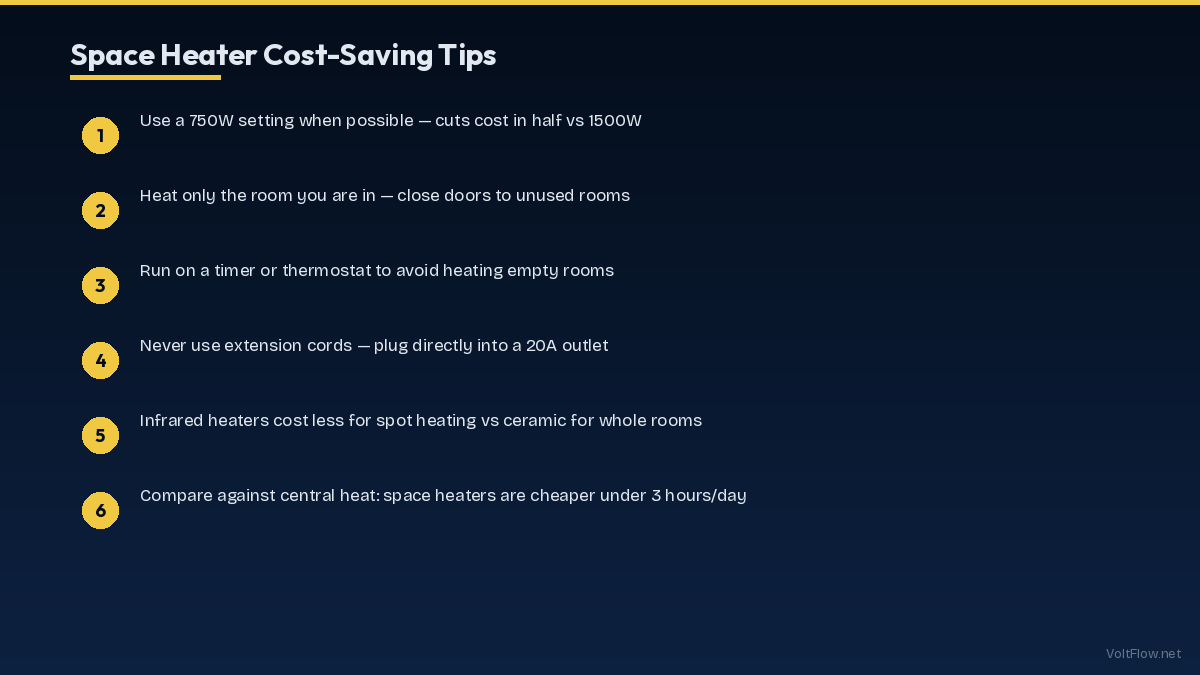
Your electricity rate determines whether a space heater is affordable or budget-breaking. Here are monthly costs for a 1500W heater at 8 hours/day by state. Cheapest states (under $40/month): Idaho: $31/month (10.4¢). Washington: $32/month (10.6¢). Utah: $33/month (10.9¢). Oklahoma: $34/month (11.3¢). Louisiana: $35/month (11.5¢). Average states ($40-60/month): Texas: $44/month (14.5¢). Florida: $46/month (15.4¢). Ohio: $48/month (15.9¢). Michigan: $56/month (18.5¢). Most expensive states ($60-100+/month): New York: $70/month (23.4¢). Massachusetts: $85/month (28.2¢). California: $96/month (32.0¢, varies by tier). Connecticut: $99/month (33.1¢). Hawaii: $131/month (43.6¢). 5 tips to reduce space heater costs: 1. Use a heater with a programmable thermostat (saves 30-50%). 2. Close the door to the room being heated (prevents heat escape). 3. Use a lower wattage heater for small rooms (750W for under 100 sq ft). 4. Layer clothing and use a blanket before turning up the heater. 5. Seal windows with plastic film insulation ($5 per window, saves 10-15% heat loss). The best money-saving approach: An oil-filled radiator set to 68°F in a closed room with sealed windows costs roughly 40-60% less than a ceramic heater running at full blast in an open room. Comfort and cost are about smart setup, not just the heater itself.
Frequently Asked Questions
How much does it cost to run a 1500 watt space heater for 24 hours?
At the US average of 16¢/kWh: 1.5 kW × 24 hours × $0.16 = $5.76 per day. Monthly at 24/7: $172.80. Costs vary from $2.64/day in cheap states to $15.70/day in Hawaii.
Is it cheaper to run a space heater or central heat?
A space heater is cheaper for heating 1 room. Central heating is cheaper for 2+ rooms. The crossover is typically 2-3 rooms. A heat pump is 2.5-4x more efficient than any space heater.
What size space heater do I need for my room?
Rule of thumb: 10 watts per square foot. A 150 sq ft room needs 1,500W. A 100 sq ft room needs 1,000W. A small office needs 500-750W. Oversizing wastes electricity.
Can a space heater increase my electric bill by $100?
Yes. A 1500W heater running 8 hours/day adds $48-100/month depending on your electricity rate. In expensive states like California or Connecticut, 12+ hours daily can add $100-150.
Are oil-filled heaters cheaper to run than ceramic heaters?
Both use the same electricity at full power (1500W = 1500W). However, oil-filled radiators with thermostats cycle on/off, averaging 800-1000W effective use — saving 30-50% compared to a ceramic heater running continuously.