Best Time to Run Appliances to Save Electricity 2026: TOU Rate Guide

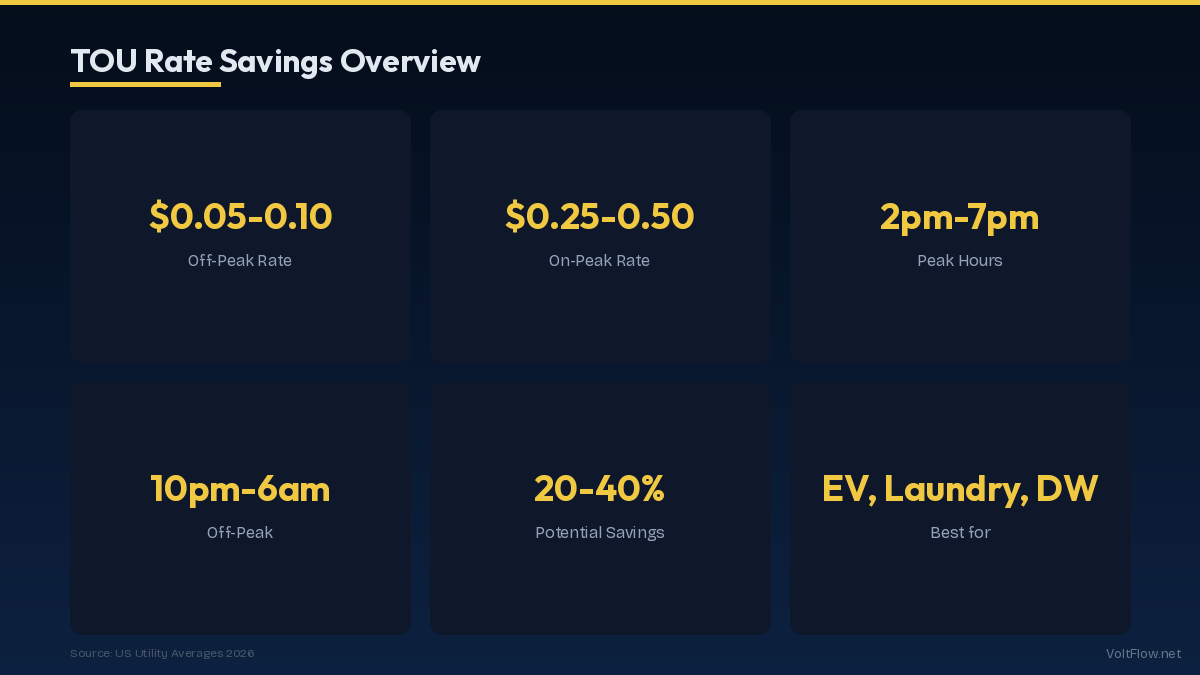
If your utility offers time-of-use rates, running major appliances during off-peak hours (typically 9 PM to 7 AM) can cut your electricity bill by 20-40 percent. The difference between peak and off-peak rates ranges from $0.10 to $0.30 per kWh depending on your utility, meaning a single load of laundry that costs $0.75 during peak hours costs just $0.30 during off-peak. This guide identifies the best and worst times to run every major appliance and calculates your potential annual savings.
Understanding Time-of-Use Electricity Rates
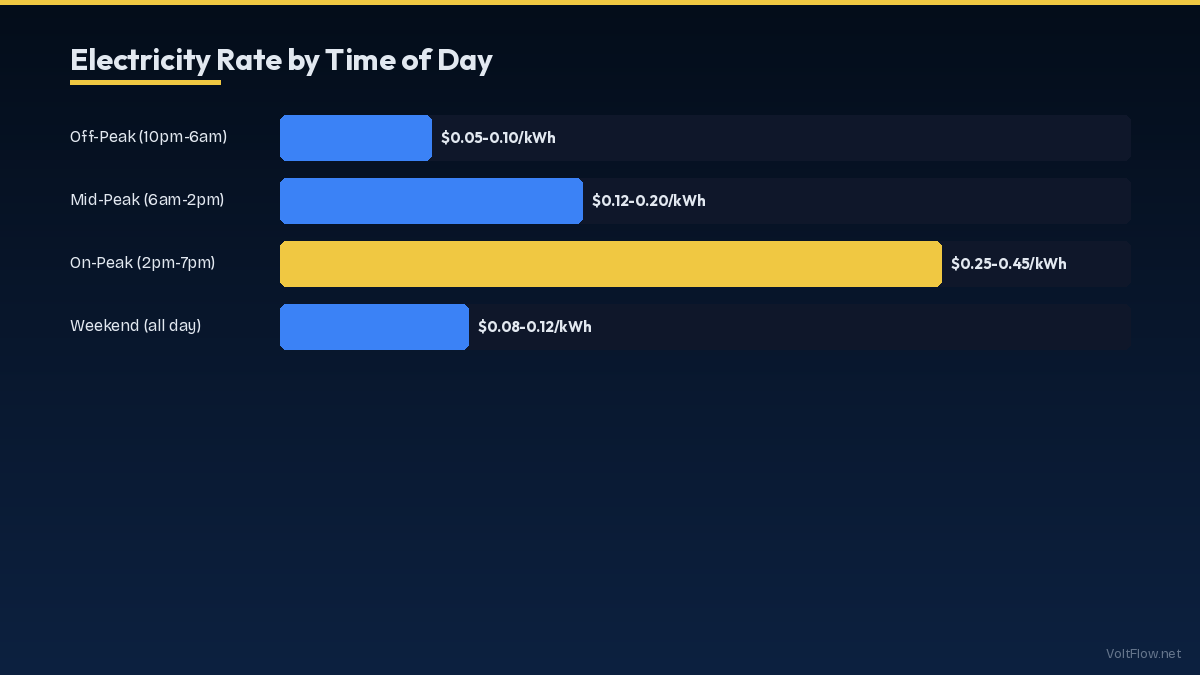
Time-of-use or TOU rate plans charge different prices for electricity depending on when you use it. Utilities implement TOU rates because electricity generation costs vary dramatically throughout the day. During peak demand hours when everyone runs air conditioning and cooks dinner, utilities fire up expensive peaker plants that cost 3-5 times more per kWh to operate than baseload plants. Off-peak rates reflect the lower cost of generation when demand is low and efficient baseload plants handle the load. Most utilities structure TOU rates into two or three time periods. Peak hours typically span 4 PM to 9 PM on weekdays when residential demand surges from people arriving home, cooking, running laundry, and cooling their homes. This period has the highest rates, ranging from $0.25 to $0.55 per kWh depending on the utility and season. Mid-peak or partial-peak hours fill the transition periods, usually 7 AM to 4 PM and 9 PM to 11 PM on weekdays. Rates fall in the middle range at $0.15 to $0.30 per kWh. Off-peak hours cover the overnight period from 11 PM to 7 AM and often all day on weekends and holidays. These hours have the lowest rates at $0.08 to $0.18 per kWh. Some utilities offer super off-peak rates from midnight to 6 AM at even lower prices. The rate difference between peak and off-peak is substantial. Pacific Gas and Electric in California charges approximately $0.45 per kWh during summer peak and $0.17 during off-peak, a $0.28 per kWh difference. Southern California Edison has a similar spread. Con Edison in New York charges $0.30 during peak and $0.12 off-peak. Duke Energy offers $0.22 peak and $0.09 off-peak in some markets. Not all utilities offer TOU rates, and not all customers benefit from switching. TOU plans reward households that can shift significant consumption to off-peak hours. If you work from home and run appliances throughout the day with minimal ability to shift usage, a flat rate plan may cost less overall. Contact your utility to request both flat-rate and TOU rate projections based on your actual usage pattern before switching. Most utilities offer online calculators that analyze your historical consumption and estimate your cost under each available rate plan. The savings potential increases with your total consumption. A household using 2,000 kWh per month with 40 percent shifted to off-peak can save $80-$150 per month on TOU rates compared to flat rates. A household using only 500 kWh has less flexibility and smaller total savings.
Appliance-by-Appliance Scheduling Guide
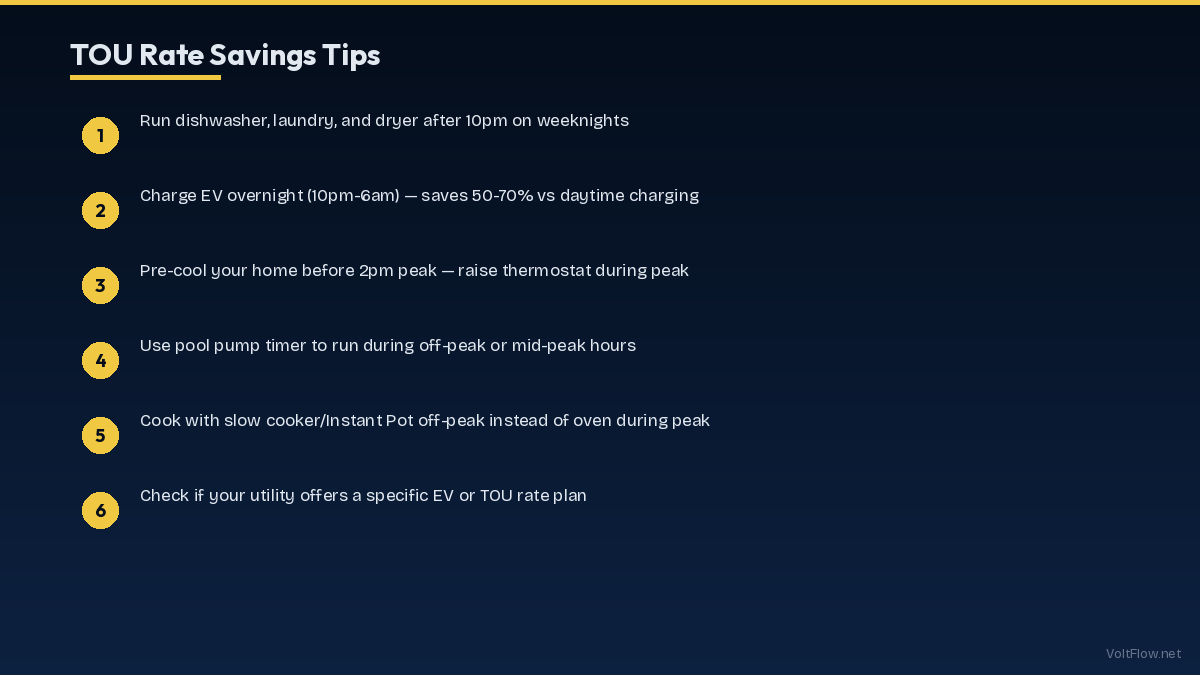
Not all appliances benefit equally from off-peak scheduling. The biggest savings come from shifting your highest-consumption appliances. Here is a ranked list of appliances by annual electricity consumption and TOU savings potential. Your electric dryer is typically the single most expensive appliance to run per cycle. A standard dryer uses 3,000-5,000 watts for 45-60 minutes per load, consuming 2.5-5 kWh per cycle. At peak rates of $0.35 per kWh, each load costs $0.88-$1.75. At off-peak rates of $0.12 per kWh, the same load costs $0.30-$0.60. Shifting 5 dryer loads per week from peak to off-peak saves $150-$300 per year. Schedule your dryer to run after 9 PM or on weekend mornings. Your dishwasher uses 1,200-2,400 watts per cycle for approximately 1.5 hours, consuming 1.8-3.6 kWh. Running the dishwasher at night instead of after dinner saves $50-$100 per year. Most modern dishwashers have delayed-start timers. Load the dishwasher after dinner and set the delay timer to start at 11 PM or later. The washing machine itself uses modest electricity at 400-500 watts per cycle, but the associated dryer load makes laundry a high-savings target. Combined washer and dryer savings from off-peak scheduling reach $200-$350 per year for a typical household. Your electric water heater maintains 40-80 gallons at 120-140 degrees Fahrenheit, cycling on for 3-5 hours per day and consuming 9-15 kWh daily. This is your largest daily electricity consumer. Some water heaters can be placed on a timer to heat water primarily during off-peak hours, relying on tank insulation to maintain temperature through peak hours. A well-insulated tank loses only 1-2 degrees per hour, making this strategy feasible. Savings range from $200-$400 per year. Heat pump water heaters are even more efficient, using one-third the electricity of resistance heaters while producing the same hot water. Your EV charger adds 8-15 kWh per daily charge session at 240 volts. Charging during peak hours at $0.35 per kWh costs $2.80-$5.25 per session. Charging at off-peak rates of $0.12 per kWh costs $0.96-$1.80 per session. Annual savings from off-peak EV charging reach $500-$1,000 for daily commuters. Every EV and most Level 2 chargers support scheduled charging. Pool pumps running 6-10 hours daily consume 8-20 kWh. Shifting pump run time to off-peak hours saves $200-$400 per year, and combining off-peak scheduling with a variable-speed pump maximizes savings.
The Peak Hour Trap: Appliances to Avoid Running 4-9 PM
The hours between 4 PM and 9 PM are the most expensive electricity hours in virtually every TOU rate plan, yet they coincide with when most people traditionally run their heaviest loads. Understanding which activities drive peak consumption helps you identify opportunities to shift usage. Cooking dinner between 5 and 7 PM is deeply ingrained in most households and difficult to shift. An electric oven uses 2,000-5,000 watts for 30-60 minutes, and a stovetop adds another 1,000-3,000 watts. Combined with the kitchen exhaust fan, overhead lighting, and dishwasher pre-rinse, the kitchen alone can draw 5,000-10,000 watts during dinner preparation. While you cannot easily shift dinner time, you can reduce the electrical cost by using a microwave for preheating tasks (80 percent less energy than an oven for small items), using the pressure cooker function on your Instant Pot (70 percent less energy and time than oven cooking), batch cooking on weekends during off-peak hours and reheating during the week, and using the outdoor grill during summer to avoid oven heat load and reduce air conditioning demand. Running laundry after arriving home from work is a common peak-hour habit. The combination of a washer (500 watts) and dryer (4,000 watts) running during peak hours is one of the most expensive routine activities. Moving just this one habit to evenings after 9 PM or weekend mornings saves more than any other single behavioral change. Air conditioning represents the largest single electrical load during summer peak hours, often consuming 3,000-5,000 watts continuously from 3 PM to 8 PM. While you cannot eliminate air conditioning during peak hours without discomfort, pre-cooling your home to 70-72 degrees during mid-peak hours when rates are moderate, then letting the temperature rise to 76-78 degrees during peak hours with the thermostat set higher, reduces peak consumption by 30-50 percent. Smart thermostats from Ecobee, Nest, and Honeywell can automate this pre-cooling strategy based on your specific TOU rate schedule. The pool pump defaulting to afternoon run time is another common peak-hour waste. Many pool owners set their pump to run during the hottest hours for chemical effectiveness, but this puts 1,500-2,500 watts of continuous load right in the peak rate window. Splitting the run time between early morning and late evening captures off-peak rates for most of the filtration cycle while maintaining adequate chemical circulation.
Smart Home Automation for TOU Optimization
Smart home technology takes the effort out of TOU rate optimization by automatically scheduling appliances and adjusting settings based on the current electricity price. The investment in smart controls typically pays for itself within one to two years through reduced electricity costs. Smart thermostats are the most impactful single device for TOU optimization. Models from Ecobee, Nest, and Honeywell can be programmed with your specific TOU rate schedule to pre-cool or pre-heat your home before peak hours begin, then reduce HVAC operation during the most expensive hours. The Ecobee Smart Thermostat Premium can integrate with utility demand response programs that offer bill credits for allowing temporary temperature adjustments during grid emergencies. Smart thermostat savings of $100-$200 per year come on top of the general efficiency savings these devices provide. Smart water heater controllers like the Aquanta or the Rheem EcoNet system learn your hot water usage patterns and schedule heating cycles during off-peak hours while ensuring hot water is available when you need it. These devices cost $100-$200 and save $150-$300 per year on TOU rates. They work with existing electric water heaters and require no plumbing changes, just an electrical connection to the water heater circuit. Smart plugs and smart outlets provide scheduling capability for any appliance you plug into them. A smart plug on your portable space heater, window AC unit, or dehumidifier can automatically turn off during peak hours and resume during off-peak. Models from TP-Link Kasa, Wemo, and GE Cync cost $10-$25 each and include energy monitoring that shows you exactly how much each appliance consumes. EV charging automation is built into most electric vehicles and Level 2 chargers. Set your departure time and preferred charge level in the Tesla app, ChargePoint app, or your EV native app, and the system automatically delays charging to start during your cheapest rate period while ensuring the car is ready when you need it. This single automation saves $500-$1,000 per year for daily EV commuters. Whole-home energy monitoring systems like the Sense energy monitor, Emporia Vue, or Span Panel provide real-time visibility into your entire home electricity consumption broken down by appliance and circuit. Seeing exactly what is consuming power and when enables informed decisions about which habits to change. Most users report 10-15 percent electricity savings from awareness alone, before making any specific automation investments. These monitors cost $200-$500 for the device plus installation if professional help is needed for CT clamp placement inside the panel.
Calculating Your Potential TOU Savings
To estimate your savings from switching to a TOU rate plan and shifting appliance usage, work through this calculation for your specific situation. First, identify your current electricity rate. Most customers on a flat rate plan pay $0.12-$0.30 per kWh depending on location. Your electric bill shows this as the per-kWh charge, though it may be split into generation, transmission, and distribution components that add up to the total rate. Next, look up the TOU rates available from your utility. You need the peak rate, off-peak rate, and the hours for each tier. Contact your utility or check their website for current TOU rate schedules. Most utilities publish these publicly and many offer online rate comparison tools. Now estimate what percentage of your consumption you can shift to off-peak. Be realistic. You cannot shift cooking, lighting during evening hours, or HVAC during occupied hours. But you can shift laundry, dishwasher, EV charging, water heating, and pool pump operation. Most households can shift 30-50 percent of total consumption to off-peak with behavioral changes and basic automation. For a household using 1,500 kWh per month at a flat rate of $0.18 per kWh, the monthly bill is $270. On a TOU plan with $0.30 peak, $0.18 mid-peak, and $0.10 off-peak, shifting 40 percent of consumption (600 kWh) from mid-peak and peak to off-peak changes the math significantly. If you reduce peak consumption from 450 kWh to 250 kWh and increase off-peak from 300 kWh to 700 kWh, your monthly bill drops to approximately $214, saving $56 per month or $672 per year. The savings scale with your total consumption and your ability to shift usage. Households with EVs, pool pumps, and electric water heaters have the most shiftable load and see the largest savings. A high-consumption household at 2,500 kWh per month can potentially save $100-$200 per month by aggressively shifting to off-peak. The breakeven point for TOU rates depends on your lifestyle. If you are home during the day with heavy daytime consumption you cannot shift, TOU rates may cost more than flat rates. Model both scenarios using your actual consumption data before switching. Most utilities allow a trial period or will switch you back if TOU rates do not work for your household.
Weekend and Seasonal Strategies for Maximum Savings
TOU rates typically offer lower prices on weekends, holidays, and during winter months, creating additional opportunities for strategic energy use. Most utilities classify weekends as off-peak for all hours, meaning you can run any appliance at any time on Saturday and Sunday at the lowest rate. This makes weekends the ideal time for energy-intensive household tasks like multiple loads of laundry, running the clothes dryer for bedding and towels, deep cleaning with the vacuum and steam cleaner, batch cooking and oven-heavy meal prep, running the dishwasher multiple times, and garage workshop projects with power tools. By concentrating your heavy electricity use on weekends, you effectively get 28 percent of the week at the cheapest rate without changing any weekday habits. Federal holidays are also off-peak on most TOU plans. Check your specific rate schedule for confirmed holiday dates. Seasonal rate variations create another optimization layer. Most utilities charge higher TOU rates during summer months of June through September when air conditioning drives grid demand to annual peaks. Winter TOU rates are typically 15-25 percent lower across all tiers. Shifting discretionary electricity use from summer to spring and fall when possible saves additional money. For example, heavy cleaning, deep freezer defrosting, and other energy-intensive household projects are cheaper in October than in July even at the same time of day. Summer strategies focus on minimizing peak air conditioning load. Close blinds and curtains on south and west facing windows before the afternoon sun hits them. Use ceiling fans to maintain comfort while setting the thermostat 2-3 degrees higher. Cook outside on the grill instead of heating the kitchen with the oven, which reduces both cooking electricity and the air conditioning load needed to remove that heat. Each degree you raise the thermostat during summer peak hours reduces cooling costs by approximately 3 percent. Winter strategies differ because heating loads peak in the morning and evening rather than the afternoon. If you have a heat pump, pre-heat the house to 72-74 degrees during off-peak morning hours before the rate increases, then let it coast down to 68-70 degrees during peak hours. The thermal mass of your home and furnishings retains heat for several hours. Use a programmable or smart thermostat to automate this pre-heating cycle. Electric space heaters used during peak hours are one of the most expensive ways to stay warm. A 1,500-watt space heater running 4 hours during peak at $0.35 per kWh costs $2.10 per session, adding $63 per month to your bill. If supplemental heating is needed, run space heaters during off-peak hours to warm specific rooms, then turn them off during peak hours and rely on your central heating system or thermal mass to maintain comfort. Combining all of these strategies — weekday off-peak scheduling, weekend batch usage, seasonal awareness, and smart thermostat automation — can reduce your total electricity cost by 25-40 percent compared to flat-rate usage patterns, saving $500-$2,000 per year depending on your consumption level and local rate differential.