How Many Amps Does a House Use? 2026 Electrical Load Guide
The average American home uses 100-200 amps of electrical service, but actual simultaneous demand rarely exceeds 40-80 amps at any given moment. Understanding the difference between your service capacity and your actual usage is critical for planning panel upgrades, adding circuits, and avoiding overloaded systems. In 2026, with homes adding EV chargers, heat pumps, and smart systems, knowing your amperage demands has never been more important.
Understanding Electrical Service Size vs Actual Usage
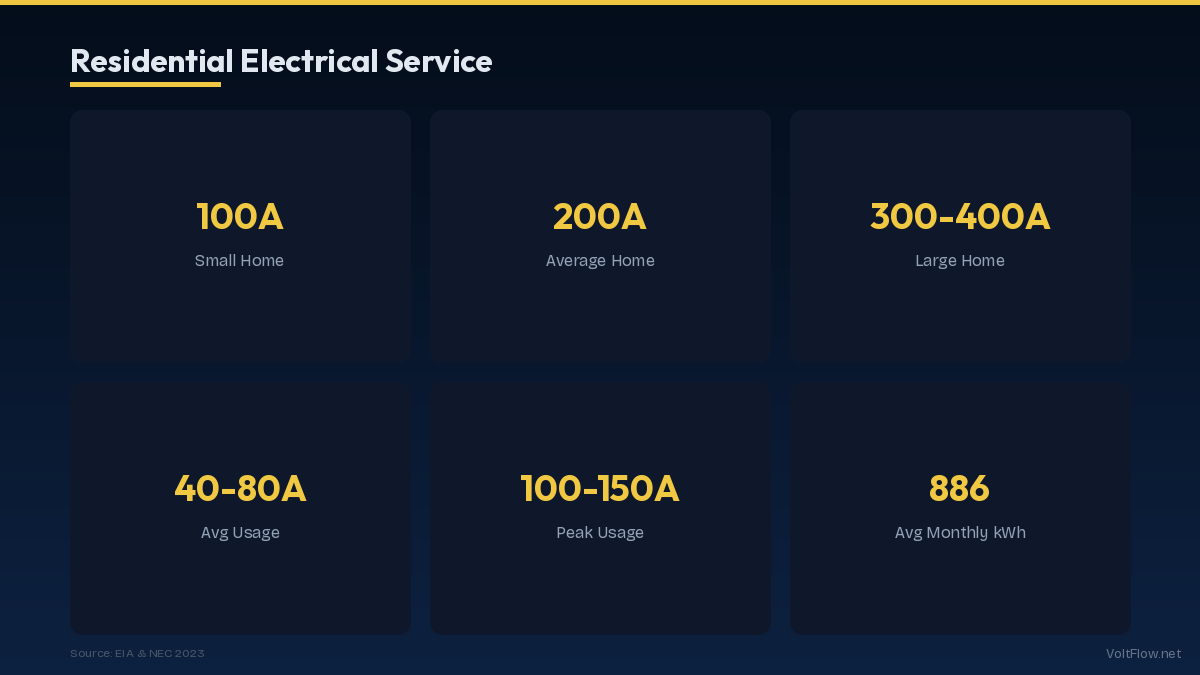
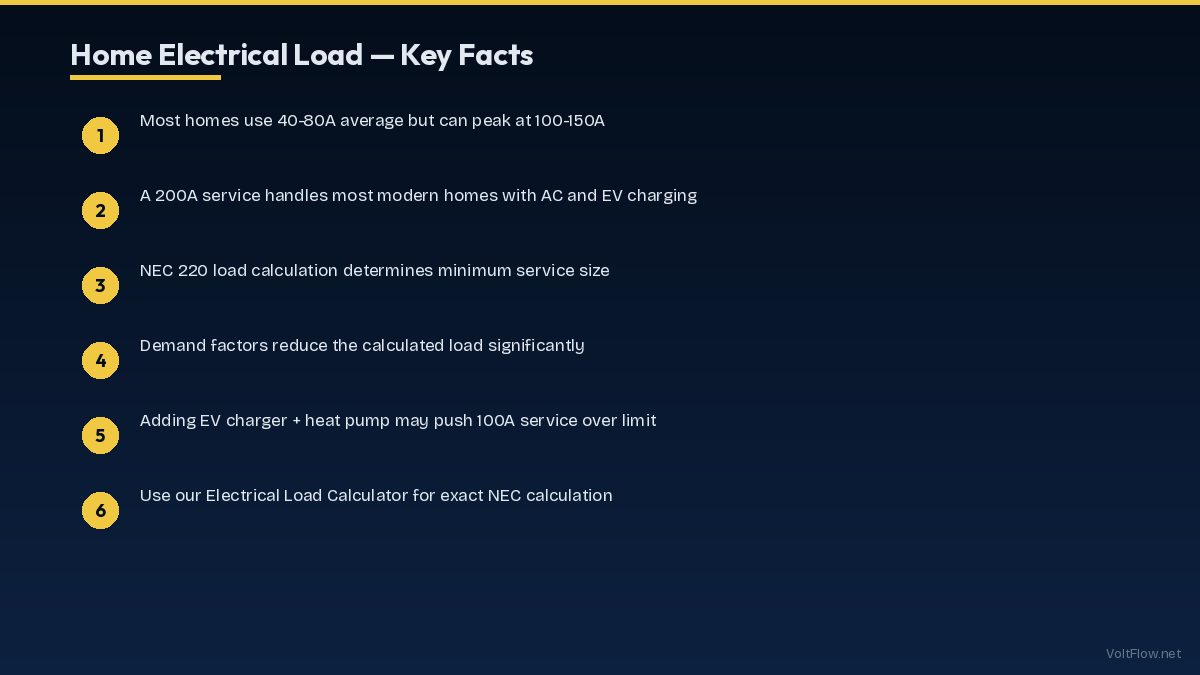
Your electrical service size — the number on your main breaker — represents the maximum amperage your home can draw from the utility grid simultaneously. Common residential service sizes are 100 amps, 150 amps, 200 amps, and occasionally 320 or 400 amps for large homes. This is not the amount of electricity your home uses continuously. Think of it as the width of the pipe: it determines how much can flow at once, not how much actually flows. Actual simultaneous demand, also called the demand load, is the amperage your home draws at any given moment. Even in a busy household with the oven on, the dryer running, and the air conditioner cycling, simultaneous demand typically ranges from 40 to 80 amps on a 200-amp service. This is because not all circuits operate at full capacity at the same time, and many loads cycle on and off rather than running continuously. Your air conditioner compressor draws 20-30 amps when running but cycles off when the thermostat is satisfied. Your refrigerator draws 6-8 amps when the compressor runs but only runs 30-40 percent of the time. Lighting throughout the house might total 15-20 amps of breaker capacity but draws only 3-5 amps during evening hours when most lights are actually on. The NEC uses demand factor calculations in Article 220 to account for this diversity. When calculating the minimum service size for a home, the NEC applies demand factors that reduce the calculated load below the sum of all circuit breaker ratings. For example, the first 10 kVA of general lighting and receptacle load is calculated at 100 percent but the remainder is calculated at only 35 percent. This mathematical recognition that not everything runs simultaneously is why a home with 300 amps of total breaker capacity can safely operate on a 200-amp service. Understanding this distinction helps you evaluate whether your current service is adequate for planned additions like an EV charger or heat pump without necessarily upgrading the entire panel.
Amperage Draw of Common Household Appliances
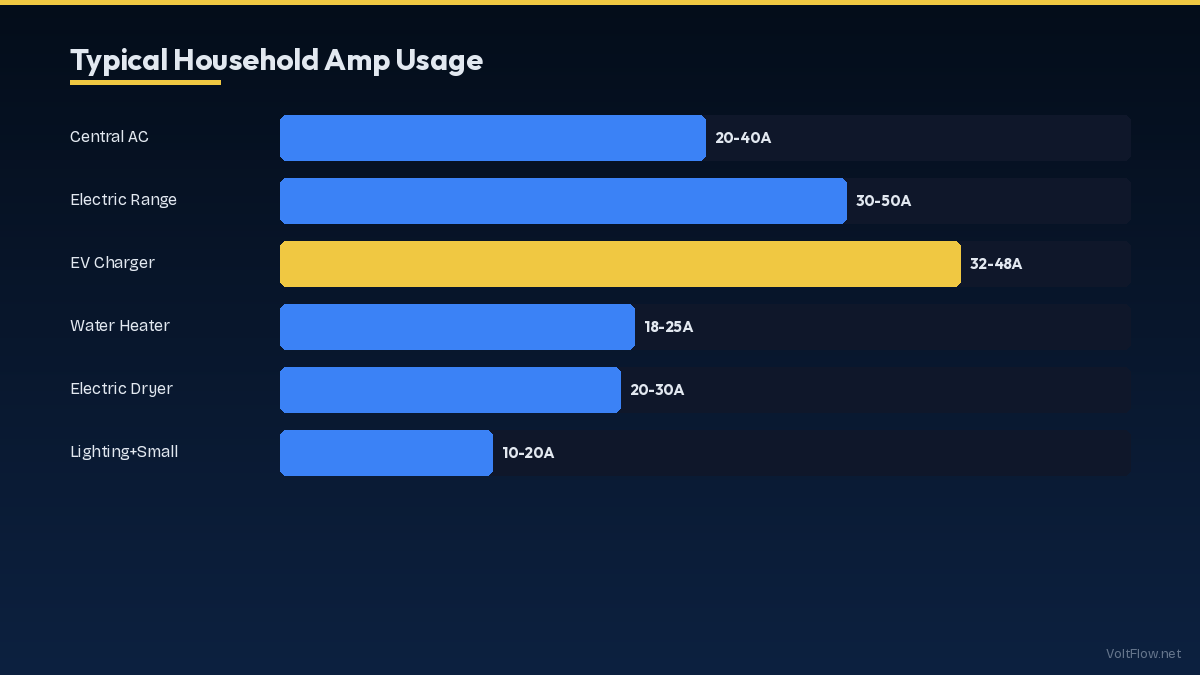
Knowing how many amps each appliance draws helps you calculate your total load and identify which additions might push you past your service capacity. Here are the typical draws for common residential equipment at 240 volts and 120 volts. Central air conditioning is the largest single load in most homes. A 3-ton unit draws 15-20 amps at 240 volts while running, with a startup surge of 40-60 amps lasting a fraction of a second. A 5-ton unit draws 22-30 amps continuous with proportionally higher surge current. Heat pumps draw similar amperage to air conditioners when cooling and add 5-10 amps for the defrost cycle during heating mode. Electric resistance backup heat strips on a heat pump can add 20-40 amps when they activate in very cold weather. An electric range or oven draws 30-50 amps at 240 volts depending on the model, but typically peaks at 30-40 amps during normal cooking when only two burners and the oven operate simultaneously. An electric clothes dryer draws 22-30 amps at 240 volts during operation. An electric water heater draws 18-25 amps at 240 volts but only when actively heating, which averages 3-5 hours per day. A heat pump water heater draws only 5-8 amps, making it a significant load reduction opportunity. An EV charger draws 24-48 amps at 240 volts depending on the charging level, typically for 4-10 hours overnight. This is a continuous load, so the NEC requires the circuit to be rated at 125 percent of the charger draw, meaning a 40-amp charger needs a 50-amp circuit. At 120 volts, common loads include microwave ovens at 8-15 amps, hair dryers at 10-15 amps, space heaters at 12.5 amps, vacuum cleaners at 8-12 amps, toasters at 7-10 amps, and refrigerators at 3-8 amps. These 120-volt loads share circuits in groups, which is why kitchens and bathrooms require dedicated 20-amp circuits — the appliances used in these rooms can easily overload a shared 15-amp circuit. LED lighting has dramatically reduced the lighting load in homes. Where a room once drew 5-8 amps for a few 100-watt incandescent bulbs, the same light output from LEDs draws under 1 amp. A whole-house transition from incandescent to LED lighting frees 10-20 amps of capacity on your service, partially offsetting the added load from modern equipment like EV chargers.
How to Calculate Your Home Total Electrical Load
Performing a load calculation tells you whether your current service has capacity for new additions and whether a panel upgrade is needed. The NEC Article 220 standard method is what electricians use, and you can do a simplified version yourself. Start by listing every circuit in your panel and the connected load on each one. For lighting and general receptacle circuits, the NEC assigns 3 VA per square foot of living space. A 2,000-square-foot home gets 6,000 VA for general lighting and receptacles. Add the nameplate ratings of all permanently connected appliances: central AC, heat pump, water heater, range, dryer, dishwasher, garbage disposal, and any other hardwired equipment. Add the nameplate ratings of any motor loads like a well pump, sump pump, or pool pump. Add the EV charger rating if you have or plan one. Now apply the NEC demand factors. For the general lighting and receptacle load, the first 10,000 VA is at 100 percent and the remainder at 35 percent. For the range, apply Table 220.55 which allows a demand of 8 kW for a single range rated between 8.75 and 12 kW. For the dryer, the demand is 5 kW or the nameplate rating, whichever is larger. For heating and air conditioning, take the larger of the two since they do not operate simultaneously. Add all the demand-adjusted loads together and divide by 240 to convert from VA to amps at 240 volts. The result is your calculated demand in amps. For a typical 2,000-square-foot home with central AC, electric range, electric dryer, electric water heater, and no EV charger, the calculated demand comes out to approximately 80-100 amps. This fits comfortably within a 200-amp service with room for future additions. Adding a 40-amp EV charger increases the calculated demand by roughly 30-35 amps after applying the continuous load factor, potentially pushing the total to 110-135 amps. Still within 200-amp service capacity, but getting closer to the limit. If you then add a heat pump to replace a gas furnace, the calculated demand may approach 150-170 amps, leaving little headroom on a 200-amp service. This is where smart panels and load management devices earn their value by ensuring that the EV charger and heat pump never run at maximum simultaneously, keeping actual demand within the service capacity without requiring a costly service upgrade.
When You Need a Panel Upgrade: 100 vs 200 vs 400 Amps
Your calculated load determines the minimum service size, but future planning should drive the actual service you install. Upgrading a panel is expensive enough that you want to do it once and not revisit the question for 20-30 years. A 100-amp service was standard in homes built from the 1950s through the 1970s and is adequate for small homes under 1,500 square feet with gas heating, gas cooking, gas water heating, and no EV charger or other large 240-volt loads. If your home uses gas for heating, cooking, and hot water, a 100-amp service might handle your needs, but it leaves virtually no room for future electrification. The moment you add an EV charger, heat pump, or electric cooktop, you exceed 100-amp capacity. A 200-amp service handles most modern homes comfortably, including one EV charger, central air conditioning, an electric range, an electric dryer, and an electric water heater. It provides adequate headroom for typical future additions like a second EV charger on a managed circuit, a heat pump, or a pool pump. The cost to upgrade from 100 to 200 amps runs $1,800-$3,500 for the panel swap and $2,500-$5,000 for a full service upgrade including the meter base and utility work. A 320-amp or 400-amp service targets homes pursuing full electrification with multiple high-draw systems. If you plan to run two EV chargers at 48 amps each, a heat pump HVAC system, an electric water heater, an induction cooktop, and potentially a pool heater or hot tub, the calculated demand can exceed 200 amps. A 400-amp service typically uses two 200-amp panels fed from a 400-amp meter base. The cost for a 400-amp service runs $5,000-$10,000 and requires utility coordination for a larger transformer or dedicated service drop. An increasingly popular alternative to upgrading service size is installing a smart electrical panel. Products like the Span Panel and Lumin provide dynamic load management that prevents simultaneous peak draws from exceeding your service capacity. A 200-amp smart panel can effectively support loads that would otherwise require 300 or more amps of conventional service by intelligently staggering EV charging, water heating, and HVAC operation. The smart panel costs $4,000-$6,500 installed, which compares favorably to a $5,000-$10,000 service upgrade to 400 amps.
Peak Demand Patterns Throughout the Day
Your home amperage demand fluctuates constantly throughout the day following predictable patterns that differ by season. Understanding these patterns helps you manage load, avoid overloading circuits, and make informed decisions about time-of-use electricity rates. On a typical summer weekday, demand starts low overnight at 10-20 amps as the refrigerator cycles, the water heater maintains temperature, and the EV charges. Between 6 and 8 AM, demand rises to 30-50 amps as the household wakes up, showers run the water heater, hair dryers and curling irons activate, breakfast cooking starts, and the AC begins cycling more frequently as outdoor temperatures rise. From 8 AM to 4 PM in a working household, demand drops to 15-30 amps with just the AC cycling, the refrigerator running, and possibly a pool pump operating. The peak period hits from 4 to 9 PM as the family returns home. The oven and cooktop fire up for dinner at 30-50 amps, the dryer runs at 25-30 amps, the dishwasher starts at 10-15 amps, the AC runs harder as doors open and close, and electronic entertainment systems activate. Total household demand during this peak can reach 60-80 amps or more on a 200-amp service. This is when overloaded panels trip breakers. After 9 PM demand falls as cooking ends, the dryer finishes, and the household winds down. EV charging typically starts at 10 or 11 PM when time-of-use rates drop, adding 30-48 amps of steady load that continues through the night. Winter patterns differ because heating replaces air conditioning as the dominant load. Electric heat pumps and especially resistance heat strips can draw heavily during morning and evening hours when the thermostat calls for heat after overnight setbacks. Morning shower demand on the water heater combines with space heating demand to create winter morning peaks that sometimes exceed summer afternoon peaks. Monitoring your actual demand pattern with a home energy monitor like the Sense, Emporia Vue, or the monitoring built into smart panels reveals exactly when your home approaches its service capacity limits. This data is invaluable for deciding whether you need a panel upgrade or can simply manage loads more effectively. Many homeowners discover that their brief daily peak lasts only 30-60 minutes and can be managed by staggering dryer and oven use, eliminating the need for an expensive service upgrade.
Future-Proofing Your Home Electrical Capacity
The electrification trend is accelerating in 2026, and homes that prepare their electrical infrastructure now will save significantly compared to those that upgrade reactively as each new device demands more power. Here is how to future-proof your electrical capacity. Start by creating an electrification roadmap. List every gas appliance in your home and the likely timeline for replacing each with an electric alternative. A gas furnace replaced by a heat pump adds 30-60 amps of demand. A gas water heater replaced by a heat pump water heater adds only 5-8 amps. A gas cooktop replaced by induction adds 30-50 amps. Adding a Level 2 EV charger adds 32-48 amps. A second EV adds another 32-48 amps. Total the anticipated additions and add them to your current calculated demand to determine your future service needs. If your projected total exceeds 160-180 amps, consider upgrading to a service that accommodates the full electrification plan. The incremental cost of going from 200 amps to 400 amps during a planned upgrade is far less than doing a second upgrade later. Every service upgrade involves utility coordination, permitting, and a day without power, so combining everything into one project saves time, money, and disruption. Load management technology can extend the useful life of your current service significantly. A 200-amp service with a smart panel or load management device can handle calculated loads of 250-300 amps by ensuring that the EV charger, water heater, and HVAC system never run at full capacity simultaneously. The controller automatically reduces EV charging speed when the AC compressor starts, then ramps charging back up when the AC cycles off. This intelligent coordination is invisible to the homeowner while preventing overload. Install wiring infrastructure even before you need the actual equipment. Running a 240-volt circuit to the garage for a future EV charger costs $300-$600 during a renovation when walls are open. The same circuit costs $800-$1,500 as a standalone project after the walls are closed. Running conduit to a future heat pump location, pre-wiring for an induction cooktop, and installing a sub-panel in the garage for workshop equipment all cost significantly less when done during a renovation or new construction than as afterthoughts. Make sure your panel has adequate circuit spaces. A 200-amp panel with 40 or 42 spaces provides room for current and future circuits. If your existing panel has 20 or 30 spaces and most are full, upgrading to a 42-space panel during your next electrical project ensures you never have to swap panels just to add a circuit. The cost difference between a 30-space and 42-space panel is only $50-$100. Finally, document your electrical system. Take detailed photos of your panel with the cover on and off, label every circuit accurately, and keep a written record of your calculated load, available capacity, and planned additions. This documentation helps every electrician who works on your home provide faster, more accurate quotes and better recommendations for phasing your electrification plan.