EV Charger Installation UK 2026 — Cost, Grants & Best Chargers
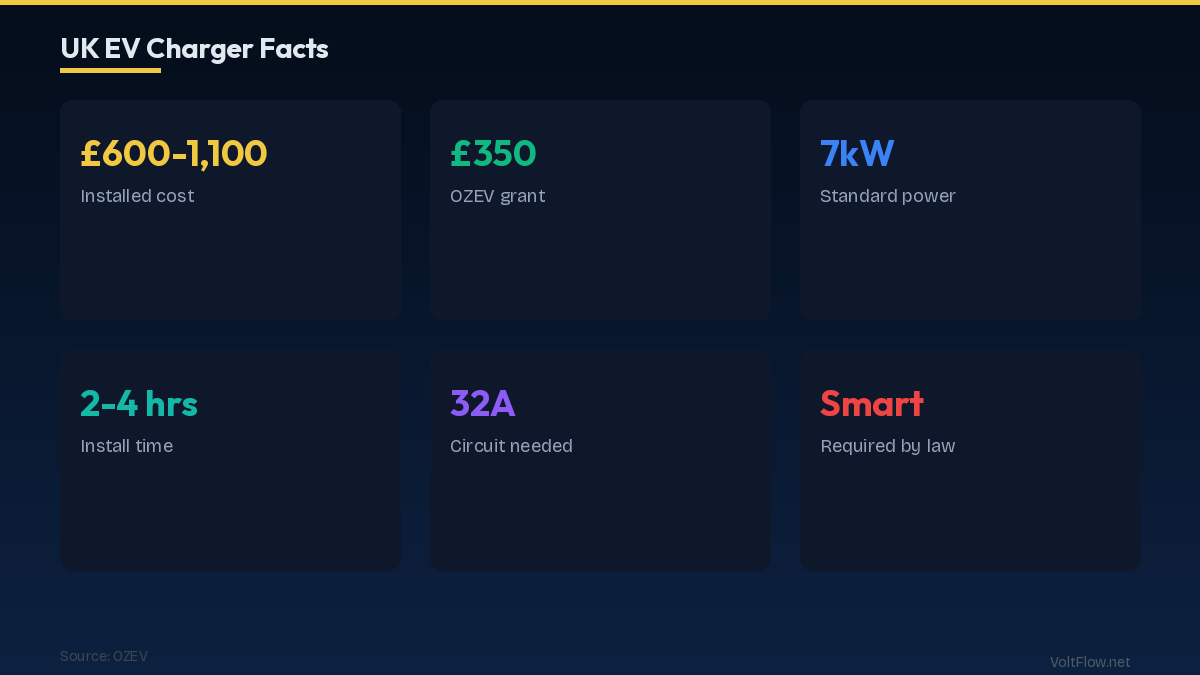
A home EV charger in the UK costs £600-1,100 installed in 2026. The OZEV grant provides up to £350 off for eligible households. Smart chargers are legally required. Top picks: Ohme Home Pro, myenergi Zappi, Pod Point Solo 3.
Home Charger Costs and What Is Included
Typical installed costs (7kW): Budget: £600-800 (Rolec, EO Mini Pro). Mid-range: £800-1,000 (Ohme Home Pro, Pod Point Solo 3, Wallbox Pulsar Plus). Premium: £1,000-1,300 (myenergi Zappi, Andersen A2). Prices include the charger unit, installation labour, 32A dedicated circuit from consumer unit, and OZEV-compliant commissioning. What affects price: Cable run length from consumer unit to charger location (every extra 5m adds £50-100). Consumer unit upgrade if no spare MCB ways (adds £200-400). Civil works (drilling through walls, trunking, underground cable runs for detached garages) adds £100-400. Type A RCD or RCBO if not built into the charger (adds £80-150). Standard installation includes: Up to 10m cable run, 32A Type A RCBO or RCD protection, wall mounting, commissioning, handover documentation, and OZEV submission (if applicable). Timeline: From order to installation: 1-3 weeks. Installation itself: 2-4 hours for standard install.
OZEV Grant: Up to £350 Off
The Office for Zero Emission Vehicles (OZEV) Electric Vehicle Homecharge Scheme provides up to £350 toward the cost of installing a home charger. Current eligibility (2026): Tenants (renting) and leaseholders in flats — owner-occupiers in detached/semi-detached/terraced homes are NOT currently eligible (eligibility rules change periodically; check gov.uk). Landlords installing chargers for tenants. Requirements: Must use an OZEV-approved installer. Charger must be smart (capable of scheduling, load management, and remote control). Must have off-street parking. How to claim: Your installer handles the application and deducts the grant from your invoice. You don't need to apply directly. Provide your installer with: proof of tenancy/leasehold, vehicle details (must own or have ordered an eligible EV/PHEV), and property address. Workplace Charging Scheme: Businesses can claim up to £350 per socket (maximum 40 sockets) for workplace charger installations. If you're self-employed and work from home, this may apply.
Best Home EV Chargers in the UK 2026
Ohme Home Pro (£800-950 installed): Best for Octopus Energy users — directly integrates with Octopus tariffs for automatic cheapest-rate charging. 7.4kW output, tethered cable, excellent app. Dynamic charging adjusts to real-time electricity prices. myenergi Zappi (£1,000-1,300 installed): Best for solar owners — automatically charges using solar surplus. Two modes: Eco (solar only) and Eco+ (solar + grid). Also has scheduled charging. 7kW tethered or untethered options. Pod Point Solo 3 (£800-950 installed): Clean design, reliable, good app. Available tethered or untethered. Type A RCD built in (saves on installation). Popular with fleet and home users. Wallbox Pulsar Plus (£700-900 installed): Compact, powerful, good value. 7.4kW with built-in load management. Bluetooth and WiFi connectivity. Andersen A2 (£1,100-1,400 installed): Premium design — wooden fascia options for aesthetic integration. Popular with homeowners who want a charger that doesn't look industrial. 7.4kW, untethered. All chargers listed are OZEV-compliant smart chargers meeting the Electric Vehicles (Smart Charge Points) Regulations 2021.
Installation Process: What to Expect
Pre-installation survey: Your installer surveys your property (often remotely via photos). They assess: consumer unit capacity (spare ways, main switch rating), cable route from consumer unit to parking space, wall construction (brick, render, timber frame), any civil works needed (ground channels, wall penetrations). Day of installation: Installer runs the dedicated 32A circuit from your consumer unit. Mounts the charger on the exterior wall near your parking space. Installs Type A RCBO or RCD protection. Runs cable through the property using trunking or conduit as needed. Commissions the charger, tests, and connects to WiFi. Hands over documentation and OZEV paperwork. Duration: Standard installation: 2-4 hours. Complex installation (long run, consumer unit work): 4-6 hours. Consumer unit upgrade: If your consumer unit is full (no spare MCB ways) or outdated, an upgrade is recommended. A new 18th Edition metal consumer unit costs £400-800 installed and ensures compliance with current BS 7671 requirements. Three-phase: Most UK homes are single-phase (100A). A 7kW charger on a 32A circuit is well within capacity. If you have two EVs or high overall demand, consider a load management device that balances the charger with other household loads.
Charging Speeds, Cables, and Practicalities
7kW (32A, single-phase): The standard and maximum for single-phase UK homes. Adds approximately 30 miles of range per hour. Overnight (8 hours) adds 240 miles — more than enough for daily use. 22kW (3-phase): Only available if you have three-phase power supply (rare in UK homes). Adds 90 miles per hour. Most UK EVs accept maximum 7-11kW AC anyway, making 22kW unnecessary for most. Tethered vs untethered: Tethered has a permanently attached cable — convenient, just grab and plug in. Untethered has a Type 2 socket — you bring your own cable. Better if you might change cars (different cable lengths) or want a cleaner look. Cable length: Most tethered chargers come with 5-7.5m cables. Ensure the cable reaches your EV's charge port in all parking positions. Outdoor rating: All UK home chargers are IP65 or higher (weatherproof). Mount at a height that avoids flooding risk and is accessible without excessive bending. Load management: Smart chargers can limit charging power when other household loads are high (cooker, shower, heating). This prevents overloading your supply. Essential if your main fuse is 60A or 80A (common in older homes).

Frequently Asked Questions
How much does an EV home charger cost in the UK?
£600-1,100 installed for a 7kW smart charger. The OZEV grant provides up to £350 off for eligible tenants and leaseholders. Standard installation takes 2-4 hours.
Is the OZEV grant still available in 2026?
The OZEV EV Homecharge Scheme continues for eligible tenants, leaseholders, and landlords. Owner-occupiers in houses are currently not eligible. Check gov.uk for current rules.
Which is the best home EV charger in the UK?
Ohme Home Pro for Octopus tariff integration, myenergi Zappi for solar owners, Pod Point Solo 3 for reliability. All are OZEV-compliant smart chargers.
Do I need a dedicated circuit for an EV charger?
Yes. A 7kW charger requires a dedicated 32A circuit from your consumer unit with Type A RCD protection. This is installed as part of the charger installation.
Can I install an EV charger myself in the UK?
No. EV charger installation is notifiable electrical work under Part P. It must be done by a qualified, OZEV-approved electrician who can self-certify the work.