Cable Sizing UK — BS 7671 Wiring Regulations Guide
UK cable sizing follows BS 7671 (IET Wiring Regulations). Standard sizes: 1.0mm² for lighting, 2.5mm² for ring finals, 4-6mm² for cookers, showers, and EV chargers. Proper sizing considers current capacity, voltage drop, thermal insulation, and earth fault loop impedance.
Standard Cable Sizes for Domestic Circuits
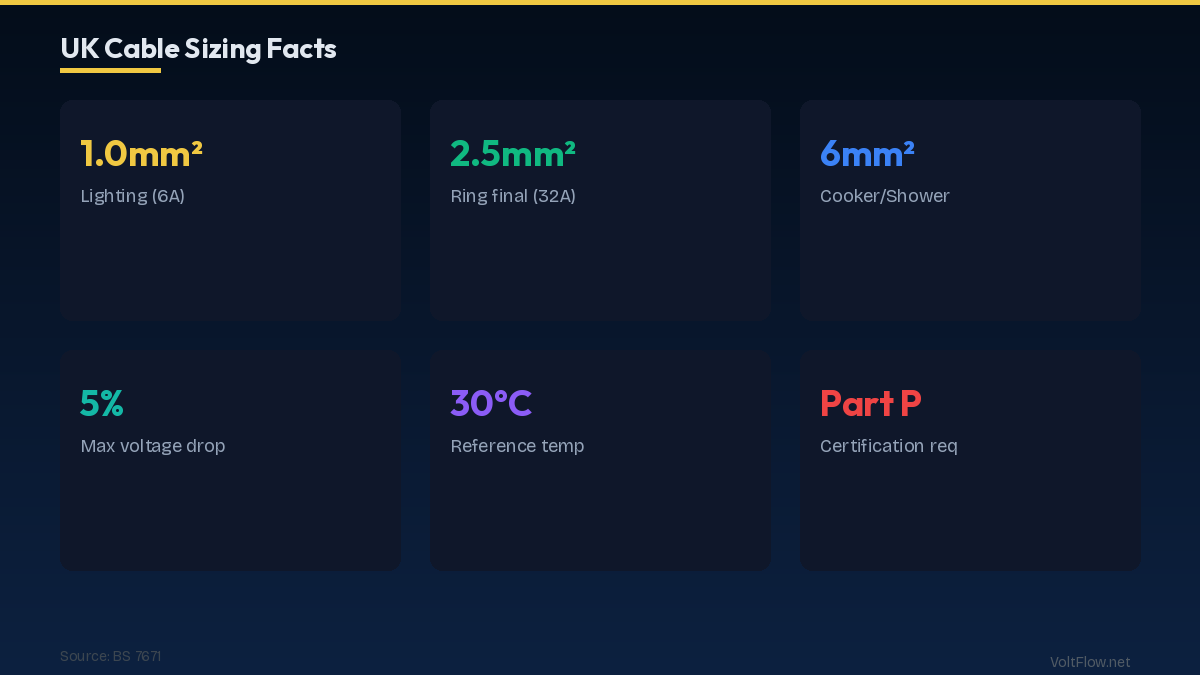
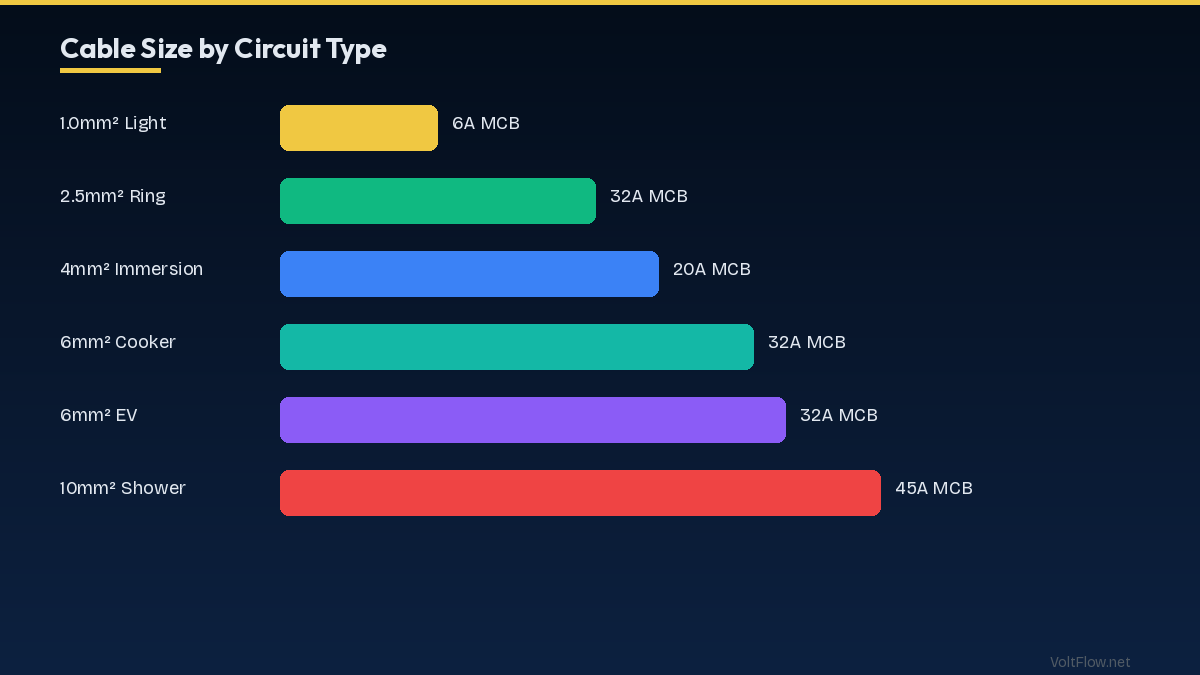
BS 7671 specifies minimum cable sizes based on the circuit design current and installation method. 1.0mm² Twin & Earth: Standard for lighting circuits protected by 6A MCB. Maximum capacity: approximately 15A (Method C, clipped direct). Used for up to 12 lighting points per circuit. Typical cost: £0.50-1.00/metre. 1.5mm² Twin & Earth: Used for lighting circuits where longer runs or higher loads require lower voltage drop. Also used for immersion heater switching circuits and some smoke alarm wiring. 2.5mm² Twin & Earth: Standard for ring final circuits (socket outlets) protected by 32A MCB. The ring configuration allows a 32A MCB with 2.5mm² cable because current flows in both directions around the ring. Also used for radial circuits on 20A MCBs. Cost: £1.00-2.00/metre. 4mm² Twin & Earth: Used for dedicated circuits: immersion heaters (3kW, 13A), large radial circuits (30A MCB), and some cooker circuits. 6mm² Twin & Earth: Standard for cooker circuits (32A MCB, up to 10kW), electric shower circuits (40A MCB, 8-10kW), and EV charger circuits (32A MCB, 7kW). Cost: £3.00-5.00/metre. 10mm² Twin & Earth: Required for high-power showers (10-12kW, 45-50A), large cookers, and some EV charger installations with long cable runs.
Current Capacity and Correction Factors
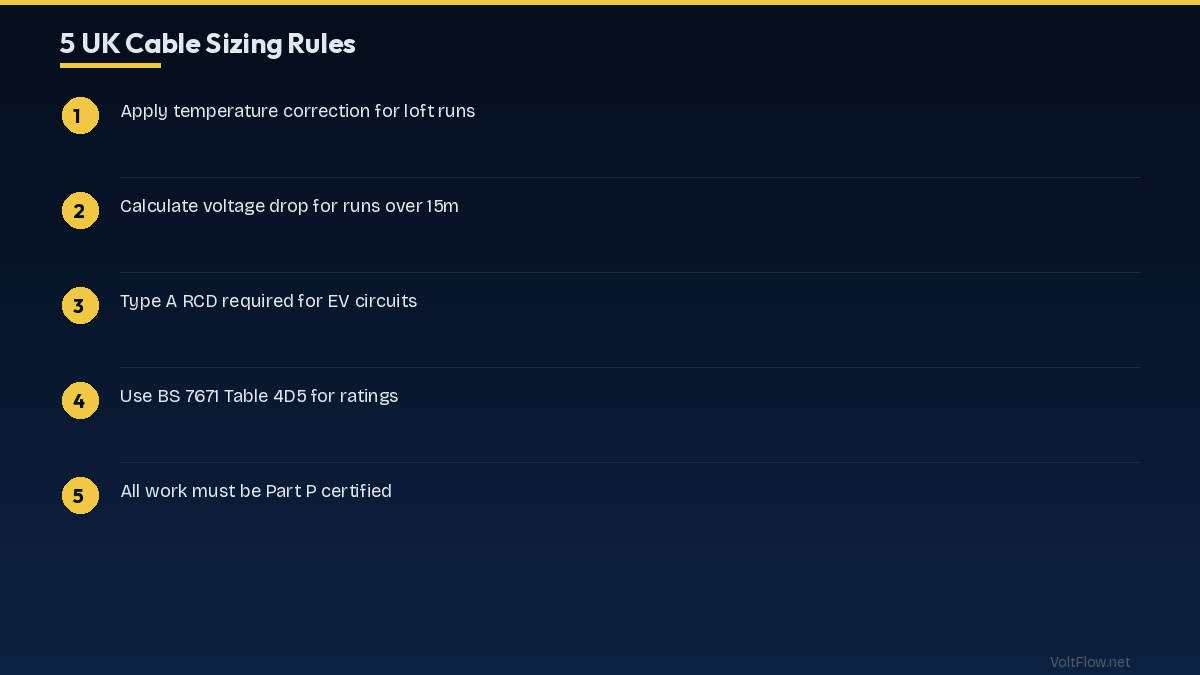
Cable current-carrying capacity depends on the installation method and ambient temperature. BS 7671 Appendix 4 (Table 4D5 for T&E cable) provides reference ratings at 30°C ambient. Installation methods (Reference Methods): Method A — enclosed in insulation (lowest capacity, heavily derated). Method B — enclosed in conduit/trunking. Method C — clipped direct to surface or on cable tray (most common domestic method, highest capacity for T&E). Correction factors: Ca (ambient temperature): At 30°C = 1.00. At 35°C = 0.94. At 40°C = 0.87. Loft spaces in summer can reach 40-50°C. Ci (thermal insulation): If cable is enclosed in thermal insulation for distances exceeding 0.5m, apply correction factor of 0.5 (halves the capacity). This is critical for cables running through insulated loft spaces or walls with cavity insulation. Cg (grouping): Multiple cables in close proximity reduce capacity. 2 cables: 0.80. 3 cables: 0.70. 4-6 cables: 0.55-0.65. Design current calculation: Ib (design current) ≤ In (MCB rating) ≤ Iz (cable capacity after correction). Example: 6mm² T&E (Method C) rated at 47A. In a 40°C loft with another cable grouped: 47 × 0.87 × 0.80 = 32.7A. A 32A MCB is appropriate.
Voltage Drop Calculations per BS 7671
Maximum permissible voltage drop: BS 7671 Appendix 12 allows 5% for lighting circuits and 5% for other circuits from the origin of the installation. At 230V, that's 11.5V maximum. Calculation formula: Vd = (mV/A/m × Ib × L) / 1000, where mV/A/m is from Table 4D5, Ib is design current, L is cable route length (one way) in metres. Common scenarios: Ring final (2.5mm²) to the furthest socket at 20m with 20A load: Vd = 18 × 20 × 20 / 1000 = 7.2V (3.1% — passes). Cooker circuit (6mm²) at 15m with 30A load: Vd = 7.3 × 30 × 15 / 1000 = 3.3V (1.4% — comfortable). EV charger (6mm²) at 25m with 32A load: Vd = 7.3 × 32 × 25 / 1000 = 5.8V (2.5% — passes). Shower circuit (10mm²) at 20m with 40A load: Vd = 4.4 × 40 × 20 / 1000 = 3.5V (1.5% — passes). Long runs are the concern: If your consumer unit is far from the point of use (garage, outbuilding, garden office), voltage drop often dictates using a larger cable than the current rating alone would require. Always calculate voltage drop for runs exceeding 15 metres.
Specific Circuits: Cooker, Shower, EV Charger
Cooker circuit: Most domestic cookers draw 10-13kW. Standard cable: 6mm² T&E on a 32A MCB via a cooker switch. For runs exceeding 20m, consider 10mm². A cooker control unit with 13A socket is standard. The diversity allowance (10A + 30% of remaining) means a 12kW cooker only has a design current of about 32A. Electric shower: 7.5-8.5kW showers: 6mm² on 32A MCB. 9.0-9.5kW showers: 6mm² on 40A MCB (check voltage drop). 10-10.8kW showers: 10mm² on 45A MCB. Important: Shower circuits must have a dedicated double-pole isolator and 30mA RCD protection. Never use a spur from a ring main for a shower. EV charger (7kW/32A): Standard cable: 6mm² T&E (Method C) on a 32A MCB. For runs exceeding 25m: 10mm². EV circuits require Type A RCD protection (or Type B for some chargers) — not standard Type AC RCDs. Many EV chargers have built-in Type A protection, reducing the need for expensive RCBOs. Immersion heater (3kW): 2.5mm² on 16A MCB or 4mm² on 20A MCB. Dedicated radial circuit. Double-pole switch near the cylinder.
Part P Building Regulations and Competent Person Schemes
Part P of the Building Regulations governs electrical installation work in dwellings in England and Wales. Notifiable work (requires building control notification or competent person self-certification) includes: new circuits, consumer unit replacements, work in bathrooms and kitchens near sinks, outdoor electrical work, and additions to special locations. Competent Person Schemes: Electricians registered with schemes like NICEIC, NAPIT, ELECSA, or Stroma can self-certify their work — issuing Part P compliance certificates without involving building control. This saves time and money. Always use a registered electrician for notifiable work. Unregistered work requires a building control application (£200-400) and inspection. BS 7671 18th Edition (Amendment 2): The current wiring regulations standard. Key domestic requirements include: 30mA RCD protection on all circuits, AFDD (Arc Fault Detection Device) recommended for bedrooms and escape routes (not yet mandatory but likely in future editions), SPD (Surge Protection Device) required at consumer unit, and maximum disconnection times of 0.4s for socket circuits and 5s for fixed equipment. Consumer unit: Must be metal (not plastic) for fire safety. All circuits must be RCD-protected. Split-load boards with dual RCDs or RCBO boards (individual RCD per circuit) are standard.
Frequently Asked Questions
What cable size for a 32A ring main in the UK?
2.5mm² Twin & Earth is standard for a 32A ring final circuit. The ring configuration allows 32A protection with 2.5mm² cable because current flows both ways around the ring.
What cable size for an EV charger in the UK?
A 7kW (32A) EV charger requires 6mm² T&E cable for runs up to 25m. For longer runs, use 10mm² to avoid voltage drop issues. Type A RCD protection is required.
What cable size for an electric shower?
7.5-8.5kW: 6mm² on 32A MCB. 9.0-9.5kW: 6mm² on 40A MCB. 10-10.8kW: 10mm² on 45A MCB. Dedicated circuit with double-pole isolator and 30mA RCD.
Do I need Part P notification for electrical work?
Yes for notifiable work (new circuits, consumer unit changes, bathroom/kitchen circuits). A registered electrician (NICEIC, NAPIT) can self-certify. Unregistered work requires a building control application.
What is the maximum voltage drop allowed in the UK?
BS 7671 allows 5% voltage drop from the origin to the point of use. At 230V supply, that is 11.5V maximum. Calculate using mV/A/m values from Table 4D5.