Electricity Cost to Run a Pool Pump 2026: Complete Savings Guide
A pool pump is one of the most expensive appliances to operate in your home, costing $50-$150 per month for a standard single-speed pump running 8-12 hours daily. In 2026, upgrading to a variable-speed pump cuts that cost by 60-80 percent, saving $600-$1,200 per year. This guide breaks down the exact electricity costs by pump type, run time, and electricity rate, then shows you how to minimize your pool pump energy bill.
Pool Pump Electricity Cost by Pump Type
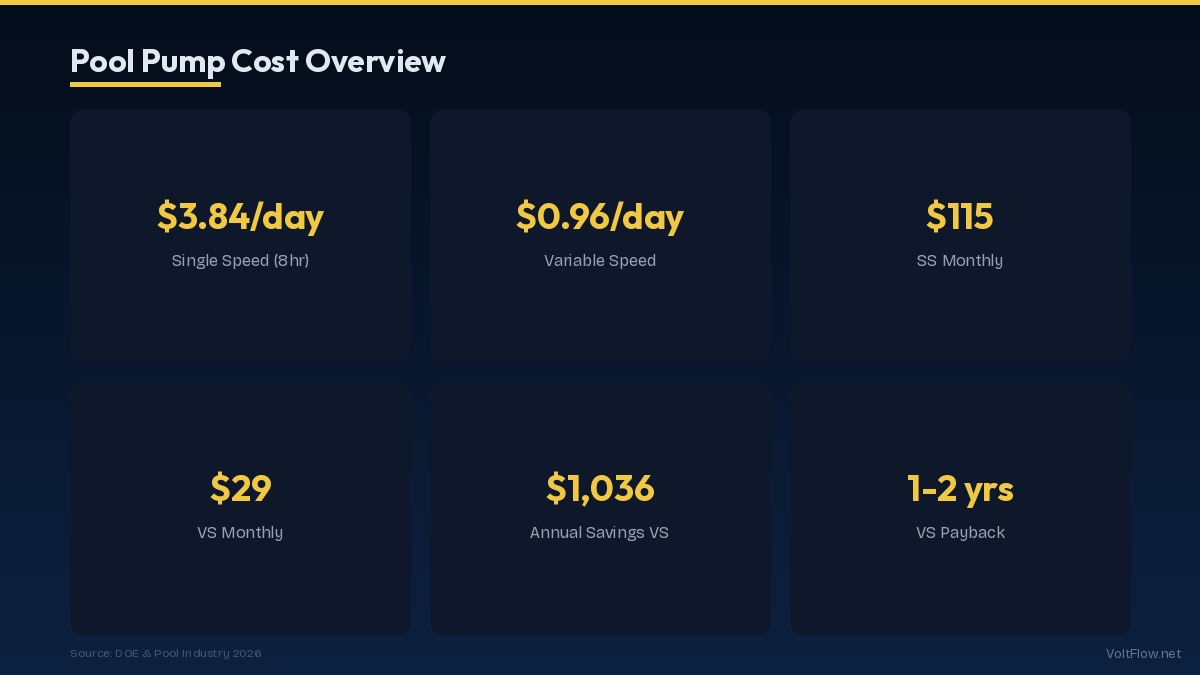
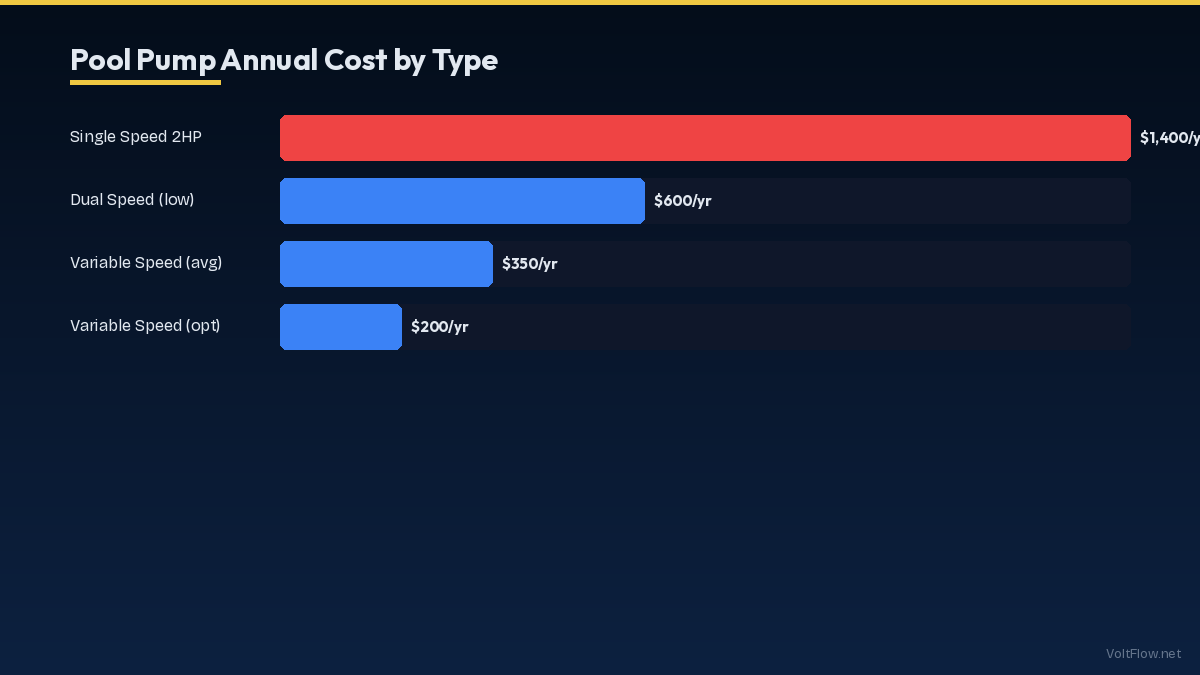
The type of pump you use is the single biggest factor in your pool electricity cost. The three pump categories — single-speed, dual-speed, and variable-speed — have dramatically different energy consumption profiles. Single-speed pumps run at one fixed speed, typically 3,450 RPM, regardless of the task. A standard 1.5 HP single-speed pump draws approximately 1,800-2,000 watts while operating. Running this pump 8 hours per day at the national average electricity rate of $0.16 per kWh costs approximately $7.68-$8.53 per day or $230-$256 per month during the swimming season. Over a typical 6-month pool season, the energy cost is $1,380-$1,536. Year-round pools in Florida, Arizona, and other warm climates face annual costs of $2,760-$3,072. A 2 HP single-speed pump draws 2,200-2,400 watts and costs proportionally more, reaching $280-$310 per month at 8 hours daily run time. Dual-speed pumps offer two operating speeds: a high speed matching a single-speed pump at 3,450 RPM and a low speed of approximately 1,725 RPM. The low speed draws roughly one-quarter the power of high speed due to the pump affinity laws, which state that power consumption varies with the cube of the speed ratio. Running a 1.5 HP dual-speed pump at low speed for 12 hours and high speed for 2 hours daily costs approximately $3.20-$3.80 per day or $96-$114 per month. This represents a 55-60 percent savings over single-speed operation while maintaining adequate filtration. Variable-speed pumps can operate at any speed from about 600 RPM to 3,450 RPM, with most daily filtration occurring at 1,200-1,800 RPM. A 1.5 HP variable-speed pump running at 1,200 RPM draws only 200-300 watts, roughly one-eighth of a single-speed pump. Running 12-16 hours per day at low speed for filtration with brief high-speed periods for spa jets or water features costs $1.20-$2.00 per day or $36-$60 per month. Annual cost for a year-round pool drops to $430-$720, saving $2,000 or more per year compared to single-speed. The pump affinity laws explain why variable-speed savings are so dramatic. When you cut pump speed in half, flow rate drops by half, but power consumption drops by eight times (2 cubed equals 8). This means running a pump at half speed for twice as long uses only one-quarter the energy while filtering the same total volume of water. The water also moves slower through the filter, improving filtration quality by giving the filter media more contact time with passing water.
Run Time and Its Impact on Energy Cost
How long you run your pool pump each day has a direct linear relationship with energy cost. The general rule is that your pump should circulate the entire pool volume at least once per day, known as one turnover. Some pool professionals recommend 1.5 to 2 turnovers per day for heavily used pools, commercial pools, or pools with inadequate skimming. To calculate your required run time, you need your pool volume in gallons and your pump flow rate in gallons per minute. Pool volume for a rectangular pool equals length times width times average depth times 7.5. A typical 15 by 30 foot pool with an average depth of 5 feet holds 16,875 gallons. A 1.5 HP single-speed pump typically flows 60-80 gallons per minute. At 70 GPM, one turnover requires 16,875 divided by 70 equals 241 minutes, or approximately 4 hours. Most pool owners run their pump 6-8 hours to provide a safety margin and account for reduced flow through dirty filters. A variable-speed pump running at 1,200 RPM flows approximately 30-40 GPM. One turnover at 35 GPM takes 482 minutes or about 8 hours. Running 10-12 hours at low speed ensures complete filtration with excellent water clarity. Despite running longer, the dramatically lower wattage results in much lower daily energy cost. Seasonal adjustments to run time can further reduce costs. During winter months when the pool is not in active use but needs to maintain circulation to prevent freezing and algae growth, you can reduce run time to 4-6 hours per day. Some variable-speed pumps include freeze protection modes that automatically activate the pump when temperatures approach freezing, then shut off when the danger passes. Summer months with heavy use, high temperatures, and increased sun exposure require maximum filtration. Bacteria and algae grow faster in warm water, and more debris enters the pool during active swimming season. Running 10-12 hours during peak summer and 6-8 hours during spring and fall optimizes the balance between water quality and energy cost. Night versus day running affects both energy cost and pool chemistry. Running the pump during the hottest, sunniest hours maximizes the effectiveness of chlorine because UV light breaks down chlorine rapidly in still water. However, running during the day means paying peak electricity rates in time-of-use areas. The optimal strategy for TOU rate customers is to split run time: 4-6 hours during the afternoon for chemical effectiveness, and 4-6 hours during off-peak hours overnight for economical filtration. Most modern pool controllers and variable-speed pump timers support multiple daily run schedules to implement this split strategy.
Cost by Electricity Rate Across States
Your local electricity rate multiplies the pump wattage to determine your actual cost, and rates vary by 3-4 times across the United States. States with the lowest electricity rates provide the cheapest pool pump operation. Louisiana at $0.10 per kWh, Oklahoma at $0.11 per kWh, Arkansas at $0.11 per kWh, and Idaho at $0.11 per kWh make pool ownership very affordable. A single-speed 1.5 HP pump running 8 hours daily costs only $144-$160 per month in these states. Variable-speed pumps in low-rate states cost just $24-$40 per month, making the upgrade payback period longer because the baseline cost is already low. Mid-range electricity states including Texas at $0.14 per kWh, Florida at $0.14 per kWh, Arizona at $0.14 per kWh, and Georgia at $0.13 per kWh represent the largest pool market by volume. Pool pump costs of $200-$230 per month for single-speed and $32-$50 per month for variable-speed make the upgrade economics compelling with payback periods of 2-3 years. High electricity rate states create the strongest case for variable-speed upgrades. California at $0.28 per kWh, Connecticut at $0.26 per kWh, Massachusetts at $0.27 per kWh, and New York at $0.22 per kWh push single-speed pump costs to $350-$450 per month. Variable-speed operation in these states costs $65-$100 per month, saving $3,000-$4,200 per year. The pump upgrade pays for itself in under one year. Hawaii leads the nation at approximately $0.40 per kWh, making pool pump operation with a single-speed pump cost $500 or more per month. Variable-speed pumps are not optional in Hawaii — they are an economic necessity. California has recognized the disproportionate energy consumption of pool pumps and was the first state to mandate variable-speed pumps for new installations and replacements. The California Title 20 appliance standards require all replacement pool pumps over 1 HP to be variable-speed. Several other states have followed with similar mandates. The federal Department of Energy enacted national efficiency standards for pool pumps in July 2021, effectively requiring variable-speed technology for most residential pool pumps sold in the US. If your current single-speed pump fails, its replacement will almost certainly be a variable-speed model regardless of your preference, making it worth understanding the operating cost differences now.
Variable-Speed Pump Upgrade: Cost and Payback
Upgrading from a single-speed to a variable-speed pump is one of the highest-ROI home improvements available to pool owners. Here is a detailed cost and payback analysis. A quality variable-speed pump costs $800-$1,500 for the unit depending on horsepower and brand. The Pentair IntelliFlo at $1,000-$1,300, Hayward Super Pump VS at $900-$1,200, and Jandy FloPro VS at $800-$1,100 are the most popular residential models. All come with built-in programmable timers and multiple speed presets. Installation cost depends on whether you are replacing a pump on existing plumbing or starting fresh. A direct replacement where the new pump connects to existing plumbing and electrical costs $200-$400 for labor. Most variable-speed pumps are designed as drop-in replacements for common single-speed models. If the electrical service needs upgrading for the variable-speed pump motor controller, add $100-$300. Total installed cost ranges from $1,000-$1,900 for a typical replacement. Now the payback calculation. In a state with $0.16 per kWh electricity, a single-speed 1.5 HP pump running 8 hours daily costs approximately $245 per month for a year-round pool. A variable-speed pump doing the same filtration work at optimized speeds costs approximately $48 per month. Monthly savings of $197 translate to annual savings of $2,364. A $1,400 total installed cost pays for itself in just 7 months. Even in low-rate states at $0.10 per kWh, the payback period is typically 12-18 months. No other pool investment comes close to this return. Beyond energy savings, variable-speed pumps offer additional financial benefits. They run quieter at low speeds, typically 45-55 decibels compared to 65-75 decibels for single-speed pumps. This eliminates noise complaints from neighbors and allows nighttime operation when electricity rates are lowest. Variable-speed pumps last longer because they spend most of their operating life at low stress levels. The bearings, seals, and motor windings experience far less heat and vibration at 1,200 RPM than at 3,450 RPM. A well-maintained variable-speed pump typically lasts 8-12 years compared to 5-8 years for single-speed. The longer lifespan further improves the total cost of ownership comparison. Variable-speed pumps improve water quality because lower flow rates through the filter increase filtration efficiency. Water passing through a sand or cartridge filter at 30 GPM has twice the contact time as water at 60 GPM, resulting in clearer water with less chemical demand. Many pool owners report reducing their chemical costs by 10-20 percent after switching to variable-speed because better filtration reduces the workload on chemical sanitization.
Solar Power and Time-of-Use Strategies
Combining a variable-speed pump with solar panels or smart scheduling on time-of-use rates can reduce your pool pump electricity cost to near zero. Here are the most effective strategies. If you have or plan to install rooftop solar panels, your pool pump is an ideal daytime load to power directly with solar production. A variable-speed pump at low speed draws 200-300 watts, which is a small fraction of even a modest 4 kW solar system output. Schedule your pump to run primarily during peak solar production hours from 10 AM to 4 PM, and the electricity is essentially free since it would otherwise be exported to the grid at a lower net metering credit rate. For pool owners without solar, time-of-use rate plans offer significant savings. Many utilities charge 2-3 times more during peak hours of 4-9 PM than during off-peak hours of midnight to 6 AM. Shifting your pump run time to off-peak hours cuts the per-kWh cost dramatically. A variable-speed pump running 12 hours overnight at $0.10 per kWh off-peak costs about $22 per month compared to $48 per month at the standard rate. Some advanced pool controllers can automatically optimize pump schedules based on your utility rate plan. The Pentair IntelliConnect and Hayward OmniLogic systems connect to Wi-Fi and can be programmed with your specific TOU rate schedule to run at the cheapest times while ensuring adequate daily filtration. These controllers add $300-$600 to your pool automation setup but save $150-$300 per year in optimized scheduling. Pool covers reduce pump run time requirements by dramatically decreasing evaporation, debris entry, and heat loss. A solar cover or liquid solar blanket reduces evaporation by 95 percent, cutting chemical consumption and reducing the filtration needed to handle debris. Pool owners with covers can often reduce pump run time by 2-3 hours daily, saving an additional $15-$30 per month in electricity. Automatic pool covers at $8,000-$15,000 provide the best results but represent a significant investment. Manual solar covers at $50-$150 provide 80 percent of the benefit at a fraction of the cost. The combination of a variable-speed pump, solar panels, and a pool cover can reduce your pool pump operating cost from $250 per month to under $10 per month — a 96 percent reduction. Even without solar, a variable-speed pump with smart TOU scheduling and a cover can achieve $20-$30 per month, saving $2,500 or more annually.
Sizing the Right Pump for Your Pool
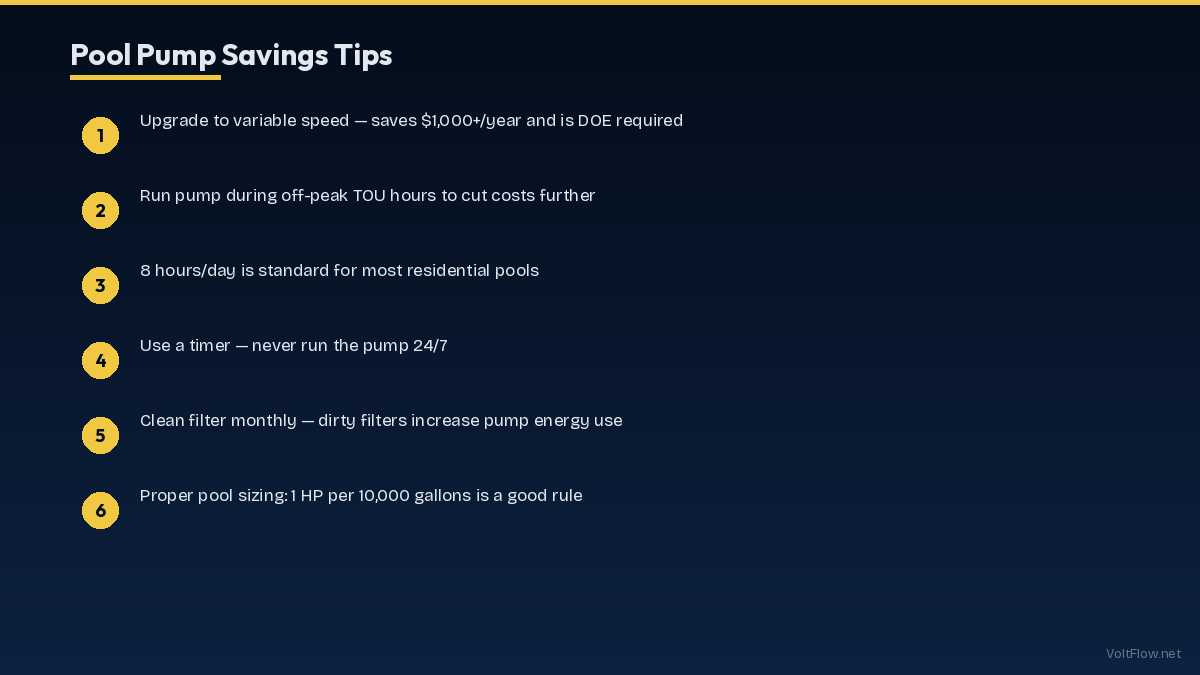
An oversized pump wastes energy and money while an undersized pump fails to provide adequate filtration. Proper sizing matches the pump flow rate to your pool volume, plumbing diameter, and filter capacity. Start with your pool volume. Rectangular pools use length times width times average depth times 7.5. Round pools use diameter squared times average depth times 5.9. Oval pools use long axis times short axis times average depth times 6.7. Irregular pools can be estimated by breaking them into rectangular and circular sections and adding the volumes. Most residential pools hold 10,000-30,000 gallons. Next, calculate the required flow rate for one turnover per day in 8 hours of run time. Divide pool volume by 480 (minutes in 8 hours) to get the required GPM. A 20,000-gallon pool needs 20,000 divided by 480 equals 42 GPM. This is your minimum flow rate requirement at the pump normal operating speed. Now match the pump to the plumbing. Residential pool plumbing uses either 1.5-inch or 2-inch pipe. A 1.5-inch pipe can safely handle about 43 GPM maximum before flow velocity causes excessive friction loss and potential cavitation at the pump. A 2-inch pipe handles up to 73 GPM. If your pool needs 42 GPM and has 1.5-inch plumbing, a pump that produces exactly 42 GPM at the required head pressure is ideal. A larger pump that produces 70 GPM will be throttled by the plumbing, wasting energy by pushing water through undersized pipes. For pools with 2-inch plumbing, you have more flexibility in pump sizing. Most residential pools with 2-inch plumbing are well served by a 1.5 HP variable-speed pump, which can produce 40-80 GPM depending on speed setting. The variable speed allows you to dial in exactly the flow rate your pool needs. Filter compatibility matters too. Your filter has a maximum design flow rate printed on its label. Exceeding this rate forces water through the filter media too fast, reducing filtration quality and potentially damaging the filter. A 300-square-foot cartridge filter typically handles 75-100 GPM maximum. A 3.6-square-foot DE filter handles 70-90 GPM. A 24-inch sand filter handles 50-65 GPM. Match your pump maximum speed flow rate to your filter maximum to avoid damage. For most residential pools between 10,000 and 25,000 gallons with 2-inch plumbing, a 1.5 HP variable-speed pump is the optimal choice. Pools over 25,000 gallons or with water features that require high flow rates may need a 2 HP or 3 HP variable-speed pump. Over-sizing by one step is less wasteful with variable-speed because you simply run at a lower speed, but the larger motor and drive electronics cost more upfront. Start with the minimum size that meets your calculated flow requirement and step up only if specific features like spa jets or waterfall pumps demand higher peak flow.