Economy 7 vs Standard Tariff UK 2026 — Which Saves More?
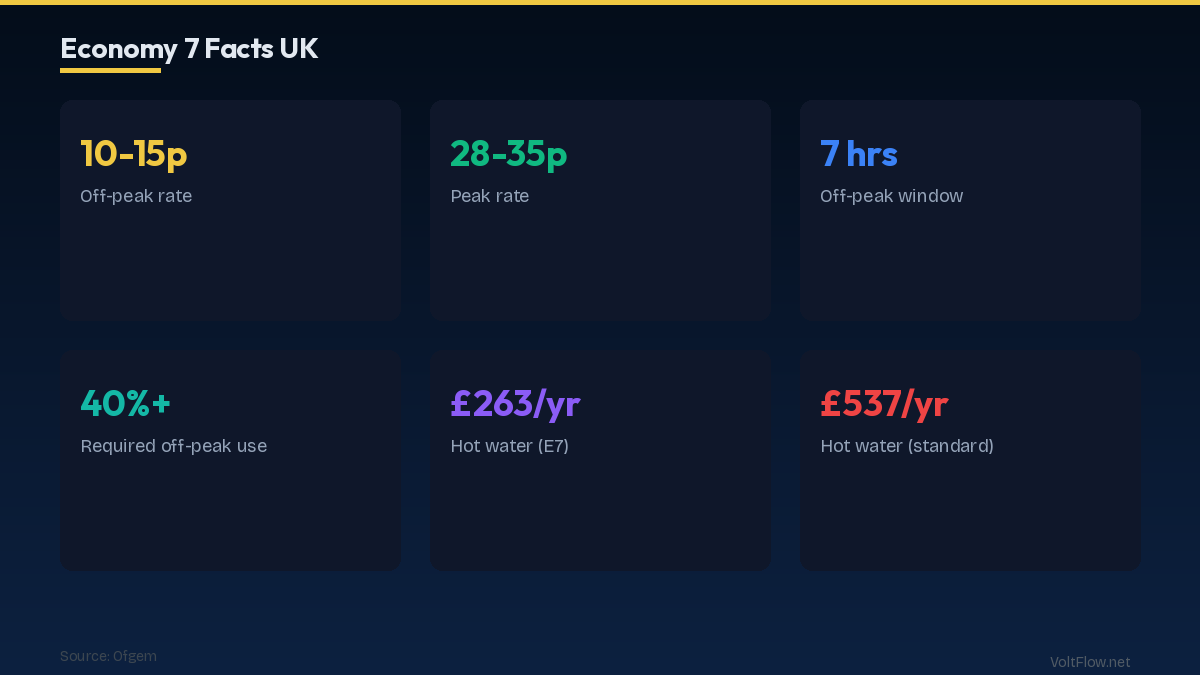
Economy 7 offers 7 hours of cheap electricity at 10-15p/kWh (typically midnight-7 AM) but charges 28-35p/kWh during peak hours. It saves money only if 40%+ of your usage is off-peak. Standard tariff at 24.5p/kWh is simpler and cheaper for most households.
How Economy 7 Pricing Works
Economy 7 splits your electricity into two rates: Off-peak (7 hours, typically midnight-7 AM): 10-15p/kWh — roughly 40-60% cheaper than standard rate. Peak (remaining 17 hours): 28-35p/kWh — 15-40% MORE expensive than standard rate. The cheap off-peak rate is subsidized by the expensive peak rate. You only save money if you use a significant portion of your electricity during the off-peak window. Critical threshold: If less than 40% of your electricity is used off-peak, Economy 7 costs MORE than a standard tariff. Most UK households use only 20-30% of electricity at night, making Economy 7 a poor deal for them. Who benefits: Households with storage heaters (designed to charge overnight), electric hot water on a timer (heats overnight, used during the day), EV owners who charge exclusively overnight, and homes with battery storage that charges off-peak and discharges during peak. Economy 7 meters: Require a specific dual-register meter showing Day and Night readings. If you switch away from Economy 7, you may need a meter change (usually free via your supplier).
Cost Comparison: Economy 7 vs Standard vs Octopus Go
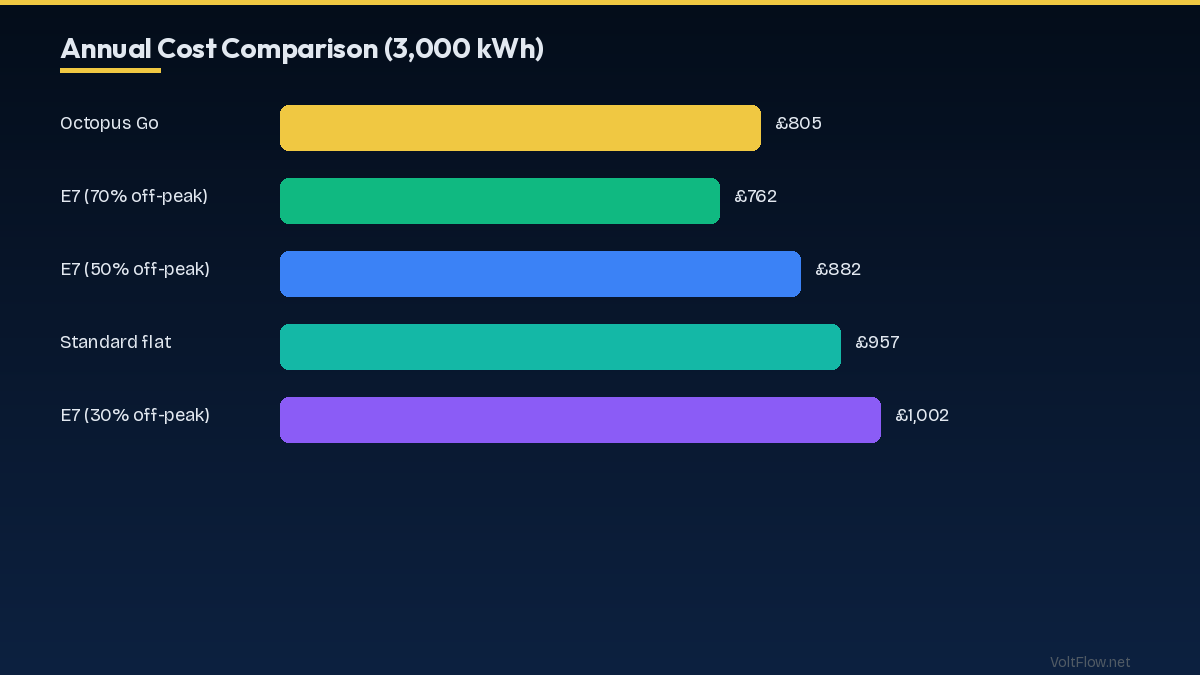
For a household using 3,000 kWh/year: Standard tariff (24.5p flat): 3,000 × 24.5p = £735 + £222 standing = £957/year. Economy 7 (30% off-peak, 70% peak): 900 kWh × 12p + 2,100 kWh × 32p = £108 + £672 = £780 + £222 = £1,002/year — MORE expensive. Economy 7 (50% off-peak, 50% peak): 1,500 × 12p + 1,500 × 32p = £180 + £480 = £660 + £222 = £882/year — saves £75. Economy 7 (70% off-peak, 30% peak): 2,100 × 12p + 900 × 32p = £252 + £288 = £540 + £222 = £762/year — saves £195. Octopus Go (7.5p off-peak, 24.5p peak, 30% off-peak): 900 × 7.5p + 2,100 × 24.5p = £68 + £515 = £583 + £222 = £805/year — saves £152. Winner: Octopus Go is almost always better than Economy 7 because its peak rate is the same as standard (24.5p vs Economy 7's 28-35p peak), while its off-peak is even cheaper (7.5p vs 10-15p).
Storage Heaters on Economy 7
Storage heaters are designed for Economy 7 — they charge overnight using cheap electricity, storing heat in ceramic bricks, then release it during the day. Running cost: A typical 2.5kW storage heater running 7 hours off-peak: 2.5 × 7 × 12p = £2.10/day. A home with 4 storage heaters: £8.40/day = £1,260/season (150 days, Oct-Mar). On standard tariff: £4.12/day per heater = £2,472/season. Saving: £1,212/season — Economy 7 clearly wins for storage heating. Problems with storage heaters: Heat is released throughout the day regardless of need — your home may be warm in the morning and cold by evening when you want heat most. Modern storage heaters (Dimplex Quantum, Elnur Ecombi) have better insulation and fan-assisted release, improving control. They cost £400-800 per unit. Alternative: Heat pump. An air source heat pump costs £8,000-12,000 installed but is 3-4x more efficient than storage heaters. Running cost on standard tariff: £500-800/season vs £1,260 for storage heaters. The Boiler Upgrade Scheme offers £7,500 toward heat pump installation.
Hot Water on Economy 7: Immersion Heater Timing
An immersion heater (3kW) heating a 150-200L cylinder overnight on Economy 7 is a cost-effective hot water strategy. Running cost: 3kW × 2 hours = 6 kWh/day at 12p off-peak = 72p/day = £263/year. On standard rate: 6 kWh × 24.5p = £1.47/day = £537/year. Saving: £274/year — the immersion timer pays for itself immediately. Setup: Wire your immersion heater to the off-peak circuit (your electrician can do this for £100-200). Set the timer for 2-3 AM to heat during the cheapest hours. The well-insulated cylinder (check it has a British Standard jacket or foam lagging) holds hot water until evening. If you run out, a boost switch provides 30-60 minutes of on-demand heating at peak rate. Solar integration: If you have solar panels, run the immersion during solar hours using a solar diverter (£200-500). This provides free hot water April-September, with Economy 7 backup in winter. Heat pump hot water: A hot water heat pump (Mixergy, Sunamp, or integrated ASHP) uses 70% less electricity than an immersion. Running cost: £100-150/year on standard rate — making Economy 7 unnecessary for hot water.
Should You Switch Away from Economy 7?
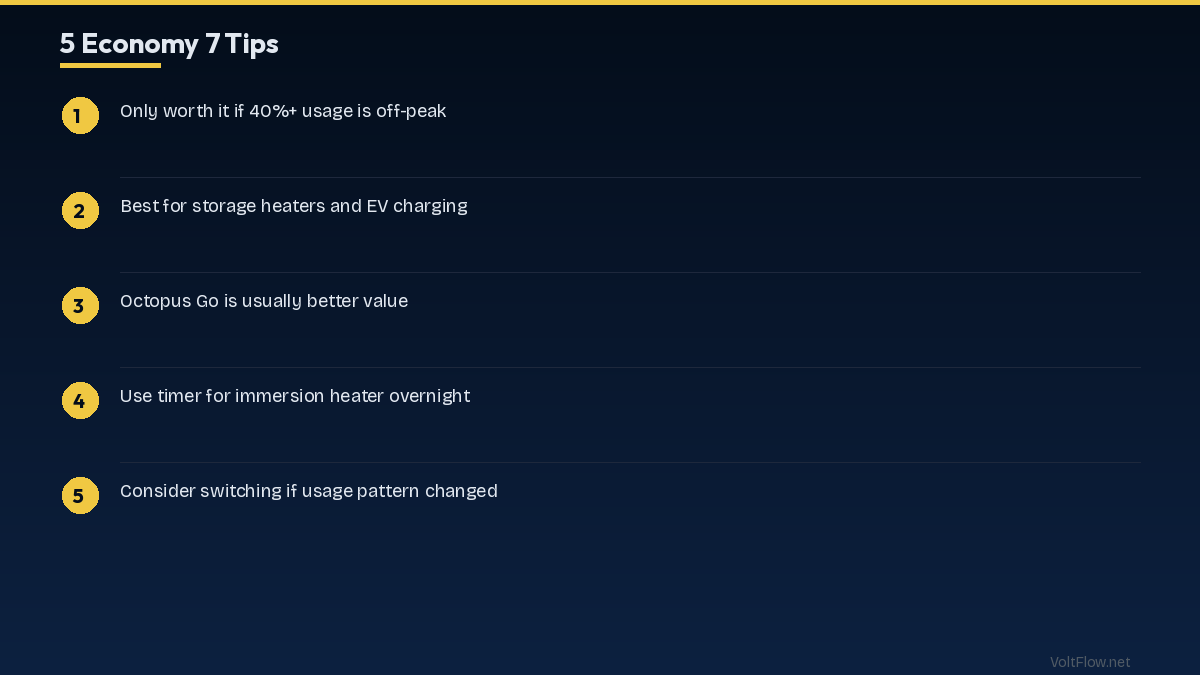
Switch AWAY from Economy 7 if: You've removed storage heaters and installed central heating. Less than 40% of your usage is off-peak (check your meter readings — divide Night by Total). You don't have an EV or electric hot water on a timer. Your peak rate exceeds 30p/kWh while standard tariffs offer 24.5p. Switch TO Economy 7 (or similar TOU) if: You have storage heaters as your primary heating. You charge an EV overnight exclusively. You have battery storage that charges off-peak. More than 50% of your usage can be shifted to night hours. Better alternatives to Economy 7: Octopus Go (7.5p off-peak, better peak rate) — best for EV owners. Octopus Agile (half-hourly pricing) — best for solar + battery users. Octopus Cosy (cheap heat pump windows) — best for heat pump homes. Standard fixed tariff + timer on hot water and EV — simple and often cheaper than Economy 7 for most households. How to switch: Contact your current supplier or use a comparison site. The switch takes 1-5 working days. If you need a meter change (from E7 to standard), your new supplier arranges this free. Keep your final E7 meter readings for the closing bill.
Frequently Asked Questions
Is Economy 7 worth it in 2026?
Only if 40%+ of your electricity is used off-peak — typically storage heater, EV charging, or electric hot water households. For most people, a standard tariff or Octopus Go is cheaper.
What are Economy 7 off-peak hours?
Typically midnight to 7 AM, but exact hours vary by region and supplier. Some areas have slight variations (1 AM-8 AM). Check with your supplier for your specific times.
Is Octopus Go better than Economy 7?
Usually yes. Octopus Go offers 7.5p/kWh off-peak (cheaper than E7's 10-15p) and 24.5p peak (cheaper than E7's 28-35p). Better deal for almost every household.
How do I know if I am on Economy 7?
Check your electricity bill for two rates (Day/Night) or two meter readings. Your meter may show a Day/Night display. Ask your supplier to confirm your tariff type.
Can I switch from Economy 7 to standard tariff?
Yes. Contact your supplier or switch via a comparison site. A meter change may be needed (free). The switch takes 1-5 working days.