Wire Size for 100 Amp Sub Panel — Complete NEC Guide
A 100 amp sub panel requires 1 AWG copper or 1/0 AWG aluminum wire per NEC Table 310.16 at 75°C. For runs exceeding 100 feet, upsizing to 1/0 copper or 2/0 aluminum is necessary to keep voltage drop under 3%. This is one of the most common residential wiring projects — feeding a detached garage, workshop, or home addition.
The Short Answer: 1 AWG Copper or 1/0 Aluminum
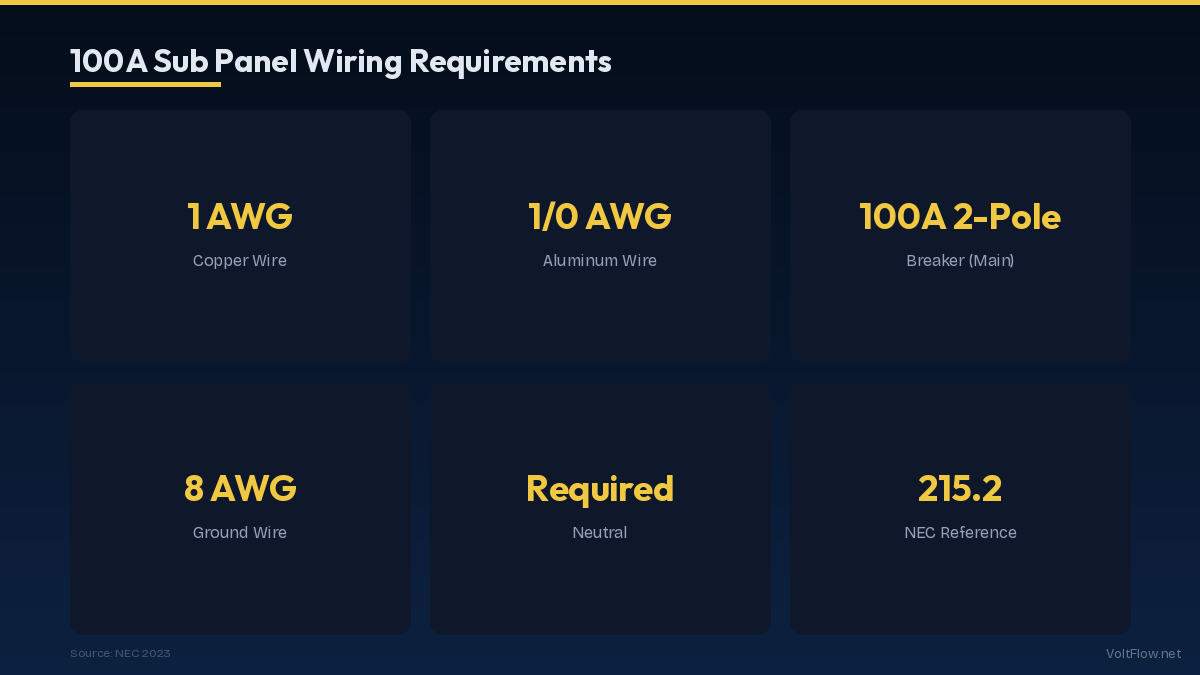
Per NEC Table 310.16, the minimum wire size for a 100 amp sub panel depends on the conductor material and insulation temperature rating. Copper conductors: 1 AWG copper wire rated at 110A at 75°C (THWN/THWN-2) or 115A at 90°C. At the 60°C column (NM-B cable), 1 AWG is rated for only 100A exactly — meeting the minimum but with zero margin. Most electricians recommend using the 75°C column since modern breakers and equipment have 75°C-rated terminals. Aluminum conductors: 1/0 AWG aluminum rated at 120A at 75°C. Aluminum is significantly cheaper for large feeders — a 100-foot run of 1/0 aluminum costs roughly $200-400 less than 1 AWG copper. However, all connections must use AL/CU rated terminals, and anti-oxidant compound must be applied per NEC 110.14. Why not 2 AWG? At the 75°C column, 2 AWG copper is rated for only 95A — insufficient for a 100A breaker. At the 60°C column, it is even worse at 85A. Never use 2 AWG for a 100A circuit regardless of insulation type. Cable type matters: For interior runs through framed walls, use 1 AWG SER (Service Entrance Rated) cable or individual THWN-2 conductors in conduit. For underground runs to a detached structure, use 1 AWG UF-B (Underground Feeder) cable rated for direct burial, or run THWN-2 conductors through Schedule 40 PVC conduit. The conduit method is preferred because it allows future conductor replacement.
Voltage Drop: Why Distance Changes Everything
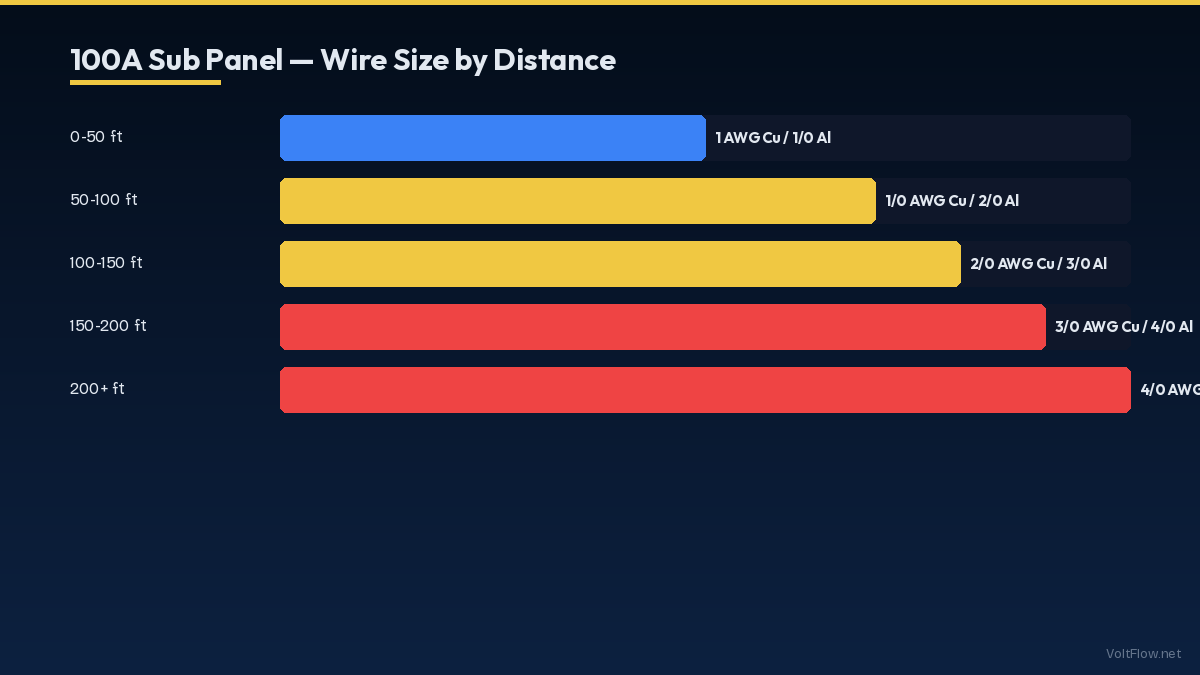
Even when wire meets ampacity requirements, voltage drop becomes the controlling factor on longer runs. NEC 210.19 Informational Note No. 4 recommends keeping voltage drop under 3% for branch circuits and 5% total (feeder plus branch). For a 240V sub panel feed at 100A, the maximum voltage drop at 3% is only 7.2V — meaning the voltage at the sub panel should be at least 232.8V. Voltage drop formula: VD = (2 × K × I × D) / CM, where K is the resistivity constant (12.9 for copper, 21.2 for aluminum at 75°C), I is current in amps, D is one-way distance in feet, and CM is the circular mil area of the conductor. For 1 AWG copper (83,690 CM) at 100A: At 50 feet: VD = (2 × 12.9 × 100 × 50) / 83,690 = 1.54V (0.64%) — well within limits. At 100 feet: VD = 3.08V (1.28%) — still good. At 150 feet: VD = 4.63V (1.93%) — acceptable. At 200 feet: VD = 6.17V (2.57%) — approaching the 3% limit. At 250 feet: VD = 7.71V (3.21%) — exceeds 3%, must upsize to 1/0. For 1/0 aluminum (105,600 CM) at 100A: At 100 feet: VD = (2 × 21.2 × 100 × 100) / 105,600 = 4.02V (1.67%). At 200 feet: VD = 8.03V (3.35%) — exceeds 3%, must upsize to 2/0. The key insight: aluminum has higher resistivity than copper, so it requires upsizing sooner on long runs despite having adequate ampacity.
Wire Size by Distance: Quick Reference Chart
Here is a comprehensive sizing chart for 100A sub panel feeds at 240V, keeping voltage drop under 3%. Copper conductors: 0-200 feet: 1 AWG copper (standard). 200-250 feet: 1/0 AWG copper. 250-300 feet: 2/0 AWG copper. 300-400 feet: 3/0 AWG copper. 400-500 feet: 4/0 AWG copper. 500+ feet: 250 kcmil copper or consider stepping up to a higher voltage transformer. Aluminum conductors: 0-150 feet: 1/0 AWG aluminum. 150-200 feet: 2/0 AWG aluminum. 200-250 feet: 3/0 AWG aluminum. 250-350 feet: 4/0 AWG aluminum. 350-450 feet: 250 kcmil aluminum. 450+ feet: 300 kcmil aluminum. Important considerations: These calculations assume 100% load on all 100A, which is a worst-case scenario. Real-world sub panel loads rarely exceed 60-80% of the breaker rating. If your expected maximum demand is 80A (which is typical for a garage workshop or home addition), you can use the 80A column, allowing longer runs with smaller wire. However, building codes and inspectors often require sizing based on the breaker rating, not the expected load. Always verify with your local inspector before choosing wire based on expected demand rather than breaker capacity. Use our Voltage Drop Calculator to check your specific scenario.
Underground Installation: Burial Methods and Conduit
Running wire underground to a detached structure is the most common use case for a 100A sub panel feed. NEC Article 300.5 specifies minimum burial depths based on the wiring method. PVC conduit (Schedule 40): Minimum 18 inches burial depth. This is the most popular method because it protects the conductors and allows replacement. Use 1.5-inch or 2-inch PVC for 1 AWG or 1/0 conductors — run four individual THWN-2 wires (two hots, one neutral, one ground). The conduit itself provides mechanical protection, so the insulation rating handles moisture. Direct burial cable (UF-B): Minimum 24 inches burial depth per NEC 300.5. More expensive than individual conductors in conduit, and cannot be replaced without re-digging. Not recommended for long runs. Rigid metal conduit (RMC): Minimum 6 inches burial depth — the shallowest allowed by code. However, RMC is expensive and difficult to work with underground. LFNC (Liquidtight Flexible Nonmetallic Conduit): 18 inches minimum. Good for short transitions but not practical for long runs. Trench preparation: Dig the trench to the required depth plus 3-4 inches for a gravel bed below the conduit. Lay the conduit on the gravel, then backfill with sand or fine soil for the first 6 inches above the conduit (no rocks that could damage it). Mark the trench with caution tape 12 inches above the conduit. Entrance to buildings: The conduit must transition above grade before entering each building. Use LB fittings or 90-degree sweeps — never make sharp bends that exceed the conduit fill radius. Seal both ends with duct seal to prevent moisture migration.
Sub Panel Installation Requirements per NEC
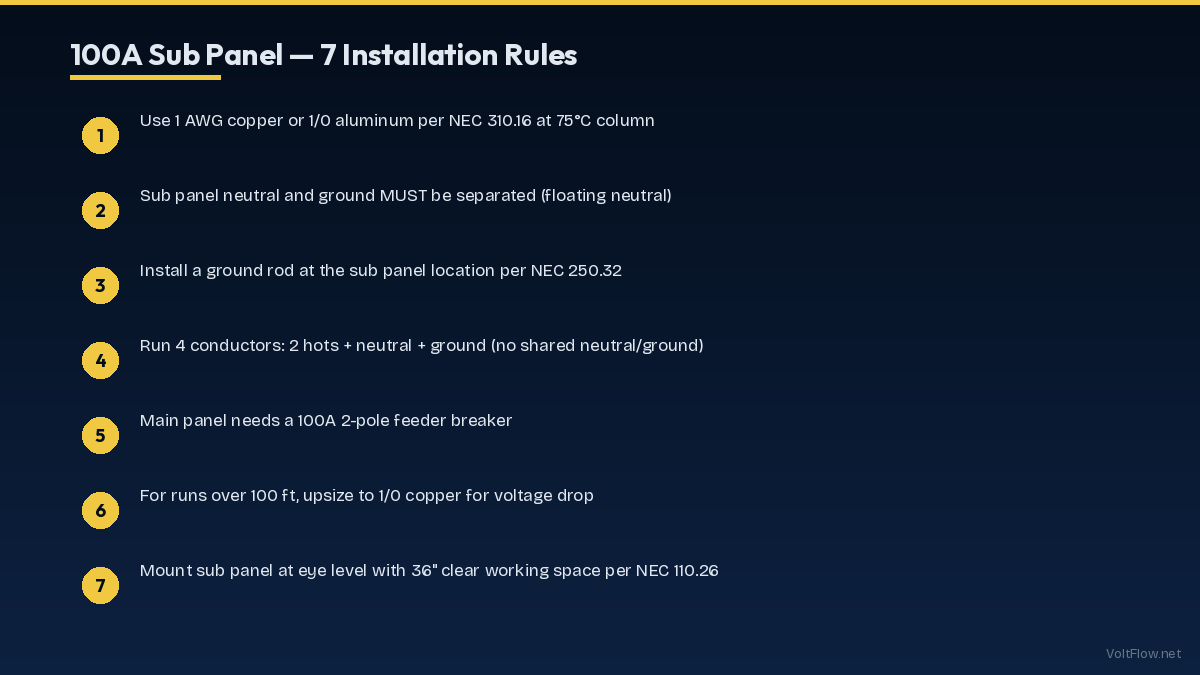
A sub panel is a downstream distribution panel fed from the main service panel. Unlike the main panel, a sub panel has specific bonding and grounding requirements that differ from the main service. Separate ground and neutral bars (NEC 250.24): This is the most critical requirement. In a sub panel, the neutral (grounded conductor) and equipment grounding conductor must be on SEPARATE bus bars. The neutral bar must be insulated from the panel enclosure. The ground bar is bonded to the enclosure. If you connect neutral and ground together in a sub panel (as they are in the main panel), you create a parallel path for fault current on the neutral conductor, which is a serious safety hazard. Four-wire feed required (NEC 250.140): The feeder from the main panel to the sub panel must include four conductors: two hot (ungrounded) conductors, one neutral (grounded) conductor, and one equipment grounding conductor. Older installations sometimes used three-wire feeds (no separate ground), which is no longer permitted for new installations. Grounding electrode at detached structure (NEC 250.32): If the sub panel is in a detached building (garage, workshop, barn), a grounding electrode system must be installed at that building. This typically means driving two ground rods at least 6 feet apart, connected with 6 AWG bare copper to the sub panel ground bar. Breaker sizing: The sub panel feed breaker in the main panel should be 100A (matching the sub panel rating). The sub panel itself should have a main breaker or main disconnect. Working clearance (NEC 110.26): 36 inches of clear working space in front of the panel, 30 inches wide, and 78 inches headroom minimum.
Cost Breakdown: Materials and Labor
Understanding the costs helps you budget accurately and evaluate contractor quotes. Wire cost (per foot, approximate 2026 prices): 1 AWG copper THWN-2: $2.50-4.00/foot. 1/0 AWG copper THWN-2: $3.50-5.00/foot. 1/0 AWG aluminum THWN-2: $1.50-2.50/foot. 2/0 AWG aluminum THWN-2: $2.00-3.00/foot. SER 1 AWG cable: $5.00-8.00/foot. For a 100-foot underground run using aluminum in PVC conduit: 1/0 aluminum wire (4 conductors × 100 ft): $600-1,000. 2-inch PVC conduit (100 ft): $80-150. Fittings (LBs, sweeps, couplings): $50-100. 100A sub panel: $150-300. 100A breaker for main panel: $40-80. Ground rods and grounding wire: $50-80. Miscellaneous (duct seal, tape, connectors): $30-50. Total materials: $1,000-1,760. Labor cost: Trenching: $500-1,500 (depends on length, soil conditions, equipment rental). Electrical installation: $500-1,500. Permit and inspection: $100-300. Total project cost: $2,100-5,060. Most homeowners spend $2,500-4,000 for a standard 100-foot run to a detached garage. DIY savings: If you dig the trench yourself ($0 vs $500-1,500) and pull the wire yourself, you can save $1,000-2,500. However, the electrical connections must be made by a licensed electrician in most jurisdictions, and a permit and inspection are required.
Frequently Asked Questions
What size wire for 100 amp sub panel?
1 AWG copper or 1/0 AWG aluminum per NEC Table 310.16 at 75°C. For runs over 200 feet, upsize to 1/0 copper or 2/0 aluminum to keep voltage drop under 3%.
Can I use 2 AWG wire for a 100 amp sub panel?
No. 2 AWG copper is rated for only 95A at 75°C and 85A at 60°C — both insufficient for a 100A breaker. Always use 1 AWG copper minimum or 1/0 aluminum.
Do I need 4 wires for a sub panel?
Yes. NEC 250.140 requires a 4-wire feeder: two hots, one neutral, and one equipment grounding conductor. The neutral and ground must be on separate bus bars in the sub panel.
How deep do I bury wire to a sub panel?
PVC conduit requires 18 inches minimum. Direct burial cable requires 24 inches. Rigid metal conduit requires only 6 inches. Always verify local code requirements.
How much does it cost to install a 100 amp sub panel?
Total project cost is typically $2,500-5,000 including materials, trenching, and labor. A 100-foot underground run to a detached garage is the most common scenario.