Electric Geyser Running Cost India 2026 — Daily, Monthly & Yearly
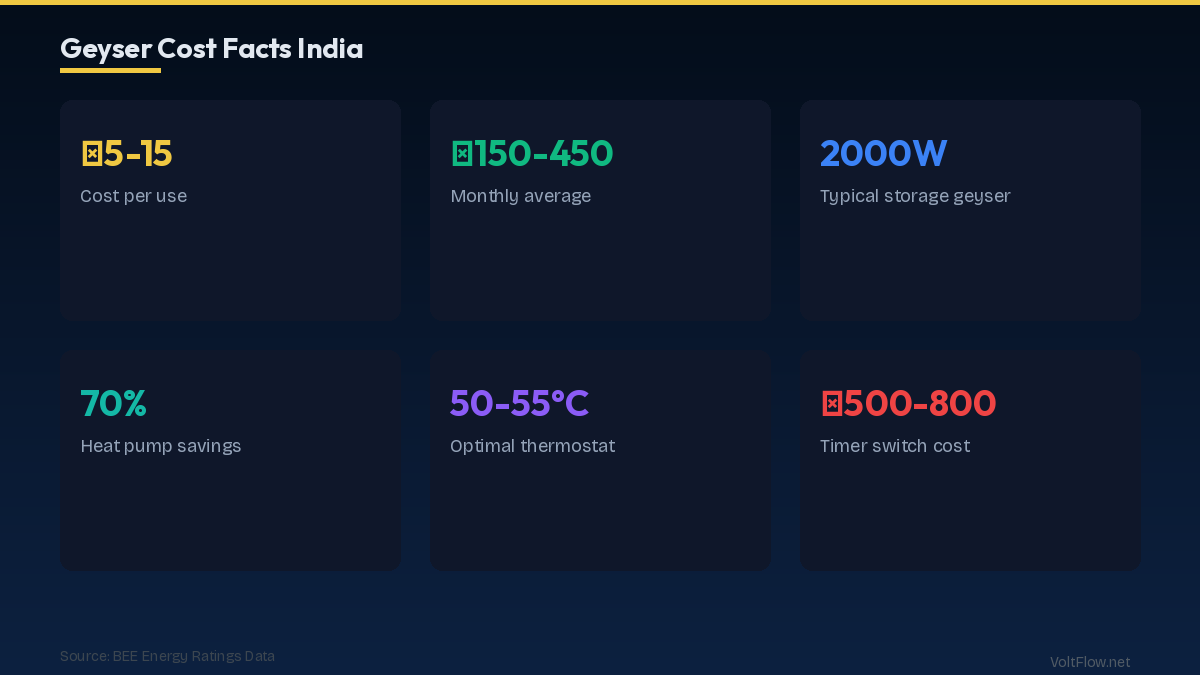
Electric geysers cost ₹5-15 per use and ₹150-450/month in India depending on type, capacity, and usage pattern. A 15L storage geyser at 2000W running 20 minutes daily costs about ₹200/month. Here's the exact calculation and comparison of storage, instant, and heat pump water heaters.

Running Cost Formula: How to Calculate Your Geyser Cost
The formula is simple: Cost = Wattage × Hours × Electricity Rate ÷ 1000. A standard 15-litre storage geyser is rated at 2000W (2kW). To heat water from 25°C to 60°C takes approximately 15-20 minutes. So per use: 2kW × 0.33 hours = 0.66 kWh. At ₹7/unit, that's ₹4.60 per heating cycle. But here's what most people miss: standby losses. If you leave the geyser on for an hour, it doesn't consume 2 kWh — the thermostat cycles on and off, maintaining temperature. However, it still loses heat through the tank walls. A well-insulated geyser (PUF insulation) loses 0.5-1 kWh/hour in standby. A poorly insulated one (glass wool) loses 1-1.5 kWh/hour. This is why leaving your geyser on "all morning" can cost 3-4x more than running it for just the 20 minutes you need. The real daily cost ranges from ₹5 (timer-controlled, 20-minute use) to ₹15-20 (left on for 1-2 hours). Monthly: ₹150-600 depending on habits.
Storage Geyser vs Instant Geyser: Cost Comparison
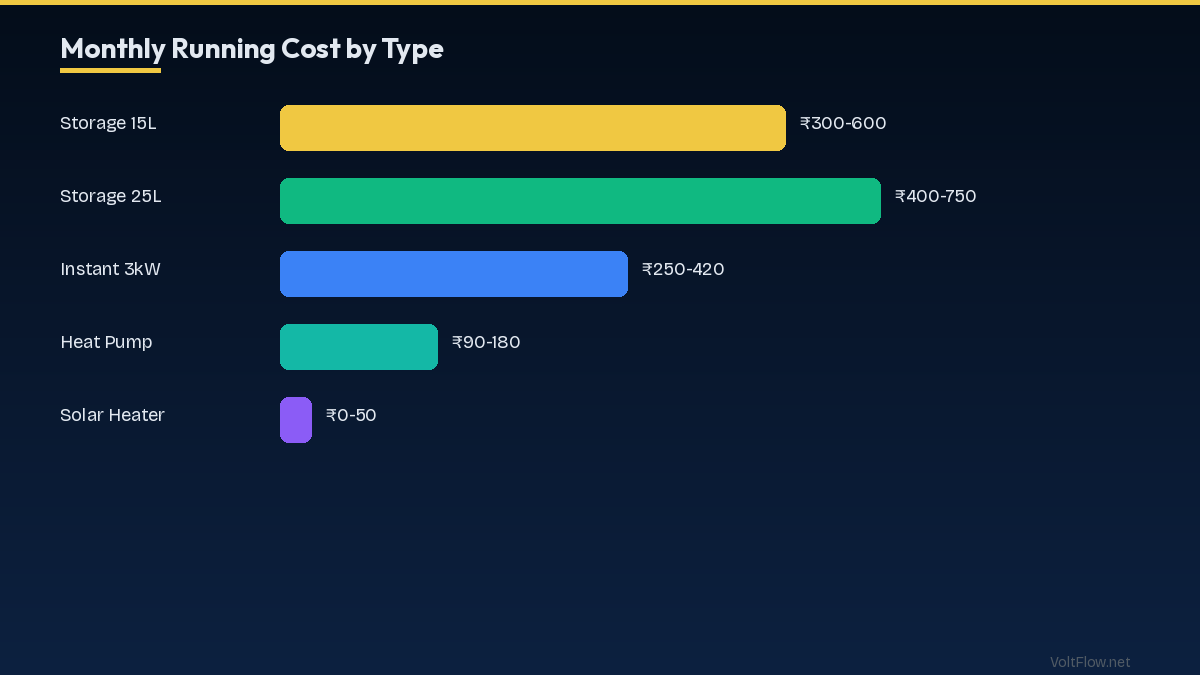
Storage geysers (15-25L, 2000-3000W) heat a tank of water and maintain its temperature. They're suited for bucket baths and multiple family members bathing in sequence. Cost per bath: ₹4-8. Daily cost for a family of 4: ₹15-30. Monthly: ₹450-900. The advantage: high flow rate and consistent temperature. The disadvantage: standby losses if left on, and the tank empties if too many people use it. Instant geysers (1-3L, 3000-4500W) heat water on demand with no storage. They use more power per minute but run only while the tap is open. A 3kW instant geyser providing a 10-minute shower consumes 0.5 kWh — ₹3.5 per shower. For a family of 4: ₹14/day, ₹420/month. Instant geysers are 20-30% cheaper to operate than storage geysers because they have zero standby losses. However, their flow rate is lower (2-3 L/min vs 6-8 L/min for storage), making them better suited for sink washing and small showers rather than bucket filling. For most Indian families, an instant geyser saves ₹100-300/month compared to a storage geyser used carelessly.
Heat Pump Water Heaters: 70% Lower Running Cost
Heat pump water heaters are the most efficient option, using 70-75% less electricity than resistance geysers. They work like a reverse AC — extracting heat from ambient air to warm the water. A 100L heat pump uses only 500-800W to produce the same hot water as a 2000W storage geyser. Daily cost for a family of 4: ₹4-7/day vs ₹15-30 for a storage geyser. Monthly savings: ₹300-700. Annual savings: ₹3,600-8,400. The catch: upfront cost is ₹30,000-55,000 vs ₹5,000-12,000 for a storage geyser. Payback period: 4-7 years depending on usage. Heat pumps work best in warm climates (above 15°C ambient) — perfect for most of India except high-altitude areas in winter. Top brands in India: Racold (Platinum range), A.O. Smith, Venus, and Haier. If you're building a new home or replacing a geyser that's 10+ years old, a heat pump is the smartest long-term investment for water heating.
Solar Water Heaters: Free Hot Water for 15-20 Years
Solar water heaters eliminate geyser electricity costs entirely for 8-9 months and reduce them by 70% in winter. A 100-litre ETC (Evacuated Tube Collector) system costs ₹15,000-22,000 and a 200-litre system costs ₹22,000-35,000. FPC (Flat Plate Collector) systems cost 30-40% more but last longer (20+ years vs 15 for ETC). MNRE subsidies cover ₹6,000-12,000 depending on capacity and state. Annual savings: ₹3,000-6,000 in electricity costs. Payback: 2-4 years. These are the most economical water heating solution for any Indian home with roof access. Solar water heaters require minimal maintenance — flush the tank annually and replace anodes every 3-5 years (₹500-1,000). In cloudy weather or winter, most systems include an electric backup element (1kW-2kW) that kicks in automatically, ensuring you always have hot water. For apartments without roof access, consider a solar-assisted heat pump — hybrid units that use a small solar panel to boost the heat pump's efficiency by 15-20%.
Smart Tips to Cut Your Geyser Bill by 50%
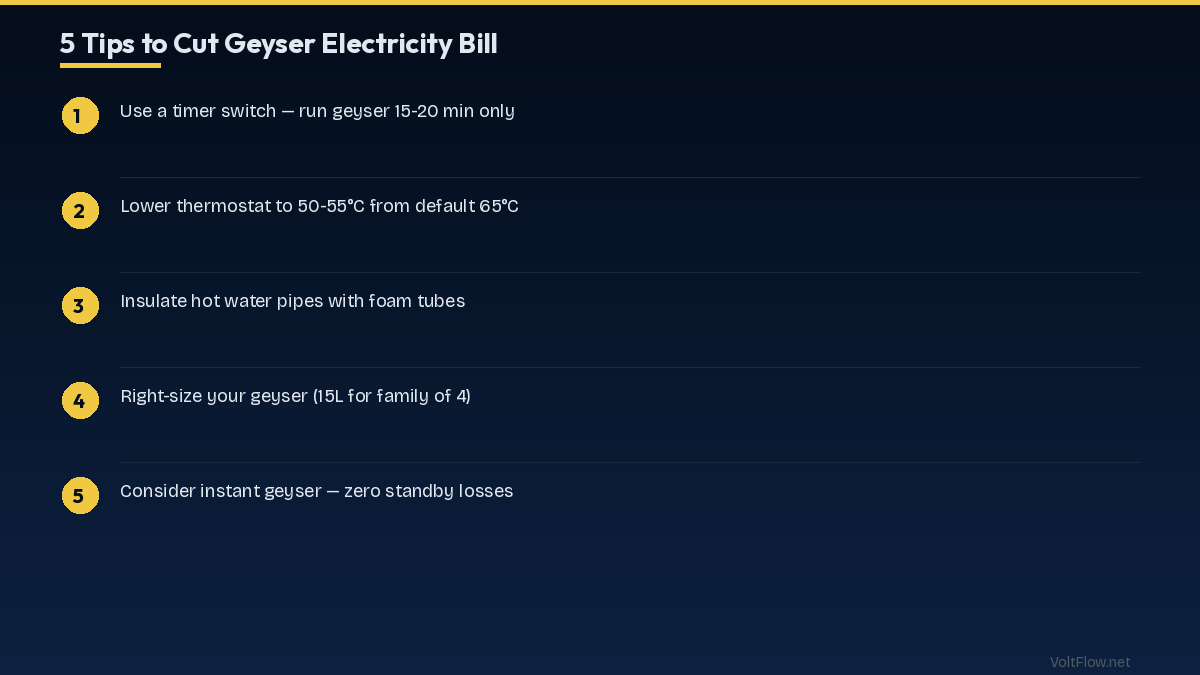
Use a timer switch (₹500-800) to automatically turn on your geyser 15-20 minutes before your bath and turn it off after. This prevents the #1 mistake — leaving the geyser on for hours. Lower the thermostat to 50-55°C instead of the default 65-70°C. Water above 55°C must be mixed with cold water at the tap anyway, wasting the extra heating energy. Each 5°C reduction saves 8-10% on heating costs. Insulate your hot water pipes with foam tubes (₹200-400 for a full bathroom run). Uninsulated pipes lose 20-30% of heat between the geyser and the tap, especially if the geyser is more than 3 metres from the bathroom. Right-size your geyser: a family of 4 using bucket baths needs a 15L geyser, not 25L. Heating extra water you don't use wastes energy. For shower-only households, an instant geyser eliminates storage losses entirely. Consider a geyser blanket (₹800-1,200) — wrapping your storage geyser with additional insulation reduces standby heat loss by 25-40%, especially useful if your geyser is in an uninsulated area like a balcony or terrace.
Frequently Asked Questions
How much electricity does a geyser use per day?
A 2000W storage geyser used for 20 minutes consumes about 0.66 kWh (₹4-5). If left on for an hour, it consumes 1.5-2 kWh (₹10-15). Average daily cost is ₹5-15 depending on usage pattern.
Which is cheaper to run: storage geyser or instant geyser?
Instant geysers are 20-30% cheaper to run because they have zero standby losses. A family of 4 saves ₹100-300/month by switching from storage to instant water heating.
Is a heat pump water heater worth it in India?
Yes, if your monthly geyser cost exceeds ₹500. Heat pumps use 70% less electricity. The ₹30,000-55,000 investment pays back in 4-7 years, then saves ₹300-700/month for 10+ years.
What temperature should I set my geyser to?
Set it to 50-55°C. The default 65-70°C wastes energy since you mix hot water with cold at the tap. Lowering by 15°C saves about 20% on heating costs.
How much does a solar water heater save per month?
A solar water heater saves ₹300-500/month on electricity (₹3,600-6,000/year). With an upfront cost of ₹15,000-35,000 and MNRE subsidies of ₹6,000-12,000, payback is 2-4 years.