Electricity Saving Tips India 2026 — Cut Your Bill by 30-50%
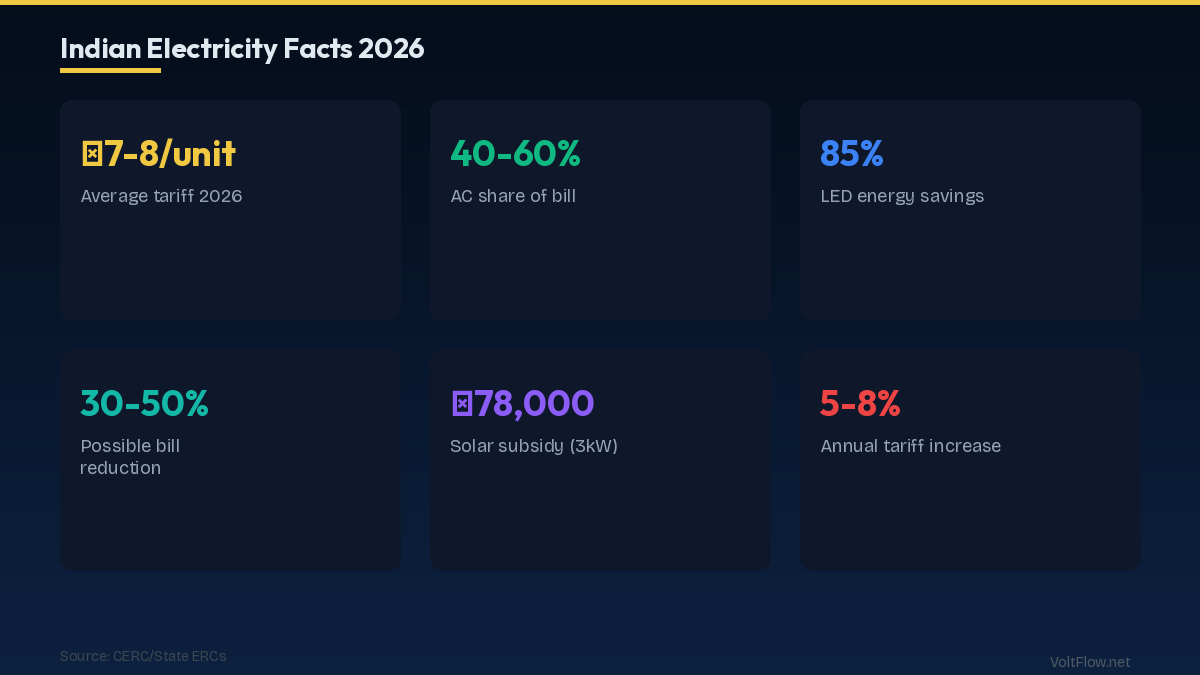
Indian households spend ₹1,500-5,000/month on electricity. With rising tariffs across states (some crossing ₹8/unit in 2026), reducing consumption is more urgent than ever. These 20 proven tips can slash your bill by 30-50% — from simple habit changes to smart investments that pay for themselves within months.
Quick Wins: Zero-Cost Habits That Save ₹500-1,500/Month
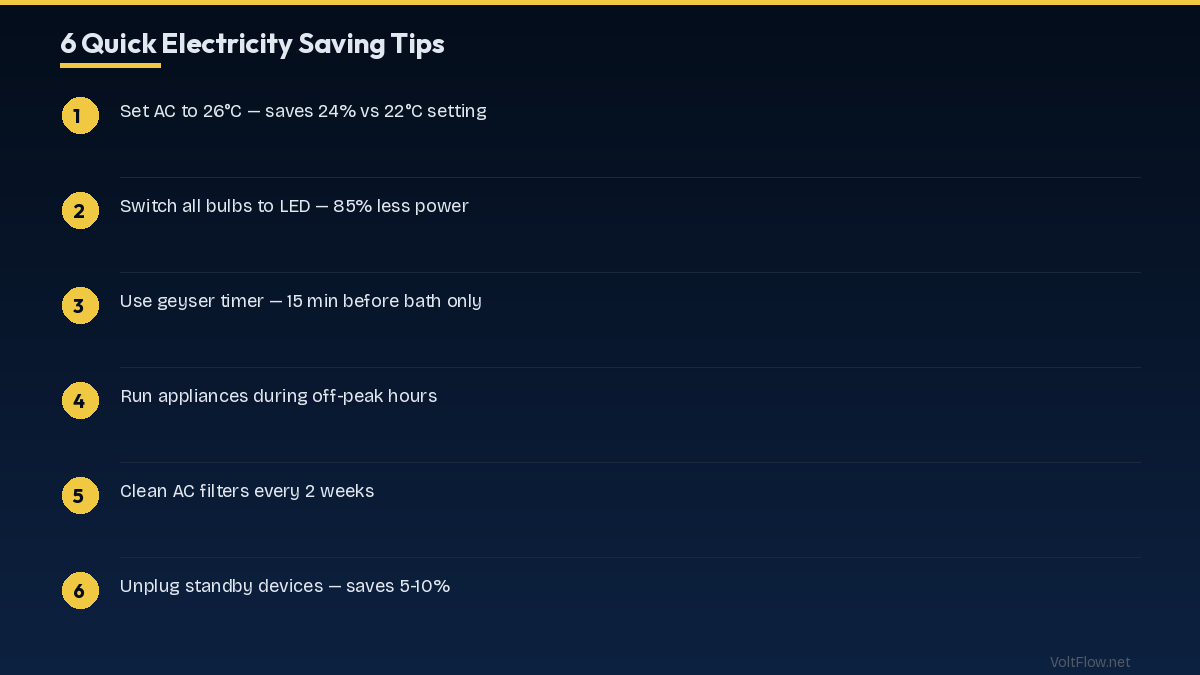
The easiest savings require no investment at all. Switch off appliances at the wall — standby power (vampire load) from TVs, set-top boxes, and chargers wastes 5-10% of your bill. A family with 8 devices on standby loses ₹200-400/month. Use natural ventilation between 6-9 AM and after sunset instead of running AC. In most Indian cities, cross-ventilation with two open windows creates enough airflow for 6+ months of the year. Run heavy appliances during off-peak hours if your state has Time-of-Day (ToD) tariffs — Maharashtra, Gujarat, and Karnataka offer 20-30% lower rates between 10 PM and 6 AM. Set your washing machine and dishwasher on a timer. Keep your fridge at 3-4°C (not colder) — every degree below 3°C adds 5% to compressor runtime. Defrost regularly; ice buildup forces the compressor to work 20% harder. These habits alone can save ₹500-1,500/month depending on your baseline consumption.
Lighting: LED Conversion Saves ₹100-300/Month
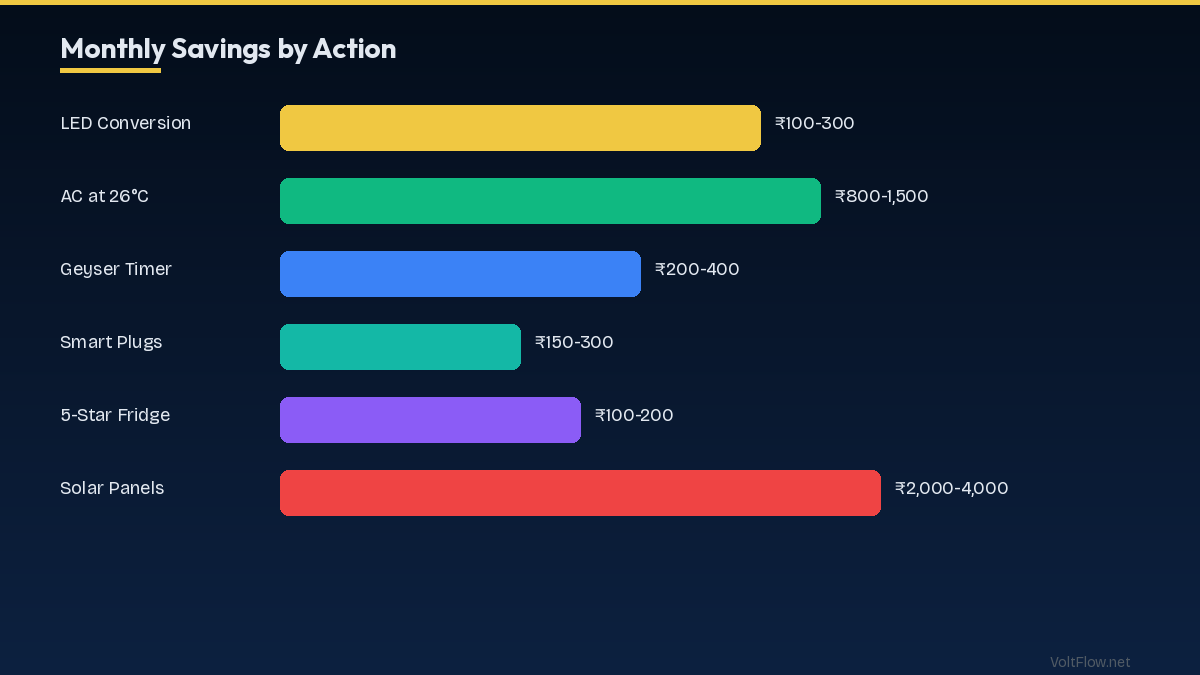
If you still have CFL or incandescent bulbs, replacing them with LED bulbs is the single best ROI investment in your home. A 9W LED produces the same light as a 60W incandescent — 85% less power. With 10 lights running 6 hours daily, switching from CFL to LED saves about 15 kWh/month (₹100-120), while switching from incandescent saves 90 kWh/month (₹600-720 in high-slab states). UJALA scheme LEDs are available at ₹70-80 per bulb through EESL — compared to ₹150-250 for branded LEDs. The payback period is under 2 months. Motion sensor lights for corridors, bathrooms, and parking areas prevent the classic problem of lights left on all night. A ₹300 sensor saves ₹50-80/month per fixture. For exterior lighting, solar-powered LED lights (₹500-1,500) eliminate grid consumption entirely. Smart LED bulbs (₹800-1,200) with app control let you dim lights to 30-50% brightness for TV watching — most people don't need full brightness in the evening.
Air Conditioning: The Biggest Bill Driver
AC accounts for 40-60% of summer electricity bills in Indian homes. The most impactful change: set your AC to 26°C instead of 22°C. Each degree below 26°C increases energy consumption by 6%. At 22°C, you're using 24% more electricity than at 26°C — that's ₹800-1,500/month wasted for a 1.5-ton unit running 8 hours. BEE 5-star rated ACs (2026 ratings) consume 30-40% less than 3-star units. A 1.5-ton 5-star inverter AC uses about 1.0-1.2 units/hour vs 1.6-1.8 for a 3-star non-inverter. Over a 6-month summer, that's ₹5,000-8,000 saved. Inverter technology is essential — inverter compressors adjust speed rather than cycling on/off, saving 30-50% compared to fixed-speed models. Clean your AC filters every 2 weeks during heavy use. Clogged filters reduce efficiency by 15-25%. Get an annual professional service (₹400-800) — refrigerant top-up alone can restore 10-15% lost efficiency. Ceiling fans with AC allow you to raise the thermostat by 2-3°C while feeling the same comfort. A BEE 5-star ceiling fan uses only 28-35 watts compared to 75-80 watts for old fans.
Water Heating: Geysers, Heat Pumps, and Solar
Electric geysers are the second biggest electricity consumer after AC in Indian homes, using 2,000-3,000 watts. A 15-minute daily shower with a 2kW geyser consumes 30 kWh/month (₹200-300). Solar water heaters (₹15,000-30,000 for 100-200 litre ETC systems) eliminate geyser electricity entirely for 8-9 months and reduce it by 70% in winter. Government subsidies through MNRE cover 30-40% of the cost. Payback: 2-3 years. Heat pump water heaters use 70% less electricity than resistance geysers — a 100L heat pump costs ₹30,000-50,000 but saves ₹150-200/month. If you keep your electric geyser, use a timer switch (₹500-800) to run it for only 15-20 minutes before your bath instead of leaving it on for hours. Set the thermostat to 50-55°C (not 70°C) — water above 55°C requires mixing with cold water anyway, wasting the heating energy. Instant geysers (3kW) use more power per minute but run for shorter durations, often consuming less total energy than storage geysers left on standby.
Smart Home and Appliance Efficiency
Investing in BEE 5-star rated appliances across the board saves 20-40% on each appliance's consumption. A 5-star refrigerator (260L) uses about 150-180 kWh/year vs 250-300 for a 2-star model — saving ₹600-1,000/year. Smart plugs (₹500-1,000) let you schedule appliances, monitor consumption in real-time, and cut standby power remotely. Some users report 10-15% bill reduction from monitoring alone — seeing your consumption makes you conscious of waste. Induction cooktops are 85-90% energy efficient compared to 40% for LPG — but they consume 1,500-2,000W. Use them for quick cooking tasks; for long simmering, a pressure cooker on gas is more economical. Washing machines: front-loaders use 50% less water and 30% less electricity than top-loaders. Always run full loads — a half-load cycle uses 60% of a full-load's energy. Inverter refrigerators adjust compressor speed based on load, saving 25-30% compared to conventional models. If your fridge is 10+ years old, replacing it likely pays for itself in 3-4 years through electricity savings.
Solar Panels: The Ultimate Bill Eliminator
A 3kW rooftop solar system generates 12-15 units/day in most Indian cities — enough to offset ₹2,000-4,000/month in electricity bills. Under PM Surya Ghar Muft Bijli Yojana, households get ₹30,000 subsidy for 1kW, ₹60,000 for 2kW, and ₹78,000 for 3kW+. After subsidy, a 3kW system costs ₹1.0-1.4 lakh installed. With net metering (available in all states), excess generation is exported to the grid and credited to your bill. Payback period: 3-5 years, after which you get essentially free electricity for 20+ years. Combined with the other tips above, many households have reduced their bill from ₹3,000-5,000/month to ₹0-200/month. Even renters can benefit — portable solar panels (1-2kW) and solar-powered fans/lights are available for ₹15,000-40,000 without permanent installation.
Frequently Asked Questions
How much can I save on my electricity bill in India?
With a combination of LED lighting, efficient AC usage (26°C setting), and smart habits, most households save 30-50% on their electricity bills — typically ₹1,000-3,000/month. Adding solar panels can eliminate the bill entirely.
Is it worth buying a 5-star AC over a 3-star?
Yes. A 5-star inverter AC saves ₹5,000-8,000 over a summer season compared to a 3-star non-inverter. The price premium of ₹5,000-8,000 is recovered within 1-2 seasons of use.
What is the cheapest way to heat water in India?
Solar water heaters are cheapest long-term (free hot water for 15-20 years after 2-3 year payback). Short-term, using an electric geyser with a timer switch for only 15-20 minutes saves 50-70% compared to leaving it on.
Do smart plugs really save electricity?
Smart plugs save 5-15% by eliminating standby power drain and enabling scheduled on/off. The bigger benefit is awareness — real-time consumption monitoring changes behavior and helps identify energy-wasting appliances.
How much does a solar panel system cost in India after subsidy?
After PM Surya Ghar subsidy, a 3kW system costs ₹1.0-1.4 lakh. It generates 12-15 units/day, saving ₹2,000-4,000/month. The system pays for itself in 3-5 years and lasts 25+ years.