What Size Breaker for an Electric Stove? 2026 NEC Guide
An electric stove or range is one of the largest electrical loads in your home, typically drawing 40-50 amps at 240 volts. Getting the breaker size wrong means either nuisance tripping that shuts down dinner, or an undersized setup that creates a fire risk. The NEC requires matching your breaker, wire gauge, and outlet to the specific amperage rating of your stove. Most full-size electric ranges need a 50-amp double-pole breaker with 6-gauge copper wire and a NEMA 14-50 outlet. This guide covers every scenario including smaller cooktops, oversized commercial-style ranges, and the NEC rules that govern the installation.
Standard Electric Stove Breaker Sizing
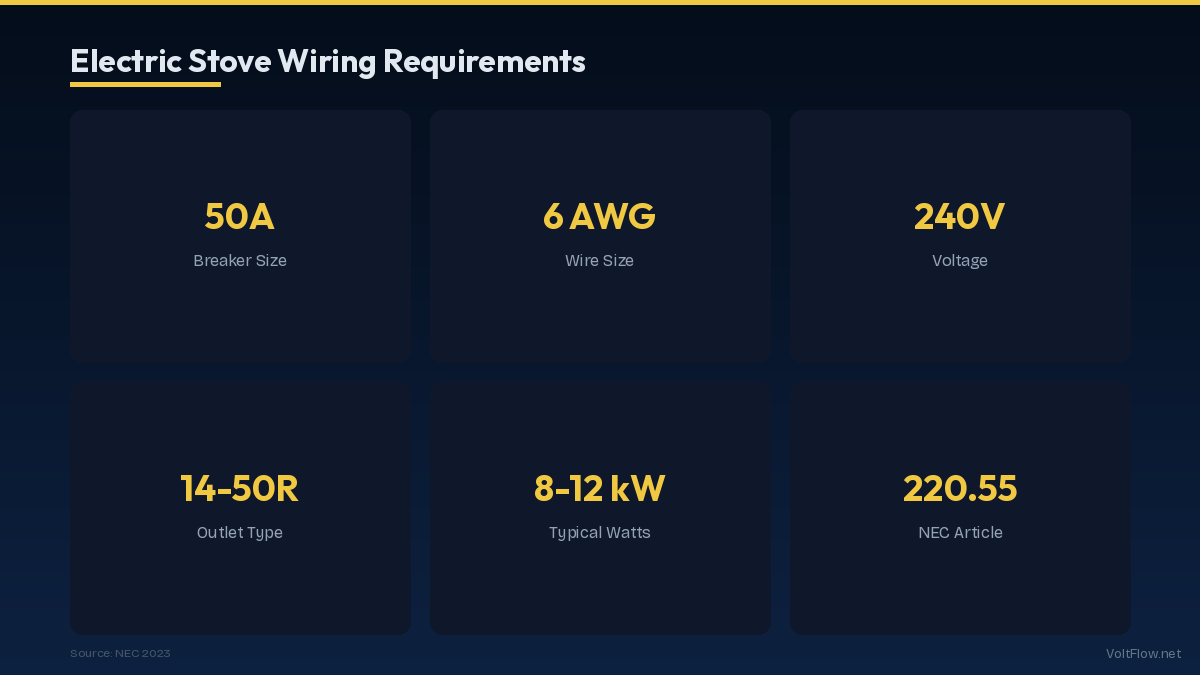
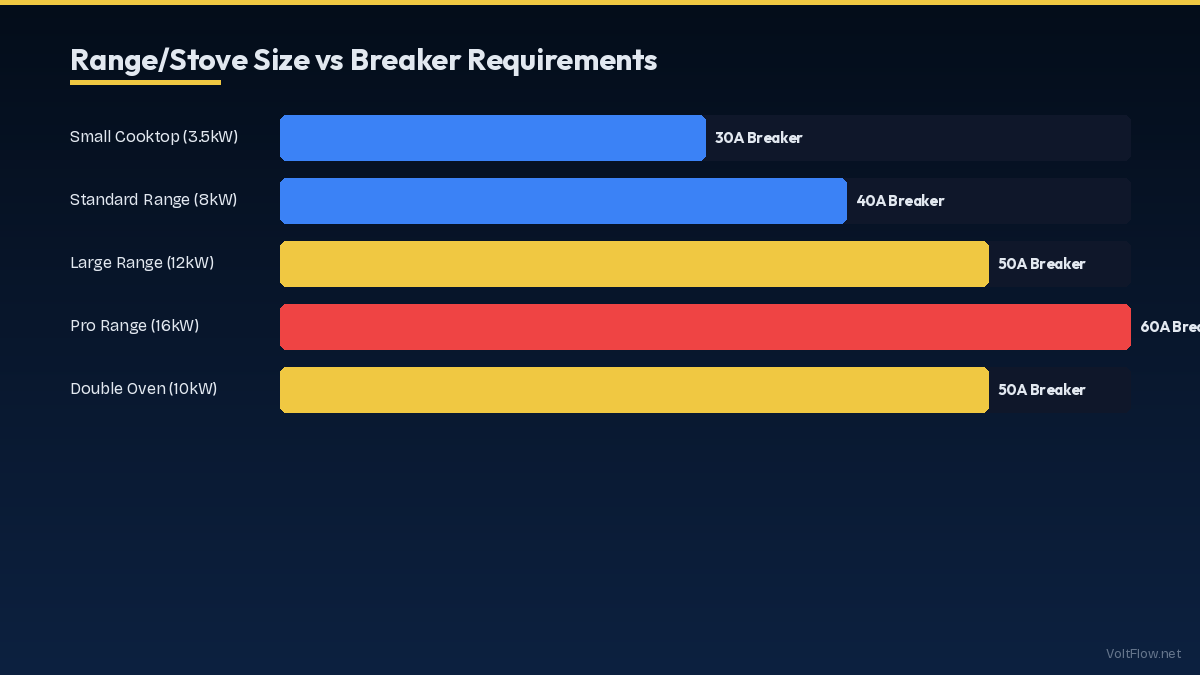
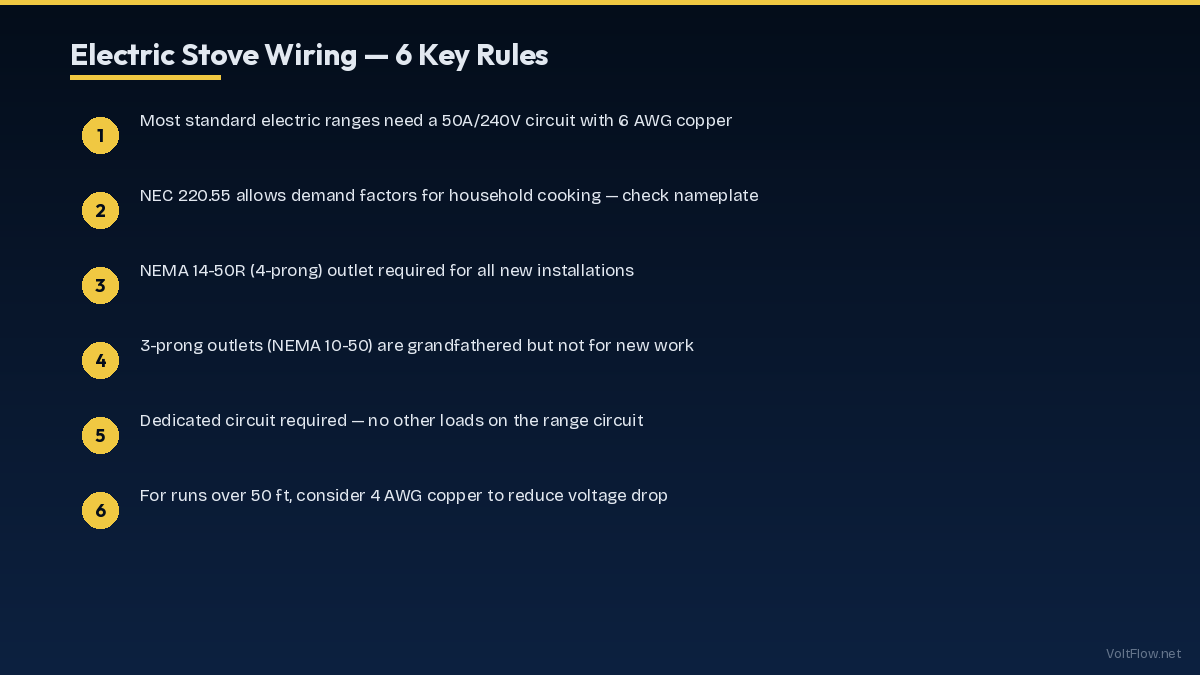
The vast majority of residential electric ranges and stoves manufactured in 2026 require a 50-amp circuit. This covers brands and models from GE, Samsung, LG, Whirlpool, Frigidaire, and KitchenAid in standard 30-inch and 36-inch widths. The circuit consists of three components that must all match: a 50-amp double-pole breaker in your panel, 6-gauge copper wire (or 4-gauge aluminum) running from the panel to the outlet location, and a NEMA 14-50R receptacle at the stove location. The NEC requires this matching because each component in the chain must handle the maximum potential current. A 50-amp breaker on 8-gauge wire would overheat the wire before the breaker trips, creating a fire hazard inside the wall. Conversely, a 40-amp breaker on a 50-amp-rated stove would trip during normal cooking when all burners and the oven operate simultaneously. Check your specific stove model nameplate or installation guide for the exact amperage requirement. The nameplate is typically located on the back of the range or inside the oven door frame. It lists the maximum amperage draw, voltage requirement, and total wattage. For a stove rated at 12,000 watts on 240 volts, the maximum draw is 50 amps (watts divided by volts equals amps). The NEC 80-percent rule applies differently to ranges. NEC 220.55 provides a demand factor calculation for household cooking equipment that allows you to use a lower demand load than the nameplate rating. For a single range rated between 8.75 kW and 12 kW, the maximum demand is 8 kW. This is why a 40-amp circuit can legally serve some stoves rated up to 12 kW, even though their nameplate suggests otherwise. However, the safer and more common practice is to install a 50-amp circuit. The incremental cost difference between a 40-amp and 50-amp circuit is minimal, about $20-$40 in wire cost for a typical run, and the extra capacity eliminates any risk of tripping during heavy cooking. If you are running new wire for a stove installation, always go with the 50-amp circuit unless space or budget constraints make it impossible.
Wire Gauge Requirements by Breaker Size
The wire connecting your breaker to the stove outlet must match the breaker amperage rating per NEC Table 310.16. Using undersized wire is the most dangerous mistake in stove installations because the wire overheats inside the wall where you cannot see or smell it. For a 40-amp breaker, you need 8-gauge copper wire or 6-gauge aluminum wire. The copper wire is rated for 40 amps in a 60-degree-Celsius termination, which is standard for residential equipment. For a 50-amp breaker, you need 6-gauge copper wire or 4-gauge aluminum wire. This is the most common configuration for residential stove installations. The wire must be rated for 50 amps continuously. For the rare 60-amp circuit used by high-end commercial-style ranges, you need 4-gauge copper wire or 2-gauge aluminum wire. These installations are uncommon in residential settings but appear in luxury kitchens with professional-grade equipment. Wire type matters as well. Use NM-B (Romex) cable for interior runs through walls and floors. The cable must include two hot conductors (black and red), one neutral (white), and one ground (bare or green). This four-conductor configuration is required by NEC for new installations. Older three-wire setups with no separate ground are grandfathered but cannot be used for new work. For runs through conduit, use individual THHN/THWN conductors in the appropriate gauge. Conduit installations are required when wire runs through unfinished spaces, exterior walls, or exposed locations. The maximum wire run length depends on voltage drop considerations. For a 50-amp circuit at 240 volts, keep the total round-trip distance under 100 feet to stay within a 3-percent voltage drop. Longer runs need the next size larger wire. A 75-foot run with 6-gauge copper has approximately 2.1 percent voltage drop, which is acceptable. A 120-foot run would need 4-gauge copper to keep voltage drop under 3 percent. Calculate your specific run length before purchasing wire to avoid expensive mistakes or subpar stove performance with element not reaching full temperature.
NEMA Outlet Types: 14-50 vs 14-30 vs 10-50
The outlet at your stove location must match both the breaker amperage and the plug configuration on your stove. Using the wrong outlet type is a code violation and creates connection problems. The NEMA 14-50R is the standard outlet for most modern electric ranges. It is a four-prong configuration with two hot slots (for the two 120-volt legs that create 240 volts together), one neutral slot, and one ground slot. The 14-50 designation means it handles 50 amps at 250 volts maximum. This outlet is also commonly used for EV chargers, which means you can potentially share the circuit with a smart load management device. The NEMA 14-30R is a 30-amp four-prong outlet used for electric dryers and some smaller cooktops. If your stove nameplate shows a draw under 24 amps (the 80-percent rule of 30 amps), a 14-30 outlet on a 30-amp breaker may be acceptable. This is common for apartment-sized ranges and some induction cooktops without a built-in oven. The older NEMA 10-50R is a three-prong outlet that was standard before 1996. It provides 50 amps but lacks a separate ground connection, using the neutral for both neutral and ground. The NEC no longer permits new 10-50 installations, but existing ones are grandfathered. If you have a three-prong outlet and buy a new stove that comes with a four-prong cord, you can either replace the outlet with a 14-50R and add a ground wire, or in some jurisdictions, replace the four-prong cord on the stove with a three-prong cord to match the existing outlet. Check local codes before taking the cord replacement approach. Some newer induction cooktops are designed for hardwired installation without a plug and outlet. The cooktop connects directly to the circuit wires inside a junction box behind the unit. Hardwired connections must still use the correct wire gauge and breaker size for the cooktop amperage rating. The junction box must remain accessible for future service per NEC 314.29. When installing a new outlet, position it behind the stove location, centered at about 6 to 12 inches above the floor. Surface-mount outlets are easier to install but protrude and can prevent the stove from sitting flush against the wall.
Induction Cooktops vs Traditional Electric: Different Requirements
Induction cooktops have become increasingly popular in 2026, and their electrical requirements differ from traditional radiant or coil electric stoves in important ways. Understanding these differences ensures you install the right circuit for your chosen appliance. A traditional 30-inch electric range with four burners and an oven typically draws 40-50 amps at peak load. The heating elements take several minutes to reach full temperature, so the initial surge is minimal. Induction cooktops heat faster and can draw their full rated amperage almost instantly when multiple zones activate simultaneously. A 36-inch induction cooktop rated at 11,000 watts draws approximately 46 amps at 240 volts. While this fits within a 50-amp circuit, the near-instantaneous power draw can cause momentary voltage sags on marginal wiring. Use 6-gauge copper wire minimum and keep runs as short as possible. Induction ranges that include an oven section may draw 50-60 amps total with both the cooktop and oven operating at maximum. High-end models from Wolf, Miele, and Thermador sometimes require a 60-amp circuit with 4-gauge copper wire. Always check the installation manual before purchasing to verify your panel has capacity for the required circuit. Separate induction cooktops that mount into a countertop without a built-in oven often have lower power requirements. A 30-inch four-zone induction cooktop might draw only 30-40 amps, allowing installation on a 40-amp or even a 30-amp circuit depending on the model. Many are designed for hardwired installation rather than plug-in connection, which eliminates the outlet selection question but requires a junction box. Some manufacturers offer smart power management features that limit total cooktop draw to match your available circuit capacity. For example, a cooktop rated for 50 amps might include a setting to limit draw to 40 amps by reducing power to individual zones when total demand exceeds the threshold. This can be a useful feature if your panel capacity is limited. The choice between induction and traditional electric affects more than just the circuit. Induction cooktops generate electromagnetic fields that can affect nearby electronics. Keep your smart home hub, wireless access points, and other sensitive electronics at least three feet from the cooktop. This is rarely a problem in practice but worth noting during your kitchen electrical planning.
Installation Cost and DIY Considerations
Running a new 240-volt circuit for an electric stove is one of the more expensive individual electrical projects in a home, but the cost varies widely based on your starting point. If you are replacing an existing electric stove with a similar model and the wiring and outlet are already in place, there is zero electrical cost beyond plugging in the new unit. If you are converting from gas to electric and need a completely new circuit, expect to pay $500-$1,500 for a licensed electrician to run 6-gauge wire from your panel to the kitchen, install a 50-amp breaker, and mount a NEMA 14-50 outlet. The cost depends primarily on the distance from the panel to the kitchen and whether the route requires opening walls, running through an attic or crawlspace, or drilling through floor joists. A 20-foot run through an unfinished basement might cost $500-$700 while a 60-foot run through finished walls could hit $1,200-$1,500 including drywall repair. If your panel needs a breaker slot, most 200-amp panels have space for a new 50-amp double-pole breaker. If the panel is full, you may need a tandem breaker swap or a sub-panel addition, adding $200-$600 to the project. Some homeowners consider DIY stove circuit installation. While this guide provides the knowledge to do it correctly, there are important reasons to hire a licensed electrician. First, permits are required for new 240-volt circuits in virtually every jurisdiction, and inspectors expect to see a license number on the permit application. Second, insurance companies may deny fire claims if electrical work was performed without permits and proper licensing. Third, 240-volt circuits carry lethal voltage on both legs, doubling the danger compared to standard 120-volt household work. If you insist on DIY, work with the main breaker turned off and verified dead with a non-contact voltage tester on every wire before touching anything. Never work alone on 240-volt circuits. Have someone nearby who knows where the main breaker is and can call 911 if something goes wrong. The materials cost for a DIY installation runs approximately $100-$200 including a 50-amp breaker ($15-$25), 25-50 feet of 6/3 NM-B cable ($2-$3 per foot), a NEMA 14-50 outlet ($12-$18), and a surface-mount or recessed outlet box ($5-$15). Compare this to the $500-$1,500 professional installation cost when deciding whether the savings justify the risk.
Troubleshooting: Breaker Tripping and Stove Performance Issues
If your electric stove keeps tripping the breaker, the problem is almost always one of four things: an undersized breaker, a worn-out breaker, a loose connection, or a faulty heating element. Start your troubleshooting by checking the breaker rating against the stove nameplate. If you have a 40-amp breaker and the stove draws 48 amps at full load, the breaker is doing its job by tripping. The solution is upgrading to a 50-amp breaker and verifying the wire gauge supports 50 amps. Never simply replace a tripping breaker with a larger one without checking the wire gauge. Next, check for loose connections. Turn off the breaker and inspect the wire connections at the outlet, the breaker terminals in the panel, and any junction boxes along the run. Loose connections cause arcing, which generates heat and can trip AFCI breakers or eventually start a fire. Tighten any loose terminal screws to the manufacturer specified torque, typically 20-25 inch-pounds for residential breakers. If the breaker is more than 15-20 years old, it may be worn out. Breakers have a limited number of trip cycles before their bimetallic strip weakens and trips at lower-than-rated currents. A breaker that trips at 38 amps when rated for 50 amps needs replacement. Replacement breakers cost $15-$30 and take five minutes to install with the main breaker off. Stove performance issues like elements not reaching full temperature often indicate voltage problems rather than breaker problems. Measure voltage at the outlet with a multimeter. You should see 240 volts between the two hot slots, 120 volts between each hot slot and neutral, and 120 volts between each hot slot and ground. If you measure 120 volts between the hot slots instead of 240, you have lost one leg of power, usually from a tripped breaker on one leg, a loose connection at the panel, or a utility-side issue. If elements glow red but take excessively long to heat pans, check for voltage drop. Measure voltage at the outlet while the stove is running at full power. If voltage drops below 228 volts (5 percent of 240), the wire run may be too long for the gauge installed, or connections along the run are adding resistance. Induction cooktops may display error codes related to power supply issues. Common codes include E0, E1, or F1 depending on the manufacturer. Check the user manual for specific error code meanings, but most power-related codes trace back to low voltage, a tripped breaker on one leg, or a loose connection at the hardwire junction box. If all electrical checks pass and the stove still underperforms, the issue is likely internal to the appliance and requires a stove repair technician rather than an electrician.