Rooftop Solar ROI India 2026 — Payback Period & Returns
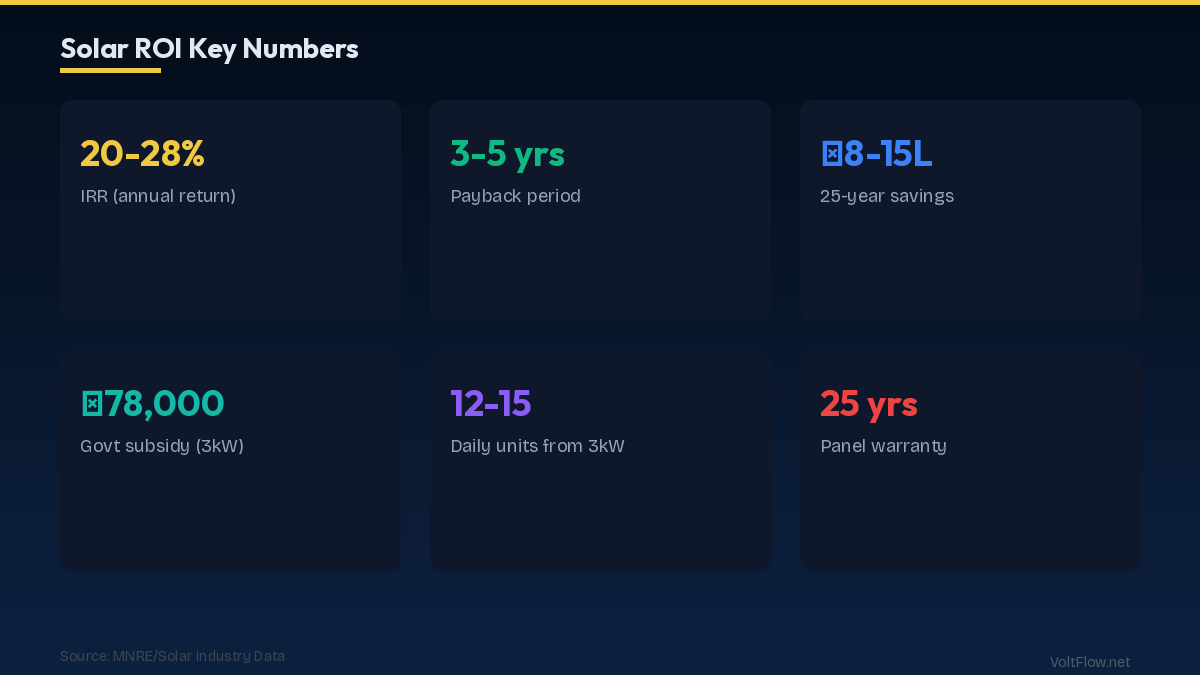
Rooftop solar in India delivers 20-25% annual returns — better than most investments. With PM Surya Ghar subsidies covering ₹30,000-78,000, a typical 3kW system pays back in 3-5 years and generates free electricity for 20+ more years. Total lifetime savings: ₹8-15 lakh. Here's the complete financial analysis.

Investment Cost Breakdown: What You Actually Pay in 2026
A grid-tied rooftop solar system in India costs ₹50,000-65,000 per kW before subsidy in 2026. For a typical 3kW residential system: panels (₹75,000-90,000), inverter (₹25,000-35,000), mounting structure (₹15,000-20,000), wiring and installation (₹10,000-15,000), net meter (₹2,000-5,000). Total pre-subsidy: ₹1.5-1.95 lakh. Under PM Surya Ghar Muft Bijli Yojana, the central government subsidy is: ₹30,000 for 1kW, ₹60,000 for 2kW, ₹78,000 for 3kW and above. Some states add their own subsidies — Gujarat offers additional ₹10,000-20,000, while Rajasthan and Madhya Pradesh have state-level incentive programs. After subsidy, a 3kW system costs ₹72,000-1.17 lakh depending on panel quality (mono-PERC vs polycrystalline) and installer. Premium tier-1 panels (Tata, Adani, Vikram, Waaree) cost 10-15% more but offer better efficiency and warranty terms. We recommend mono-PERC panels — their 20-21% efficiency means you need less roof space and they perform better in low-light conditions.
Monthly and Annual Returns: How Much You Actually Save
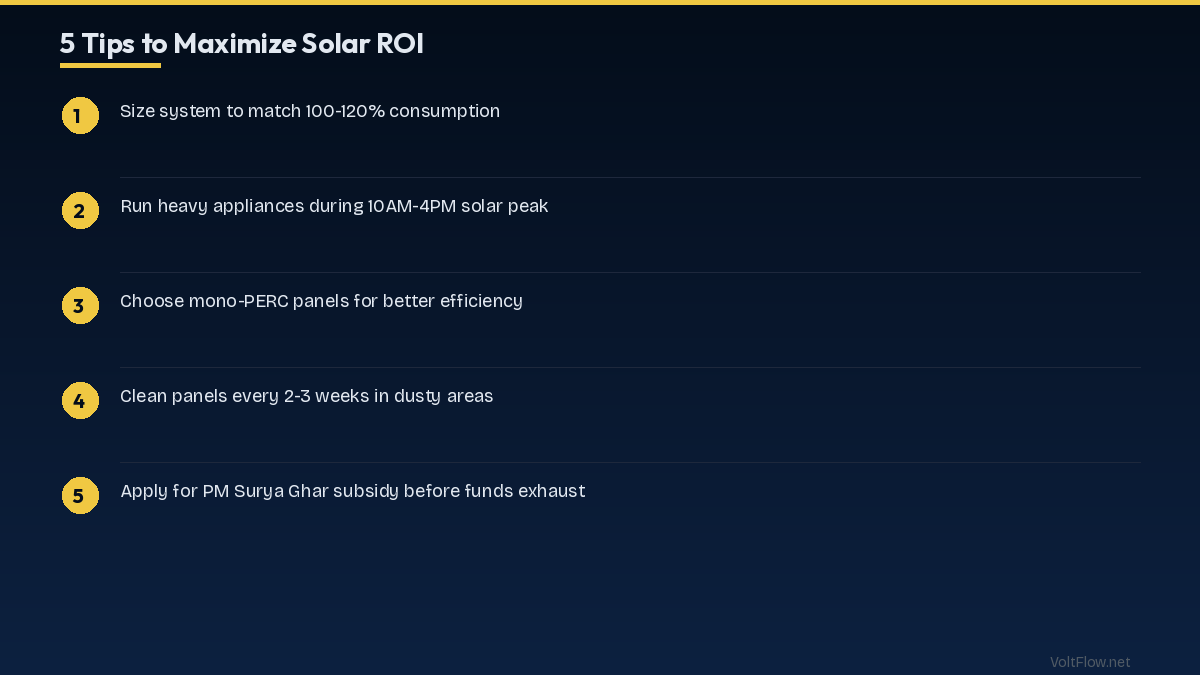
A 3kW system in India generates 12-15 units (kWh) per day depending on location — 360-450 units/month. At an average tariff of ₹6-8/unit (accounting for slab rates), that's ₹2,160-3,600/month saved. Annual savings: ₹26,000-43,000. But here's where it gets interesting — electricity tariffs in India have been rising 5-8% annually. In 2020, the average residential rate was ₹5.50/unit; by 2026 it's ₹7-8/unit. Projecting 6% annual tariff increases, your Year 5 savings will be ₹35,000-58,000 and Year 10 savings will be ₹47,000-77,000 — because the tariff you're avoiding keeps increasing while your solar output remains steady. Net metering ensures any excess generation (typically 20-40% for families away during the day) is exported to the grid and credited on your bill. In states like Karnataka and Tamil Nadu, net metering settles at the retail tariff — meaning every unit exported saves you the full retail rate. Other states like Maharashtra offer slightly lower export rates. The best ROI strategy: maximize self-consumption by running heavy appliances (washing machine, water heater, AC) during 10 AM - 4 PM peak solar hours.
Payback Period: State-by-State Analysis
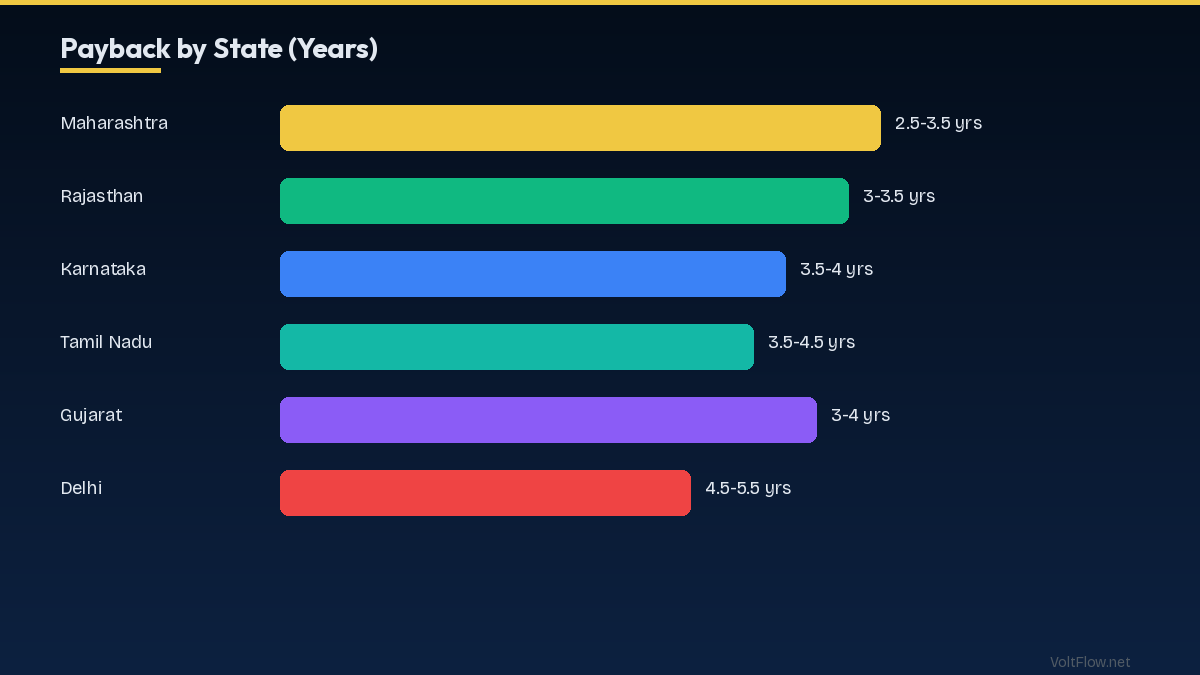
Payback period varies dramatically by state due to tariff differences and solar irradiance. Fastest payback (2.5-3.5 years): Maharashtra (₹8-12/unit in higher slabs), West Bengal (₹8-9/unit), and Rajasthan (excellent solar irradiance of 5.5-6.0 kWh/m²/day). Good payback (3.5-4.5 years): Karnataka (₹6-8/unit), Tamil Nadu (₹5-7/unit but excellent irradiance), Gujarat (good irradiance + state subsidy), and Andhra Pradesh. Longer payback (4.5-6 years): Delhi (lower irradiance, moderate tariffs), Punjab (subsidized agricultural rates reduce the bill you're offsetting), and northeastern states (lower irradiance due to cloud cover). The key factor is your current electricity slab. If you're consuming 300+ units/month and paying ₹8-12/unit in the highest slab, solar eliminates the most expensive units first — your effective savings per unit are higher than the average tariff. A family paying ₹4,000/month in the top slab sees faster payback than a family paying ₹2,000/month in lower slabs, even with the same system.
25-Year Financial Analysis: Total Lifetime Returns
Solar panels come with 25-year performance warranties (guaranteeing 80% output at year 25). Inverters last 10-15 years; budget ₹20,000-30,000 for one replacement around year 12. With these assumptions, here's the 25-year financial picture for a 3kW system (₹1.0 lakh net cost after subsidy): Years 1-5: Total savings ₹1.3-2.15 lakh — system fully paid back by year 3-5. Years 6-10: Additional savings ₹1.7-2.8 lakh — minus ₹25,000 for inverter replacement. Years 11-15: Additional savings ₹2.3-3.7 lakh (higher because tariffs have risen). Years 16-25: Additional savings ₹4.0-7.0 lakh (panel output degrades ~0.5%/year but tariffs keep climbing). Total 25-year savings: ₹8-15 lakh on a ₹1 lakh investment. That's an IRR of 20-28% — better than most equity mutual funds, with far less risk. The investment is inflation-hedged (savings grow as tariffs rise), asset-backed (panels on your roof), and government-subsidized. No other household investment offers this combination.
Common Mistakes That Reduce Solar ROI
Oversizing the system is the most common mistake. If your monthly consumption is 250 units, a 3kW system (generating 400+ units) means 40% excess goes to net metering at potentially lower export rates. Size your system to match 100-120% of consumption for optimal ROI. Ignoring shading destroys returns. Even partial shading on one panel can reduce the entire string's output by 20-40%. Get a professional site survey — a ₹500 investment prevents ₹50,000+ in lost generation. Choosing cheap panels from unknown manufacturers saves ₹10,000-15,000 upfront but risks 15-20% lower generation and warranty claims issues. Stick to BIS-certified tier-1 panels. Not cleaning panels regularly in dusty Indian conditions reduces output by 15-25%. Clean every 2-3 weeks, or install an automated cleaning system (₹8,000-15,000) that pays for itself in one year. Delaying installation is the biggest mistake of all — every month without solar is a month of paying full tariff rates that you could be avoiding. The subsidy budget is limited; apply now through the PM Surya Ghar portal while funds are available.
Frequently Asked Questions
What is the payback period for rooftop solar in India?
With PM Surya Ghar subsidy, typical payback is 3-5 years depending on your state tariff and consumption. High-tariff states like Maharashtra see payback as fast as 2.5-3 years.
How much does a 3kW solar system cost after subsidy?
A 3kW system costs ₹1.5-1.95 lakh before subsidy. After PM Surya Ghar subsidy of ₹78,000, you pay ₹72,000-1.17 lakh. Some states offer additional subsidies.
What is the IRR of rooftop solar investment in India?
The Internal Rate of Return (IRR) for rooftop solar in India is typically 20-28%, making it one of the best household investments available. Returns increase as electricity tariffs rise.
How long do solar panels last in India?
Solar panels come with 25-year performance warranties and typically last 30+ years. Output degrades by about 0.5% per year. You may need to replace the inverter once around year 12 (₹20,000-30,000).
Is solar worth it if my electricity bill is only ₹1,000/month?
For very low bills (under ₹1,000), the payback period extends to 6-8 years. It is still profitable long-term but the ROI is lower. Solar makes the most financial sense for bills above ₹2,000/month.