EV Charging Station Business India 2026 — Cost, Profit & ROI Guide
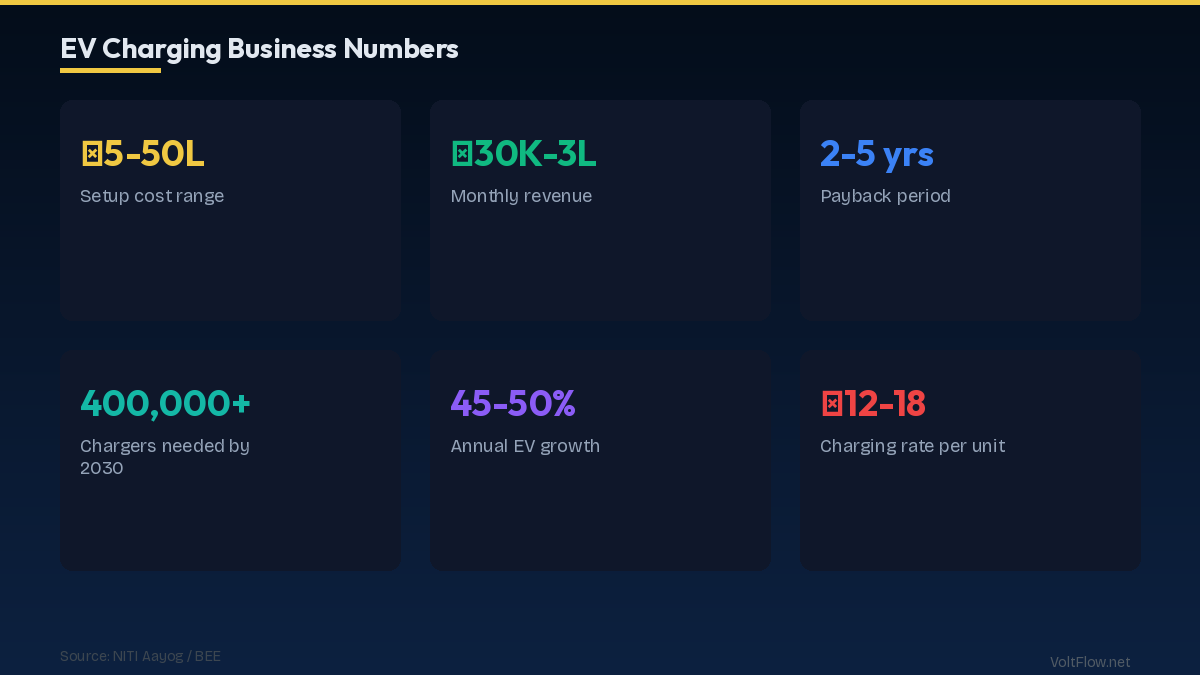
India's EV market is growing at 45-50% annually with 1.5 million+ EVs sold in 2025. The government targets 30% EV adoption by 2030, creating massive demand for charging infrastructure. Starting an EV charging station costs ₹5-50 lakh depending on charger type, with monthly revenues of ₹30,000-3 lakh and payback in 2-5 years.
Market Opportunity: Why EV Charging Is a Profitable Business in 2026
India has approximately 12,000 public charging stations as of 2026 but needs 400,000+ by 2030 according to NITI Aayog projections. The current ratio is roughly 1 charger per 125 EVs — far below the global benchmark of 1:10. This gap represents a ₹15,000-20,000 crore investment opportunity. Monthly EV sales crossed 150,000 units in late 2025, with two-wheelers (Ather, Ola, TVS) driving volume and four-wheelers (Tata, MG, Hyundai, Mahindra) driving charging revenue. Each EV on the road generates ₹500-2,000/month in charging revenue across the network. Key demand drivers: range anxiety makes charging stations essential along highways (NHAI is mandating chargers every 25km); fleet operators (Uber, Ola, BluSmart) need dedicated charging hubs; residential complexes and office parks need destination chargers. The business is also relatively recession-proof — EV adoption is driven by fuel cost savings and government mandates, not discretionary spending.
Setup Cost: Level 2 vs DC Fast Charging
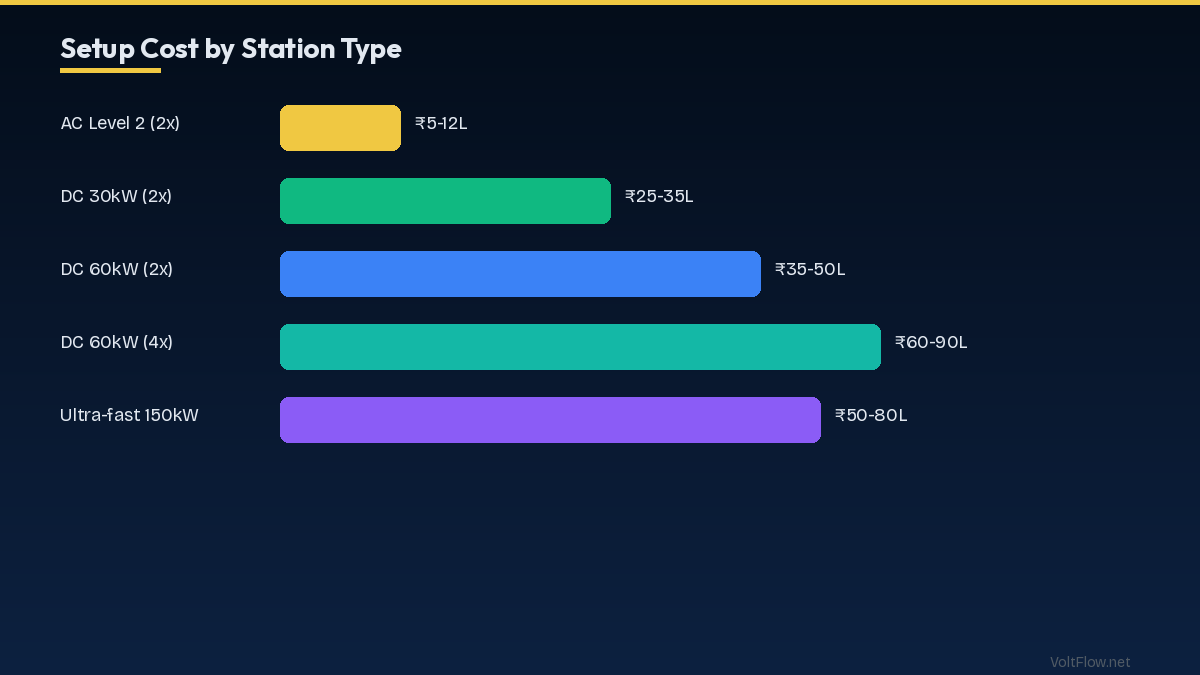
Level 2 AC Chargers (7-22 kW) are the entry point. A single 7.4kW AC charger costs ₹50,000-1.5 lakh. Setup with 2-4 chargers, electrical infrastructure, and basic canopy: ₹5-12 lakh total. These serve two-wheelers (2-4 hours for full charge) and overnight/workplace four-wheeler charging. Revenue per charger: ₹3,000-8,000/month. Best for: residential complexes, office parks, malls, parking lots. DC Fast Chargers (30-60 kW) are the mainstream business model. A 30kW CCS2 charger costs ₹8-12 lakh; a 60kW costs ₹12-20 lakh. Setup with 2-4 chargers plus civil/electrical work: ₹25-50 lakh total. Charging time: 30-60 minutes for 80% (four-wheelers). Revenue per charger: ₹15,000-40,000/month at 15-25% utilization. Best for: highway locations, petrol pump add-ons, high-traffic commercial areas. Ultra-fast chargers (120-240 kW) cost ₹30-60 lakh each and are typically deployed by OEMs (Tata, ChargeZone) or large CPOs. Not recommended for first-time operators due to high capital requirement and the need for dedicated HT power connection.
Government Subsidies: FAME III and State Incentives
The FAME III scheme (2024-2027) allocates ₹10,000 crore for EV ecosystem development, including charging infrastructure subsidies. Charger manufacturers and CPOs (Charge Point Operators) receive subsidies of ₹15,000-50,000 per charger for AC chargers and ₹50,000-5 lakh per charger for DC fast chargers, depending on power rating. Additionally, the Ministry of Power has capped electricity tariffs for EV charging at the commercial/industrial rate (₹6-8/unit) regardless of connection type — no higher tariff slabs apply. Many states offer additional incentives: Delhi — 100% subsidy on charging equipment up to ₹6 lakh; Maharashtra — 25% capital subsidy and electricity duty exemption; Karnataka — 25% subsidy on capital expenditure; Gujarat — 25% subsidy + 5 years electricity duty exemption; Rajasthan — EV charging classified as essential service with simplified permits. The DISCOM approval process has been simplified — most states now grant charging station connections within 7-15 days vs the earlier 2-3 months. You need to register with the Bureau of Energy Efficiency (BEE) and comply with IS 17017 standards for public chargers.
Revenue Model: Monthly Income and Profit Margins
EV charging stations earn on the spread between electricity purchase cost and charging tariff. You buy electricity at ₹6-8/unit (commercial tariff) and sell at ₹12-18/unit (market rate for DC fast charging). The spread: ₹6-10 per unit. A 60kW DC charger running at 20% utilization (4.8 hours/day) dispenses 288 kWh/day × 30 days = 8,640 kWh/month. Revenue at ₹15/unit: ₹1.30 lakh/month. Electricity cost at ₹7/unit: ₹60,000. Gross profit: ₹70,000. After rent (₹10,000-25,000), maintenance (₹5,000-10,000), staff (₹15,000-20,000), and software/network fees (₹3,000-5,000): Net profit: ₹20,000-40,000/month per 60kW charger. A station with 4 chargers can generate ₹80,000-1.6 lakh monthly net profit. Highway stations with higher utilization (30-40%) earn proportionally more. Additional revenue streams include convenience store/cafe (₹20,000-50,000/month), advertising on digital screens (₹5,000-15,000/month), and parking fees. Utilization is the key variable — it's currently 10-15% nationally but rising 3-5% annually as EV adoption accelerates.
Payback Period and Long-Term ROI
Level 2 station (₹8-12 lakh investment): Monthly net income ₹15,000-30,000. Payback: 2.5-4 years. 10-year ROI: 150-250%. Best suited for low-risk entry with steady workplace/residential demand. DC Fast station (₹30-50 lakh investment): Monthly net income ₹50,000-1.5 lakh. Payback: 2-4 years. 10-year ROI: 200-400%. Requires better location and higher utilization but significantly more profitable. The key risk factors: Location is everything — a charger at a busy highway dhaba or shopping complex may see 30% utilization while one on a side road sees 5%. Negotiate revenue-share deals with property owners instead of fixed rent to reduce risk. Technology obsolescence is real — CCS2 is the current standard for four-wheelers, but ensure your chargers are firmware-upgradeable. Electricity rate increases eat into margins — consider adding solar panels (10-15kW, ₹5-8 lakh) to reduce your cost of electricity by 40-60% and become partially grid-independent. The fundamental tailwind: EV population in India is doubling every 18-24 months. Charging utilization will mechanically increase even without any effort, making the economics better each year.
Step-by-Step: How to Start Your EV Charging Station
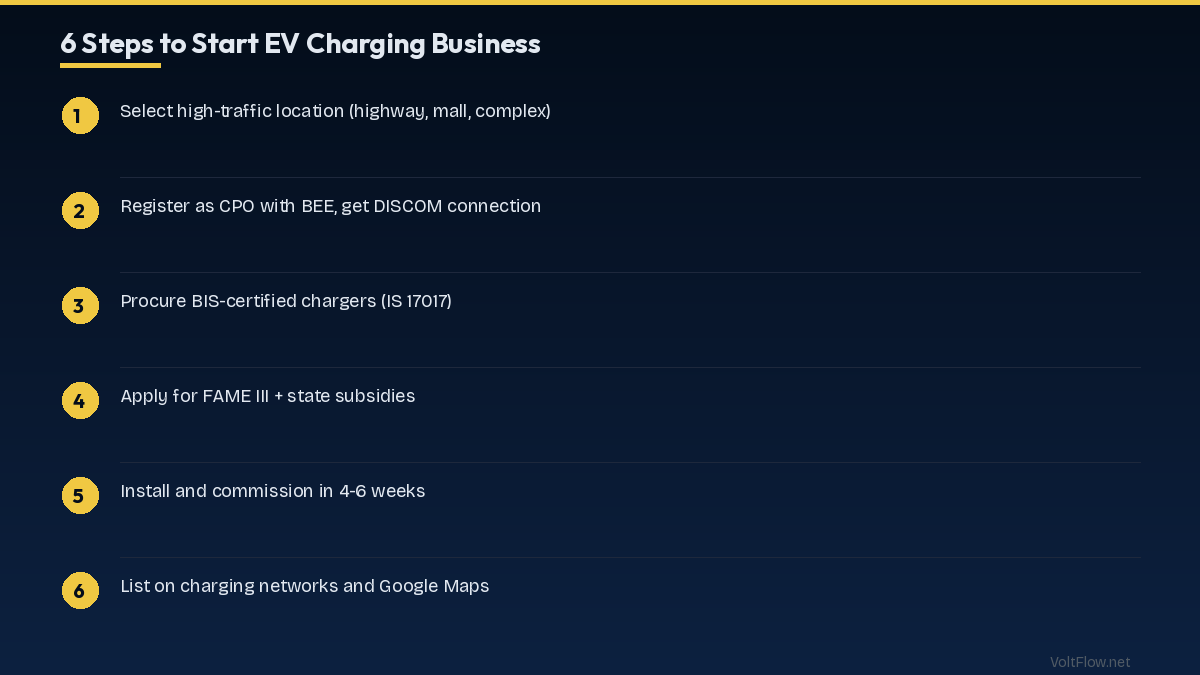
Step 1: Location selection. Identify high-traffic spots — highway dhabas, petrol pumps, mall parking, commercial complexes, or residential societies. Check for existing electrical infrastructure (3-phase connection, transformer proximity). Step 2: Business registration. Register as a CPO (Charge Point Operator) with BEE. Obtain GST registration. Apply for DISCOM connection (15-30kW for Level 2, 100kW+ for DC fast). Step 3: Equipment procurement. Choose BIS-certified chargers (IS 17017 compliant). Major suppliers: Tata Power, Delta Electronics, ABB, Exicom, Servotech, and ChargeZone. Get 3-4 quotes and negotiate — there's a 15-20% margin in charger pricing. Step 4: Installation. Civil work (foundation, canopy, drainage): 2-3 weeks. Electrical work (transformer, panels, cabling): 1-2 weeks. Charger mounting and commissioning: 1-2 days. Total timeline: 4-6 weeks. Step 5: Network integration. Connect to a charging network (Tata Power EZ Charge, CHARGE+ZONE, Statiq, or create your own app). Network fees: 5-15% of revenue but essential for customer discovery. Step 6: Launch and marketing. List on Google Maps, ChargePoint apps, and EV community forums. Partner with fleet operators (BluSmart, Uber Green) for guaranteed utilization.
Frequently Asked Questions
How much does it cost to start an EV charging station in India?
A Level 2 (AC) station costs ₹5-12 lakh. A DC fast charging station costs ₹25-50 lakh. Government subsidies (FAME III + state incentives) can cover 25-50% of equipment costs.
What is the monthly profit from an EV charging station?
A DC fast charging station with 2-4 chargers generates ₹50,000-1.6 lakh net monthly profit at 15-25% utilization. Revenue grows as EV adoption increases.
What is the payback period for an EV charging business?
Payback is typically 2-5 years. Level 2 stations: 2.5-4 years. DC fast stations: 2-4 years depending on location and utilization rates.
Do I need a license to operate an EV charging station in India?
You need to register with BEE (Bureau of Energy Efficiency), obtain DISCOM approval for power connection, and ensure IS 17017 compliance for public chargers. No separate license is needed — the government has delicensed EV charging.
Which EV charger brand is best for India?
Top brands include Tata Power, Delta Electronics, ABB, Exicom, Servotech, and ChargeZone. Choose BIS-certified chargers with CCS2 standard for four-wheelers and Type 2 AC for broader compatibility.